
Non-FictionBusiness BriefIntake
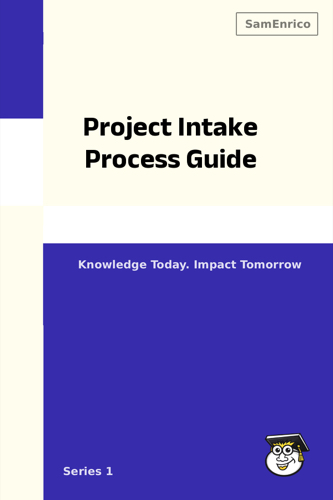
Project Intake Process Guide eBook
Evaluate and prioritize new project requests forma
Evaluate and prioritize new project requests formally.
Formats
Free sample
Chapter 1: The Black Hole...--–- Every morning, Maria, a senior product manager at a mid-sized financial services company, opens her email to find a familiar sight: fourteen unread messages, three of which are project requests. One is from the CEO’s chief of staff asking for a “quick analysis” of a new compliance dashboard. Another is from the head of sales demanding an urgent integration with a third-party lead generation tool. A third is from a colleague in operations who has been waiting three weeks for a status update on a request she submitted last month and is now “just checking in.” Maria sighs, flags all three as “high priority,” and promises herself she will get to them after her 10 a.m. meeting.
That meeting runs long. Then there is a production issue. Then lunch. By 5 p.m., she has not touched any of the requests. Tomorrow, she will have seventeen.
This is the black hole—and Maria’s organization is not alone.The “black hole” problem is the single most common failure mode in project intake. It is the phenomenon where stakeholders submit requests—via email, Slack, Jira, verbal conversations, or even sticky notes—and then hear nothing for weeks, months, or forever. The request disappears into a void. No acknowledgment. No triage.
No decision. No explanation. Just silence. This silence erodes trust, fuels frustration, and creates a shadow culture of back-channel pleading, executive escalation, and quiet resignation. Stakeholders learn that the only way to get a response is to be loud, persistent, or connected to someone with power.
And once that lesson takes hold, the intake process is no longer a process at all. It is a survival game.This chapter diagnoses the black hole problem in surgical detail. It quantifies the true cost of chaos—not just in wasted hours but in strategic opportunity, team morale, and organizational agility. It introduces the Three Levels of Failure as a diagnostic framework to help you assess exactly where your own intake process is breaking down. And it concludes with a radical reframing: a formal intake process is not bureaucratic overhead.
It is a business survival tactic. Without it, no amount of Agile methodology, project management software, or team heroics can save you from working on the wrong things, in the wrong order, with the wrong people, at the wrong time.The Anatomy of the Black Hole The black hole does not appear overnight. It is built gradually, request by request, decision by non-decision. Let us examine its anatomy. A typical black hole follows a predictable pattern.
First, a stakeholder submits a request through whatever channel is most convenient. They might use email because that is what they used last time. They might use a shared spreadsheet because the PMO sent a link six months ago. They might simply walk over to a team member’s desk and ask verbally, because that feels fastest. The request enters the system—if “system” is even the right word—without any standardization, without any metadata, and without any promise of a response.Second, the request lands in someone’s inbox or on someone’s to-do list.
That someone is usually a project manager, product owner, or team lead who is already overloaded. They glance at the request, recognize that answering it properly will require time they do not have, and defer it. Deferral becomes delay. Delay becomes silence. The requestor waits a few days, then sends a polite follow-up.
“Just checking in on the request I sent last Tuesday.” The recipient, now feeling guilty, promises to look at it “by the end of the week.” The end of the week comes and goes. A second follow-up arrives, this time with a slightly sharper tone. The recipient, now feeling defensive, explains that they have been “dealing with higher-priority items.” The requestor escalates to their manager. The manager emails the recipient’s manager. A meeting is scheduled.
In the meeting, everyone agrees that the request is important. No one agrees on when it will be done. The meeting ends with a vague commitment to “circle back.” Weeks pass. The request is never formally approved or rejected. It simply exists in a state of quantum uncertainty—simultaneously alive and dead.This pattern is so common that it has a name in organizational psychology: decision avoidance.
Humans are naturally averse to making decisions that might be wrong, might upset someone, or might commit resources that are already stretched thin. It is safer to do nothing. Nothing cannot be blamed. Nothing leaves no trace. But nothing is also the most expensive option of all, because while you are doing nothing, the requestor is not sitting idle.
They are working around you. They are escalating above you. They are quietly resenting you. And the work that prompted the request is not getting done.The Cost of Chaos: Quantifying the Damage What does a black hole cost? The answer is more than you think, and the costs are both visible and invisible.
Let us start with the visible costs.Zombie projects. These are projects that are started but never finished. Someone, somewhere, decided to begin work on a request—perhaps because it seemed urgent, perhaps because an executive demanded it, perhaps because the team had idle time and wanted to look productive. But without a formal intake process, that project was never properly scoped, resourced, or prioritized. It competed for attention with a dozen other unofficial projects.
It made progress in fits and starts. Then, inevitably, something else came along that seemed more urgent. The zombie project did not die. It did not get canceled. It simply stopped moving.
But it still consumes cognitive overhead. Team members still think about it. Documents still reference it. Meetings still mention it. Zombie projects are the corporate equivalent of half-eaten meals left in the back of the refrigerator.
They take up space, they smell bad when disturbed, and no one remembers who put them there.Research suggests that in organizations without formal intake processes, 40–50% of all project work is waste—effort expended on projects that are never completed, that deliver no measurable value, or that duplicate work already done elsewhere. In a company with 100 people earning an average of $80,000 per year, that waste amounts to $3.2 million to $4 million annually. That is not a rounding error. That is a competitor’s marketing budget. That is a new product line.
That is the difference between profitability and layoffs.Bottlenecks and fire drills. Without a triage mechanism, every request looks like an emergency. The stakeholder who shouts loudest wins. The executive who has the most power wins. The request that happens to arrive on a quiet Tuesday morning when the team has nothing else going on wins.
None of these are proxies for strategic value. The result is a portfolio that reflects the organization’s political dynamics, not its economic priorities. Teams are constantly firefighting, constantly context-switching, constantly apologizing for missed deadlines. Morale plummets. Turnover increases.
And the best people leave first because they have options elsewhere.The hidden cost of rework. When a request is rejected after months of silence, the requestor does not simply accept the rejection and move on. They re-submit. They rephrase.…
This is the end of the free sample. Get the eBook to keep going. Buy now
About this book
Details
- Author
- Lumpkin Heath
- Publisher
- SamEnrico
- Language
- English
- Genre
- Non-Fiction, Business Brief, Intake
- Released
- 2026-06-06
- Pages (approx.)
- 153
- Available as
- eBook, Audiobook

Read better in the ZLOADR app
Your eBooks on your phone or tablet. Sign in with your SamEnrico account and start reading.
More by Lumpkin Heath
 Financial Management Memory AidsLumpkin Heath$11.99
 Beach Walking Meditation GuideLumpkin Heath$11.99
 Body Scan Meditation for VeteransLumpkin Heath$11.99
 Alcohol and Diabetes ManagementLumpkin Heath$11.99
 Bach to Beethoven: The Harmonic RevolutionLumpkin Heath$11.99
 Uni-Assist Application ManualLumpkin Heath$12.99
 DuPont Manufacturing SWOTLumpkin Heath$12.99
 Understanding NyctophobiaLumpkin Heath$17.99
 Shopper Marketing ManagerLumpkin Heath$11.99
 How to Start a Musical Scores (retail) Business (Beginners Guide)Lumpkin Heath$11.99
You may also like
 Hong Kong Handover 1997Dunn Johnnie$11.99
 Zumba For Postnatal Recovery CourseNeal Christian$11.99
 Zumba for BeginnersLadner Nikia$11.99
 YouTube Comment Mining GuideHumes Pandora$12.99
 Worry Box MeditationCarlin Rudy$11.99
 Workplace Stress MeditationNguyen Lynn$11.99
 Workplace Stress and Sleep RepairHawley Ivory$11.99
 Workplace Perfectionism CureDelaney Jeffry$11.99
 Workplace Injustice Anger GuideWallen Isabelle$11.99
 Work Addiction and Burnout LinkGreenwood Ester$11.99
 Women in Yoga and WellnessBeattie Galina$11.99
 Women in Stand Up ComedyChun Evangeline$11.99