
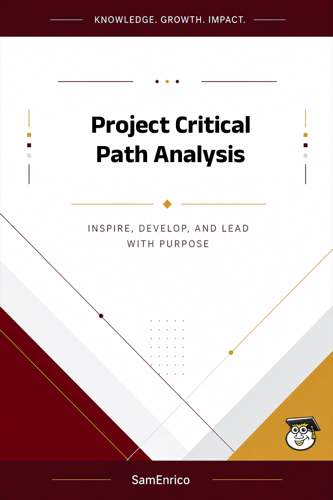
Non-FictionBusiness BriefCritical Path
Project Critical Path Analysis eBook
Identify longest sequence of dependent tasks acros
by Dorsey Loyce
Identify longest sequence of dependent tasks across projects.
Formats
Free sample
Chapter 1: The Longest Lie--–- "Your project is not late because your team is slow. Your project is late because you are looking at the wrong path."Every project manager has lived this nightmare. It is three days before a major launch. The executive sponsor walks into the status meeting, coffee in hand, and asks the question that tightens every stomach in the room: "Are we on track?"The team leader for electrical wiring says they are at 92 percent completion. The foundation crew reports they finished two days early.
The procurement manager has all materials on site. The numbers look good. The dashboard is green. And yet, everyone feels it in their bones: something is wrong. The launch date is three days away, and the building is not ready.
The software is not deployed. The product is not shipping.What happened? How can every team report progress, every task show completion, and the project still be late?The answer is so simple that most project managers overlook it entirely. Your project's finish date is not determined by the average of all tasks. It is not determined by the majority of tasks.
It is determined by exactly one thing: the longest sequence of dependent tasks in your entire project network. Everything else is noise. Everything else is a distraction. And if you are looking at any other path, you are being lied to—not maliciously, but structurally, by a project management system that rewards activity over insight.This chapter exposes that lie. It reorients your attention from the comforting fog of average performance to the sharp, unforgiving edge of the critical path.
By the time you finish reading, you will never look at a project dashboard the same way again.The 95 Percent Illusion Let us begin with a thought experiment. Imagine you are managing a project with one hundred tasks. Ninety-five of those tasks finish exactly on time. Five tasks finish late. What is the probability that your project finishes on time?If you answered anything other than "zero percent" when those five late tasks are on the critical path, you have fallen victim to the single most dangerous fallacy in project management: the confusion between task-level performance and system-level outcomes.Consider a real example.
A construction project for a mid-sized office building had a critical path that ran through foundation excavation, rebar installation, concrete pouring, curing, framing, roofing, electrical rough-in, insulation, drywall, painting, and final inspection. That was the chain. Every other task—landscaping, window installation, interior decorating, parking lot paving—had float. They could slide. They had cushion.Three weeks before the deadline, the project dashboard showed that 87 percent of all tasks were complete or ahead of schedule.
The sponsor was optimistic. The team was confident. And then the concrete curing was delayed by four days because of unseasonable rain. That four-day delay propagated through framing, roofing, electrical, and every subsequent task on that chain. The project finished nineteen days late.Here is the brutal truth that no dashboard will tell you: a task that is off the critical path can be a month late and the project still finishes on time.
A task that is on the critical path can be one hour late and the project misses its deadline. The metric that matters is not "percentage of tasks on time." The metric that matters is "percentage of critical path tasks on time." Everything else is vanity.Defining the Critical Path: The Zero-Float Rule The critical path is formally defined as the longest sequence of dependent tasks from project start to project finish, measured in duration. Every task on this path has zero slack—also called zero float. This means that if any task on the critical path is delayed by one day, the entire project is delayed by one day. There is no buffer.
There is no forgiveness. There is no rescue from non-critical tasks because they are not on the path.This definition is precise, mathematical, and unforgiving. But before we can calculate anything, we must understand the components that create the path: dependencies and durations.Dependencies: The Arrows That Bind A dependency is a logical relationship between two tasks. It answers the question: "What must happen before something else can happen?" Without dependencies, every task could run in parallel, and every project would finish in the time of its single longest task. That is not how the world works.
Foundations must cure before walls go up. Code must be written before it can be tested. Regulations must be approved before construction begins.There are four types of dependencies. Most project managers only know the first one. The other three are where projects get into trouble.Finish-to-Start (FS): The Workhorse Finish-to-start is the default dependency in every project management software package for a reason: it matches how most people think about sequences.
Task B cannot start until Task A finishes. You cannot start framing walls until the foundation has finished curing. You cannot begin user acceptance testing until the code has finished its final QA pass. You cannot ship a product until the packaging has finished its print run.In an FS relationship, the delay propagates directly. If Task A finishes three days late, Task B starts three days late, and every subsequent task shifts by three days.
This is the dependency that most project managers intuitively understand. It is also, ironically, the dependency that is most often applied incorrectly when the relationship is actually one of the other three types.Start-to-Start (SS): The Synchronized Start Start-to-start is the dependency that separates novice schedulers from experienced ones. In an SS relationship, two tasks must begin at the same time, but they may finish at different times. The most common example is in construction: sprinkler system installation and drywall hanging often must start simultaneously because the sprinkler pipes need to be placed inside the walls before the drywall is fully sealed, but neither can begin until the framing is complete.Another example is in software development: test case writing and coding. The best teams write tests before or concurrently with code (test-driven development).
The two tasks start together, but coding may finish before all test cases are written, or vice versa.The critical insight about SS dependencies is that the completion dates are decoupled. Task A can finish early without affecting Task B's finish, as long as the SS relationship is satisfied at the start. This creates opportunities for parallel work that FS relationships would forbid.Finish-to-Finish (FF): The Synchronized End Finish-to-finish dependencies are rarer but crucial. In an FF relationship, two tasks must finish at the same time, even if they started at different times. The classic example is in content creation: the final edit of a video and the final mix of its audio track must finish simultaneously for the combined export to happen.
If the video edit finishes three days early, it waits. If the audio mix finishes three days early, it waits. The project cannot proceed until both are complete.Another example is in event planning: the arrival of the caterers and the arrival of the rental furniture must finish (meaning, be fully set up) at the same time before the doors open to…
This is the end of the free sample. Get the eBook to keep going. Buy now
About this book
Details
- Author
- Dorsey Loyce
- Publisher
- SamEnrico
- Language
- English
- Genre
- Non-Fiction, Business Brief, Critical Path
- Released
- 2026-06-08
- Pages (approx.)
- 125
- Available as
- eBook, Audiobook

Read better in the ZLOADR app
Your eBooks on your phone or tablet. Sign in with your SamEnrico account and start reading.
More by Dorsey Loyce
 Postnatal Walking Meditation CourseDorsey Loyce$11.99
 Sleep Apnea Memory Recovery PlanDorsey Loyce$11.99
 Postpartum Alcohol Recovery GuideDorsey Loyce$11.99
 Body Scan for Shift Workers GuideDorsey Loyce$11.99
 Summit of Dreams: The Unsung Heroes of New Zealand's Alpine PioneersDorsey Loyce$11.99
 Understanding Obstructive Asymmetric Septal HypertrophyDorsey Loyce$17.99
 Software Engineer InternDorsey Loyce$11.99
 How to Start a China (retail) Business (Beginners Guide)Dorsey Loyce$11.99
 Ball Corporation SWOTDorsey Loyce$12.99
 German University City GuideDorsey Loyce$12.99
You may also like
 Hong Kong Handover 1997Dunn Johnnie$11.99
 Zumba For Postnatal Recovery CourseNeal Christian$11.99
 Zumba for BeginnersLadner Nikia$11.99
 YouTube Comment Mining GuideHumes Pandora$12.99
 Worry Box MeditationCarlin Rudy$11.99
 Workplace Stress MeditationNguyen Lynn$11.99
 Workplace Stress and Sleep RepairHawley Ivory$11.99
 Workplace Perfectionism CureDelaney Jeffry$11.99
 Workplace Injustice Anger GuideWallen Isabelle$11.99
 Work Addiction and Burnout LinkGreenwood Ester$11.99
 Women in Yoga and WellnessBeattie Galina$11.99
 Women in Stand Up ComedyChun Evangeline$11.99