
Non-FictionInformativeEducational
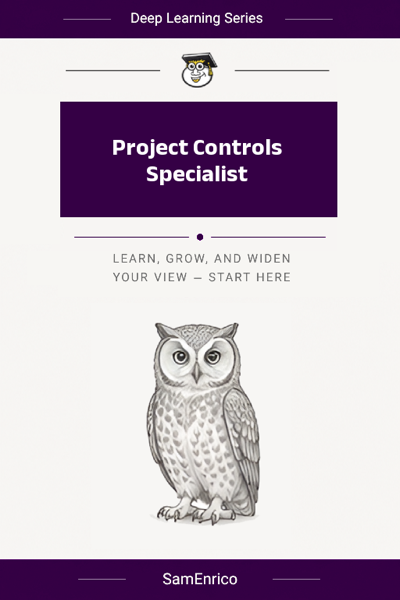
Project Controls Specialist eBook
A Coursebook on Project Controls Specialist
A Coursebook on Project Controls Specialist
Formats
Free sample
Chapter 1: The Intelligence Lie--You have been told that project controls is about tracking dates and dollars. That is a lie.The lie is comfortable. It lets executives believe that controls is clerical work—data entry with a Gantt chart. It lets project managers offload “the boring stuff” to a specialist in the corner. And it lets organizations underinvest in the very function that separates projects that fail from projects that succeed.The truth is harder.
Project controls is not about tracking. It is about predicting. It is not about recording history. It is about shaping the future before it arrives.This chapter establishes your identity as a Project Controls Specialist—not a data collector, not a progress reporter, and certainly not a human spreadsheet. You are the analytical engine of the project.
You are the person who sees what others miss, who quantifies what others guess, and who speaks truth to power before the crisis arrives.If you master only one idea from this entire book, master this: your value is not in the numbers you collect. Your value is in the story those numbers tell about what will happen next.The Three Pillars: Why Schedule, Cost, and Risk Cannot Be Separated Every project rests on three pillars: Schedule, Cost, and Risk. Most organizations treat these as separate disciplines. The schedule team builds a Gantt chart. The cost team builds a budget.
The risk team builds a register. Then they meet once a month and pretend the three documents describe the same project.They do not.A schedule without cost is a fantasy. You can sequence activities perfectly, but if you have not budgeted for the crane, the sequence means nothing. A cost estimate without a schedule is a wish. You can calculate material quantities accurately, but if you do not know when you need them, your cash flow projections will be wrong.
And a risk register without integration into schedule and cost is theater. You can list one hundred risks, but if you have not modeled their impact on the critical path or the budget contingency, you have done nothing useful.The Project Controls Specialist exists precisely at the intersection of these three pillars. Your job is to force them to talk to one another.Consider a simple example. A construction project has a risk: “Potential delay in steel delivery.” The risk register lists it as “High.” That is theater. Your job is to ask: If steel arrives three weeks late, which activities are affected?
Does that delay push the critical path? If yes, how much additional liquidated damages will the owner assess? Does the late steel require overtime to compress subsequent work? What is the cost of that overtime? Does that overtime exceed the contingency held in the cost baseline?Those questions are project controls.
The answer is not a risk score of “High.” The answer is: “A three-week delay in steel delivery will delay project completion by eleven days, incur $220,000 in liquidated damages, require $85,000 in overtime, and exhaust 63% of the schedule contingency. Recommend releasing the steel mill’s progress payment until they provide a recovery schedule.”That is what you do. You connect dots that others do not even see.The Controls Cycle: Plan, Measure, Analyze, Forecast, Correct Every control system in every industry follows the same loop. A thermostat measures temperature, compares it to the setpoint, calculates the difference, and turns the heat on or off. Your project control system follows the exact same logic.The Controls Cycle has five stages, and you will live inside this cycle every day.Plan.
Before any work begins, you establish the baseline. The baseline is not a guess. It is a signed commitment between the project team and the stakeholders. It answers three questions: What work will be done? When will it be done?
How much will it cost? The baseline includes the Work Breakdown Structure (WBS), the schedule with logical dependencies, the time-phased budget, and the risk register with quantified contingency.Measure. As work progresses, you collect data. How many feet of pipe were laid today? How many labor hours were charged?
How much material was received? This sounds simple, but measurement is where most control systems fail. Garbage in, garbage out. If your field crews report “95% complete” on an activity that has not started, your EVM metrics will lie to you. Your job is not just to collect data.
Your job is to verify that the data reflects physical reality.Analyze. This is where you earn your salary. You compare actual performance to the baseline. You calculate variances. You identify trends.
You ask why. Why is the concrete crew consistently underperforming? Why are material deliveries arriving late? Why did we burn through 40% of the contingency in the first two months? Analysis without action is worthless.
Analysis without root cause is noise.Forecast. Based on your analysis, you predict future performance. What will the final cost be? When will the project actually finish? What is the probability of meeting the milestone?
Forecasting is not pessimism. Forecasting is professional courage. It is easier to say nothing and let the bad news reveal itself. Your job is to say it first.Correct. The cycle ends with action.
You recommend corrective actions. You escalate risks that exceed thresholds. You initiate change orders when scope changes. You rebaseline only when the original baseline is no longer a useful measurement tool. Then the cycle begins again.This cycle runs weekly for detailed tasks and monthly for executive reporting.
Your rhythm becomes the heartbeat of the project.The Single Source of Truth: Why Data Integrity Is Non-Negotiable Every troubled project has the same disease. Multiple spreadsheets. Different numbers in different meetings. The schedule says one thing. The cost report says another.
The field supervisor keeps a separate log. The owner receives a third set of numbers.You cannot control what you cannot measure. And you cannot measure what is not consistent.Your first and most important deliverable on any project is the Single Source of Truth. This is a single, controlled, versioned database that contains the integrated schedule, cost, and risk information. No spreadsheets passed around by email.
No offline copies. No “my version” and “your version.”The Single Source of Truth lives in your project controls software—Primavera P6, Microsoft Project, or an equivalent platform. Every change is logged. Every baseline is preserved. Every update is timestamped and attributed.Why is this so important?
Because when things go wrong—and they will go wrong—you will need forensic evidence. Did the owner cause a delay by withholding approval? You will need to prove it with the baseline and the change log. Did the subcontractor underperform? You will need to show the planned vs.
actual productivity. Without a Single Source of Truth, you have opinions. With it, you have evidence.Key Terminology: The Language You Must Speak Fluently Project controls has its own vocabulary. You do not need to memorize definitions for an exam. You need to use these terms correctly in meetings where millions of dollars are at stake.Work Breakdown Structure (WBS).
The WBS is the “noun” of the project. It answers: What are we building? The WBS breaks the project into…
This is the end of the free sample. Get the eBook to keep going. Buy now
About this book
Details
- Author
- Givens Leeanne
- Publisher
- SamEnrico
- Language
- English
- Genre
- Non-Fiction, Informative, Educational
- Released
- 2026-06-02
- Pages (approx.)
- 135
- Available as
- eBook, Audiobook

Read better in the ZLOADR app
Your eBooks on your phone or tablet. Sign in with your SamEnrico account and start reading.
More by Givens Leeanne
 Last Words MemoirGivens Leeanne$11.99
 Depression And DisabilityGivens Leeanne$11.99
 Teen Positive Self TalkGivens Leeanne$11.99
 The Vitamin C Serum GuideGivens Leeanne$11.99
 The Foster Care Bill Of RightsGivens Leeanne$11.99
 The Baron’s Ransom: The Kidnapping That Shook Victorian EuropeGivens Leeanne$11.99
 Domain Name Bulk RegistrationGivens Leeanne$12.99
 CTO Success StoriesGivens Leeanne$12.99
 The Breeder's Guide to Southdown SheepGivens Leeanne$11.99
 How to Start a Blankets Made of Wool Business (Beginners Guide)Givens Leeanne$11.99
You may also like
 Hong Kong Handover 1997Dunn Johnnie$11.99
 Zumba For Postnatal Recovery CourseNeal Christian$11.99
 Zumba for BeginnersLadner Nikia$11.99
 YouTube Comment Mining GuideHumes Pandora$12.99
 Worry Box MeditationCarlin Rudy$11.99
 Workplace Stress MeditationNguyen Lynn$11.99
 Workplace Stress and Sleep RepairHawley Ivory$11.99
 Workplace Perfectionism CureDelaney Jeffry$11.99
 Workplace Injustice Anger GuideWallen Isabelle$11.99
 Work Addiction and Burnout LinkGreenwood Ester$11.99
 Women in Yoga and WellnessBeattie Galina$11.99
 Women in Stand Up ComedyChun Evangeline$11.99