
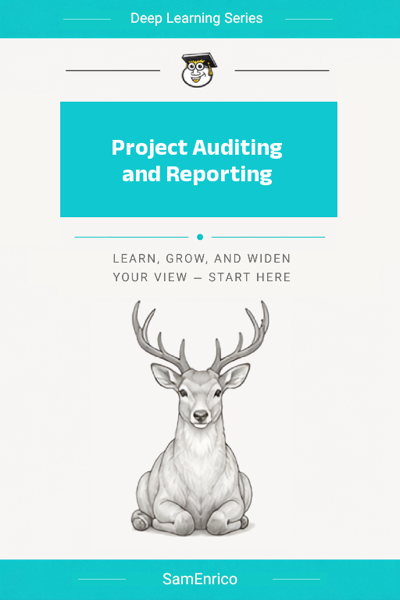
Non-FictionInformativeEducational
Project Auditing and Reporting eBook
A Coursebook on Project Auditing and Reporting
A Coursebook on Project Auditing and Reporting
Formats
Free sample
Chapter 1: The Hidden Catastrophe...-- Every failed project sends up smoke signals long before it burns down. The tragedy is not that these signals are invisible. The tragedy is that no one is trained to read them. This book exists to change that.On a Tuesday morning in March, a senior project manager named Elena walked into a steering committee meeting. Her project was nine months into an eighteen-month timeline.
The budget was on track. The milestones were green. The sponsor had just complimented her monthly report. Forty-five minutes later, the committee voted to cancel the project entirely. Total sunk cost: $14 million.
Elena sat in silence as the meeting adjourned, holding a thick binder of status reports that had all said the same thing: everything is fine.What happened? The project had been drifting for months—not on time or budget, but on strategic relevance. A competitor had released a product that made Elena's project obsolete. The business case was dead. Yet no audit had caught this because no one had asked the right question.
The project's internal controls were perfect. The earned value metrics were healthy. The documentation was immaculate. And the project was a complete waste of money.This is the hidden catastrophe of project management: projects fail silently, often with full compliance to every process. They fail not because people are lazy or stupid, but because the systems designed to catch failure are looking in the wrong places.
Financial audits look for fraud. Compliance audits look for rule-breaking. But project performance audits—the kind that could have saved Elena's project—barely exist in most organizations. And when they do exist, they are feared, resented, and often ignored.This chapter redefines what project auditing is, why it matters more than ever, and how it differs from every other form of oversight you have encountered. By the end, you will understand why traditional controls failed Elena, what project auditing actually does differently, and why the most valuable audit you will ever conduct might produce zero findings but save millions.The Three Audits: A Crucial Distinction Before we go any further, we must clear up a confusion that derails most conversations about project auditing.
When most people hear the word "audit," they think of one of three things: a financial audit, a compliance audit, or an IRS audit. None of these is our subject. Understanding the differences is not academic pedantry—it is the difference between catching a failing project and producing a useless report.Financial audits examine whether financial statements fairly represent an organization's economic reality. They ask: are the numbers right? Has revenue been recognized correctly?
Are liabilities properly stated? Financial auditors follow standards set by bodies like the PCAOB or IAASB. Their work is backward-looking, rigorous, and essential. But a project can pass a financial audit with flying colors while being a strategic disaster. Elena's project passed every financial control.
The money was spent correctly. The problem was that it should never have been spent at all.Compliance audits examine whether an organization is following laws, regulations, or internal policies. They ask: are we following the rules? Have we submitted required filings? Do we have the necessary approvals?
Compliance audits are defensive—they protect against fines, sanctions, and legal liability. They are also narrow. A project can be fully compliant with every policy and still deliver zero value. In fact, some of the most catastrophic project failures in history were perfectly compliant with their organizations' processes.Project performance audits are different in kind, not just degree. They examine whether a project is likely to deliver its intended value, on time, within budget, and with acceptable quality—and whether that intended value remains relevant.
They ask: is this project still a good idea? Are the controls actually working? Is the team set up for success? Are the risks being managed, not just logged? Project performance audits look forward as much as backward.
They are diagnostic, not just forensic. They are the difference between a doctor who tells you how you died and a doctor who catches the disease before it kills you.Most organizations have robust financial and compliance audit functions. Few have any systematic capability for project performance auditing. This book builds that capability from the ground up.The Value Proposition: Beyond Box-Ticking If project auditing is so valuable, why do so many organizations neglect it? The answer lies in a poisonous mindset that infects both auditors and auditees: the belief that auditing is about checking boxes.Here is how box-ticking auditing works.
An auditor receives a checklist. The checklist has fifty items. The auditor goes through the project documentation, confirming that each item is present. Risk register? Check.
Communication plan? Check. Signed charter? Check. The auditor produces a report noting that all fifty items are present, with perhaps a few minor exceptions.
The project manager breathes a sigh of relief. Everyone moves on. The project fails three months later.Box-ticking auditing is worse than useless—it is dangerous. It creates an illusion of oversight while catching none of the real problems. A risk register can exist without any actual risk management.
A communication plan can be filed without any actual communication. A charter can be signed without any actual governance. Box-ticking audits measure artifacts, not health.The alternative is value-driven auditing. This approach asks different questions. Instead of "Does the risk register exist?" it asks "Are the risks in the register actually being managed?
Have the top three risks changed in the last month? When was the last time the team updated its mitigation plans?" Instead of "Is there a communication plan?" it asks "Do stakeholders actually know what they need to know? When did the sponsor last hear bad news?" Instead of "Is the schedule on paper?" it asks "Is the schedule realistic? Has the critical path changed? Are the estimates grounded in historical data?"Value-driven auditing treats documentation as evidence, not as the objective.
The objective is project health, team capability, and strategic alignment. Documentation is one source of evidence among many. A good auditor spends as much time in conversations as in file cabinets. A great auditor knows that the most important findings often come from a casual conversation over coffee, not from reviewing a change log.This book teaches value-driven auditing. Every chapter, every template, every technique is designed to help you answer the real question: is this project on track to deliver value, and if not, what do we do about it?What Project Auditing Actually Covers Now that we have distinguished project auditing from other forms of oversight, we need to define its scope.
What exactly does a project audit examine?A comprehensive project audit examines ten critical areas. We will dedicate an entire chapter to each of these later, but here is a preview:Scope and benefits validation. Is the project still working on the right things? Has scope creep been controlled? Are the expected benefits still achievable and still valuable?Governance and organization.
Are decision rights clear? Does the steering committee meet regularly and make timely decisions? Is the escalation path working?Stakeholder engagement. Are key stakeholders informed, supportive, and engaged? Is resistance being managed?
Is the project burning political capital it cannot replace?Risk and opportunity management. Are risks being actively managed, not just listed?…
This is the end of the free sample. Get the eBook to keep going. Buy now
About this book
Details
- Author
- Fairchild Marti
- Publisher
- SamEnrico
- Language
- English
- Genre
- Non-Fiction, Informative, Educational
- Released
- 2026-05-18
- Pages (approx.)
- 157
- Available as
- eBook, Audiobook

Read better in the ZLOADR app
Your eBooks on your phone or tablet. Sign in with your SamEnrico account and start reading.
More by Fairchild Marti
 Vitamin E Antioxidant Protection GuideFairchild Marti$11.99
 Pet Loss For WiccansFairchild Marti$11.99
 IBS Hydration ProtocolFairchild Marti$11.99
 The Hammock Under TreesFairchild Marti$11.99
 OCD and HoardingFairchild Marti$11.99
 The Corporate Litigator StressFairchild Marti$11.99
 VC Term Sheet AnnotatedFairchild Marti$11.99
 Dinkins DavidFairchild Marti$11.99
 Men And Rage In LoveFairchild Marti$11.99
 The Vanishing Billionaire: The Untold Heist of the CenturyFairchild Marti$11.99
 The Drumbeat of the Thunderbird: How a Shaman’s Song Tamed the StormFairchild Marti$11.99
 The Silk Road's Forgotten Queen: The Untold Story of the Woman Who Ruled the Spice TradeFairchild Marti$11.99
You may also like
 Hong Kong Handover 1997Dunn Johnnie$11.99
 Zumba For Postnatal Recovery CourseNeal Christian$11.99
 Zumba for BeginnersLadner Nikia$11.99
 YouTube Comment Mining GuideHumes Pandora$12.99
 Worry Box MeditationCarlin Rudy$11.99
 Workplace Stress MeditationNguyen Lynn$11.99
 Workplace Stress and Sleep RepairHawley Ivory$11.99
 Workplace Perfectionism CureDelaney Jeffry$11.99
 Workplace Injustice Anger GuideWallen Isabelle$11.99
 Work Addiction and Burnout LinkGreenwood Ester$11.99
 Women in Yoga and WellnessBeattie Galina$11.99
 Women in Stand Up ComedyChun Evangeline$11.99