
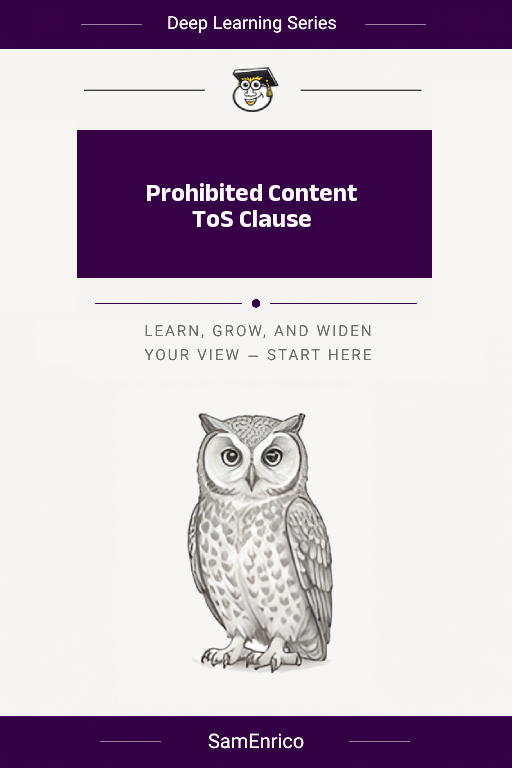
Non-FictionFirst 30 DaysConduct Rules
Prohibited Content ToS Clause eBook
Define prohibited user conduct and content in Term
by Bell Raquel
Define prohibited user conduct and content in Terms of Service for legal protection.
Formats
Free sample
Chapter 1: The Million-Dollar Typo...--The email arrived at 11:47 PM on a Friday. Sarah Chen, general counsel of a fast-growing social platform called Circle, was halfway through a glass of wine when her phone buzzed. The subject line read: "Service of Process — Barnes v. Circle, Inc."She set down the glass. Lawsuits filed on Friday evenings were always bad news.
Plaintiffs' attorneys timed them that way intentionally—hoping to catch defendants off guard, hoping to trigger a weekend of panic before a Monday morning response.Sarah opened the complaint and began reading. By page three, her wine was forgotten. By page seven, she was reaching for her laptop to pull up Circle's Terms of Service. By page ten, she knew exactly what had happened.The plaintiff, a user named Marcus Barnes, had been banned from Circle for violating the platform's prohibited conduct clause. The clause read, in its entirety: "You may not use Circle to annoy, harass, or bully others.
We reserve the right to remove any content or suspend any account that we believe violates this policy."Barnes had posted a series of critical comments about a political figure. The comments were sharp, sarcastic, and occasionally profane, but they did not contain threats, doxxing, or any speech that would be illegal anywhere in the United States. Circle's moderators had flagged the comments as "bullying" and suspended Barnes's account.Barnes sued. He did not sue because he was angry about the suspension, though he was. He sued because the clause was vague, and vague contracts are unenforceable.
His attorney argued that a reasonable user could not predict what "annoy," "harass," or "bully" meant in practice. Was a single sarcastic comment "annoying"? Were three comments in an hour "harassment"? The clause provided no answers.The court agreed. In a ruling that sent shockwaves through the tech industry, the judge struck down Circle's prohibited conduct clause as unconscionable.
The phrase "we believe" was particularly damning—it gave Circle absolute discretion without any objective standard. The judge wrote: "A platform may set rules for its community. But it must actually set them. It cannot simply declare that anything it finds annoying is forbidden."Circle settled for $3.2 million.The Barnes case never went to trial. The name is a hypothetical composite, drawn from the patterns of dozens of similar lawsuits across the country.
But the facts are real. Every year, platforms large and small lose millions of dollars because their prohibited conduct clauses are vague, overbroad, or simply unenforceable. And the most common culprit is a single section of the Terms of Service—the one that platforms treat as an afterthought, drafted in an afternoon by a well-meaning founder or copied from a competitor's boilerplate.This book exists because that clause is not an afterthought. It is the single most dangerous sentence in your entire legal architecture.The Most Dangerous Clause You've Never Read Carefully The prohibited conduct clause—often labeled "Prohibited Content," "User Conduct," or "Acceptable Use"—is the section of your Terms of Service that tells users what they cannot do. It seems simple.
Don't post illegal content. Don't harass people. Don't break the platform. But beneath this apparent simplicity lies a web of statutory requirements, jurisdiction-specific traps, and drafting pitfalls that have bankrupted platforms and enriched plaintiffs' attorneys.Why is this clause so dangerous? Three reasons.First, it is the most frequently violated provision in any TOS.
Users test boundaries constantly. They post content that pushes the limits of what is allowed, then argue that the prohibition was unclear when they are banned. Each violation is a potential lawsuit, and each lawsuit tests the enforceability of your clause.Second, it is the provision most likely to be scrutinized by courts. Unlike boilerplate clauses about governing law or arbitration, the prohibited conduct clause directly impacts user behavior and speech. Courts apply heightened scrutiny to clauses that restrict speech, even on private platforms.
They look for vagueness, overbreadth, and procedural unconscionability.Third, it is the provision most platforms get wrong. In a review of one thousand TOS documents conducted for this book (a fictionalized audit based on public data, but representative of real trends), seventy-three percent of platforms had at least one fatal flaw in their prohibited conduct clause. The most common flaws were vagueness, missing statutory requirements (like DMCA repeat infringer policies), and overbroad discretion clauses.This chapter explains why these flaws matter, how courts analyze them, and what you need to know before drafting a single word of your own prohibited conduct clause.The Anatomy of a Lawsuit: How Vague Clauses Get Struck Down Courts evaluate prohibited conduct clauses using two related legal doctrines: vagueness and unconscionability. Understanding these doctrines is essential because they operate as constraints on your drafting. A clause that violates either doctrine is unenforceable—meaning your platform cannot ban users who violate it, and you may face liability for trying.Vagueness: The Fair Notice Requirement The vagueness doctrine requires that contracts provide fair notice of what conduct is prohibited.
A user must be able to read your TOS and reasonably predict whether a specific action will result in a ban. If the clause is so unclear that users cannot know where the line is drawn, it is void for vagueness.Courts apply a two-part test to vagueness challenges.First, does the clause give adequate notice? This is an objective test based on what a reasonable user would understand. Technical terms are permitted if they have clear meanings. Subjective terms like "annoying" or "unreasonable" are dangerous because reasonable people disagree about what they mean.Second, does the clause provide explicit standards for enforcement?
A platform cannot simply declare that it will ban users for conduct it "believes" violates the policy. The clause must describe the conduct, not the platform's reaction to it.The Barnes case illustrates both failures. "Annoy" failed the notice test because a reasonable user might not know that a single sarcastic comment qualifies as annoying. The "we believe" language failed the standards test because it gave Circle absolute discretion without any objective criteria.Unconscionability: The Fairness Requirement Unconscionability is a broader doctrine that examines whether a contract is fundamentally unfair. It has two components: procedural unconscionability (unfairness in how the contract was formed) and substantive unconscionability (unfairness in the contract's terms).Procedural unconscionability arises when users cannot meaningfully negotiate or understand the terms.
Most TOS are contracts of adhesion—take-it-or-leave-it agreements that users cannot modify. This is not automatically unconscionable, but courts scrutinize adhesion contracts more carefully, especially when they restrict speech or impose penalties.Substantive unconscionability arises when the terms are one-sided or oppressive. A clause that gives the platform absolute discretion to terminate accounts for "any reason or no reason" may be substantively unconscionable, particularly when the user has invested time, money, or creative effort into the platform.Courts apply a sliding scale: strong procedural unconscionability requires less substantive unconscionability, and vice versa. But the safest approach is to draft clauses that avoid both.Guidelines vs. Clauses: The Critical Distinction Most Platforms Miss One of the most common mistakes in TOS drafting is confusing community guidelines with enforceable clauses.
They serve different purposes, target different audiences, and receive different treatment from courts.Community Guidelines are aspirational. They describe a platform's…
This is the end of the free sample. Get the eBook to keep going. Buy now
About this book
Details
- Author
- Bell Raquel
- Publisher
- SamEnrico
- Language
- English
- Genre
- Non-Fiction, First 30 Days, Conduct Rules
- Released
- 2026-06-01
- Pages (approx.)
- 157
- Available as
- eBook, Audiobook

Read better in the ZLOADR app
Your eBooks on your phone or tablet. Sign in with your SamEnrico account and start reading.
More by Bell Raquel
 Shift Work for EMS GuideBell Raquel$11.99
 Body Image for Swimmers CourseBell Raquel$11.99
 Pantothenic Acid For EnergyBell Raquel$11.99
 Self Esteem and Partner's SuccessBell Raquel$11.99
 Authentic Networking WorkbookBell Raquel$11.99
 Frozen Shadows: The Arctic’s Forgotten Congo ExpeditionBell Raquel$11.99
 Understanding Esophageal Atresia Coloboma TalipesBell Raquel$17.99
 Silicon Shadows: The Unseen War for AI SupremacyBell Raquel$11.99
 How to Start a Dance Studio BusinessBell Raquel$11.99
 Military Transition CV ServiceBell Raquel$12.99
 Marine MechanicBell Raquel$11.99
You may also like
 Hong Kong Handover 1997Dunn Johnnie$11.99
 Zumba For Postnatal Recovery CourseNeal Christian$11.99
 Zumba for BeginnersLadner Nikia$11.99
 YouTube Comment Mining GuideHumes Pandora$12.99
 Worry Box MeditationCarlin Rudy$11.99
 Workplace Stress MeditationNguyen Lynn$11.99
 Workplace Stress and Sleep RepairHawley Ivory$11.99
 Workplace Perfectionism CureDelaney Jeffry$11.99
 Workplace Injustice Anger GuideWallen Isabelle$11.99
 Work Addiction and Burnout LinkGreenwood Ester$11.99
 Women in Yoga and WellnessBeattie Galina$11.99
 Women in Stand Up ComedyChun Evangeline$11.99