
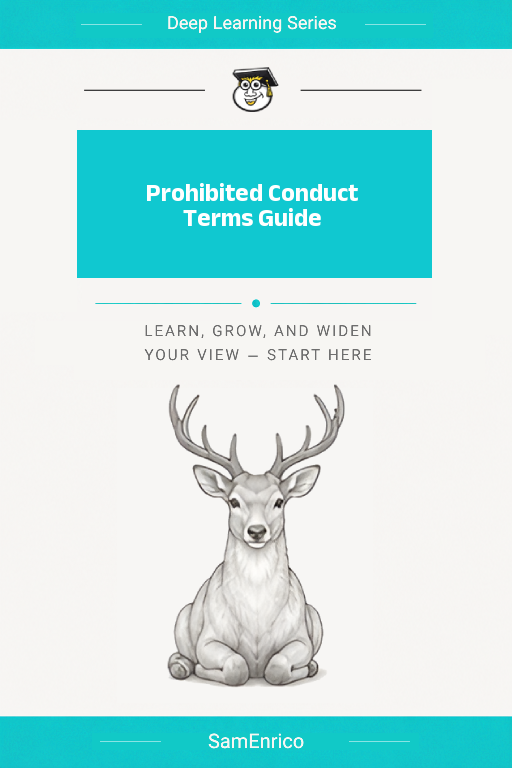
Non-FictionFirst 30 DaysUser Conduct
Prohibited Conduct Terms Guide eBook
Define unacceptable user behavior clearly. List pr
Define unacceptable user behavior clearly. List prohibited activities from hacking to harassment to reselling.
Formats
Free sample
Chapter 1: The Invisible Prison--–- Every day, millions of people wake up and check their favorite apps. They scroll, post, like, share, buy, and sell. They build businesses, friendships, and reputations inside digital spaces that feel like public squares but function like private kingdoms. And then, without warning, it stops. The login screen rejects them.
The account is gone. The appeal form leads nowhere. The email address associated with their digital life no longer works.They have been banned.Most of them have no idea why.Some of them deserved it. They were harassing others, selling stolen accounts, or posting illegal content. But many were not.
Many were small business owners who accidentally violated an arcane rule about "commercial activity" they had never read. Many were activists who ran afoul of automated moderation systems. Many were simply users who did something that a platform, in its sole discretion, decided was prohibited.This book is about those rules. Not the ones you think you know, but the hidden architecture of control that governs every interaction you have online. It is about the prohibited conduct terms that platforms write, how they enforce them, and why understanding this invisible prison is the single most important skill for anyone who lives, works, or creates in the digital age.If you have never read a terms of service agreement, you are not alone.
Studies consistently show that fewer than 10 percent of users read the terms they agree to. The average person would need more than 200 hours per year to read all the privacy policies and terms of service for the apps they use. Platforms know this. They rely on this. And they have built an entire legal architecture that assumes you will never look behind the curtain.This chapter will tear down that curtain.
It will explain why platforms create prohibited conduct lists, how vague rules fail in court, and why the distinction between "community guidelines" and "prohibited conduct terms" matters more than you think. It will introduce the frameworks that govern every subsequent chapter in this book, including the Reasonable Person Standard and the Jurisdiction Decision Framework. And it will give you a five-minute checklist to evaluate whether any platform's rules are designed for fairness or for arbitrary enforcement.By the end of this chapter, you will never look at a terms of service agreement the same way again.The Hidden Legal Architecture of Every Click Every time you sign up for a digital service, you enter into a contract. That contract is called the Terms of Service, Terms of Use, or End User License Agreement. Buried inside that contract—usually in a section labeled "Prohibited Conduct," "Restricted Activities," or "Acceptable Use"—is a list of things you are not allowed to do.On the surface, these lists seem straightforward.
Do not hack. Do not harass. Do not resell accounts. But beneath the surface, these lists are among the most carefully negotiated, legally fraught, and strategically designed documents in modern commerce. They are not afterthoughts.
They are weapons.Consider what a well-drafted prohibited conduct list can do for a platform. It can:Limit legal liability by showing that the platform warned users about specific risks Preserve brand safety by giving the platform grounds to remove harmful content or bad actors Improve user retention by creating a predictable environment where honest users feel protected Enable aggressive enforcement by providing clear, defensible standards for bans and suspensions Survive lawsuits by demonstrating that the platform acted in good faith and with clear rules A poorly drafted prohibited conduct list does the opposite. It creates loopholes that bad actors exploit. It leads to arbitrary enforcement that alienates users. It collapses in court when a judge cannot figure out what the rule actually means.
And it exposes the platform to liability for negligent enforcement or breach of contract.The difference between these two outcomes is not luck. It is design.Community Guidelines vs. Prohibited Conduct Terms: The Critical Distinction One of the most common mistakes in platform governance is confusing community guidelines with prohibited conduct terms. They are not the same thing, and treating them as interchangeable leads to failed enforcement and lost lawsuits.Community Guidelines are aspirational value statements. They describe the kind of community the platform wants to build.
They use words like "respect," "kindness," "inclusion," and "safety." They are often written in warm, inviting language. They make users feel good about being part of the platform. But they are terrible tools for enforcement.Here is an example of a community guideline: "We believe in treating everyone with respect. Bullying and harassment have no place in our community."This is a nice sentiment. But what does it actually prohibit?
Is disagreeing with someone bullying? Is a heated political debate harassment? Is a sarcastic comment disrespectful? A moderator cannot enforce this rule consistently because the standard is entirely subjective.Prohibited Conduct Terms, by contrast, are actionable, enforceable rules with specific definitions. They use precise language.
They define key terms. They provide examples. They tell users exactly what will get them banned.Here is an example of a prohibited conduct term: "You may not send more than five private messages to the same user within a 24-hour period after that user has replied 'stop' or 'unsubscribe' to any of your messages."This rule is enforceable. A moderator can count the messages. A user knows exactly what not to do.
An appeals process can verify whether the violation occurred.The best platforms have both documents. They use community guidelines to set the tone and build trust. They use prohibited conduct terms to enforce the rules. But when push comes to shove—in court, in arbitration, or in a public relations crisis—the prohibited conduct terms are what matter. They are the contract.
They are the law of the platform.Throughout this book, we will focus exclusively on prohibited conduct terms. Community guidelines are marketing. Prohibited conduct terms are enforcement.Why Vague Prohibitions Fail in Court If you take nothing else from this chapter, remember this: vague rules lose. In court, before a jury, in arbitration, before content moderation appeals boards—anywhere that a rule is tested, vagueness is death.The legal system has a name for rules that are too vague to enforce: void for vagueness. This doctrine, rooted in the Due Process clauses of the Constitution, requires that laws (and by extension, contracts) give fair notice of what is prohibited.
If a reasonable person cannot understand what the rule means, the rule cannot be enforced.Consider a real-world example. In the early days of social media, many platforms prohibited "offensive content" without defining the term. A user who posted a political cartoon that some found offensive would be banned. Another user who posted a racist tirade would also be banned. But when the first user sued, the platform struggled to defend its policy.
What made the cartoon offensive? Offensive to whom? By what standard? The court found that "offensive content" was too vague to enforce consistently.The platform lost. Not because the cartoon was protected speech, but because the platform had not defined its own rule.Now consider a better-drafted rule: "You may not post content that degrades individuals or groups…
This is the end of the free sample. Get the eBook to keep going. Buy now
About this book
Details
- Author
- Poland Evette
- Publisher
- SamEnrico
- Language
- English
- Genre
- Non-Fiction, First 30 Days, User Conduct
- Released
- 2026-06-01
- Pages (approx.)
- 158
- Available as
- eBook, Audiobook

Read better in the ZLOADR app
Your eBooks on your phone or tablet. Sign in with your SamEnrico account and start reading.
More by Poland Evette
 MBSR For Lived Experience WorkbookPoland Evette$11.99
 Bamboo Forest Visualization SwayPoland Evette$11.99
 PCOS Podcast ListPoland Evette$11.99
 Employee Assistance Program GuidePoland Evette$11.99
 The John Bardeen Double LaureatePoland Evette$11.99
 The Untold Story of the Harlem Globetrotters: How They Conquered the WorldPoland Evette$11.99
 Finding Your First Chinese StudentsPoland Evette$12.99
 Understanding Osteopetrosis, (Generic Term)Poland Evette$17.99
 How to Become a Cone OperatorPoland Evette$11.99
 Trenchless Technology SpecialistPoland Evette$11.99
You may also like
 Hong Kong Handover 1997Dunn Johnnie$11.99
 Zumba For Postnatal Recovery CourseNeal Christian$11.99
 Zumba for BeginnersLadner Nikia$11.99
 YouTube Comment Mining GuideHumes Pandora$12.99
 Worry Box MeditationCarlin Rudy$11.99
 Workplace Stress MeditationNguyen Lynn$11.99
 Workplace Stress and Sleep RepairHawley Ivory$11.99
 Workplace Perfectionism CureDelaney Jeffry$11.99
 Workplace Injustice Anger GuideWallen Isabelle$11.99
 Work Addiction and Burnout LinkGreenwood Ester$11.99
 Women in Yoga and WellnessBeattie Galina$11.99
 Women in Stand Up ComedyChun Evangeline$11.99