
Non-FictionAnnual CheckupLegal Risk
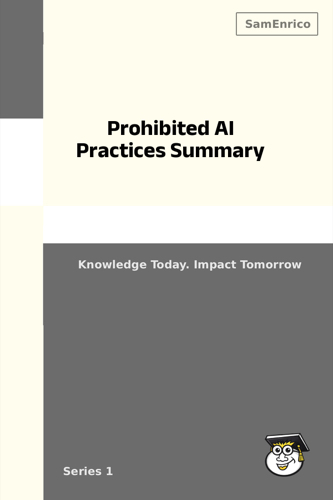
Prohibited AI Practices Summary eBook
Identify banned AI uses under the EU AI Act to avo
Identify banned AI uses under the EU AI Act to avoid fines.
Formats
Free sample
Chapter 1: The Three Words That Can Destroy You--–- Imagine waking up to a dawn raid. Not by hackers. Not by competitors. By regulators. They seize your servers, freeze your bank accounts, and hand your CEO a preliminary fine of €12 million.
Your offense? You sold API access to a tool that helped teachers understand when students looked confused. You thought you were helping education. The EU thought you were violating Article 5(1)(f) of the AI Act—the prohibition on emotion recognition in schools.This is not a hypothetical nightmare. It is the enforceable reality as of February 2, 2025.
And the difference between a compliant AI company and a prohibited one often comes down to just three words: placing on the market, putting into service, and use. These three stages of an AI system's lifecycle are the legal tripwires that determine whether your company faces a 7% global turnover fine or walks away clean.Most AI founders and compliance officers focus on the wrong question. They ask, "Is my AI system banned?" That matters, but it is the second question. The first question is: "Have I placed it, put it into service, or allowed its use in the EU?" Because if the answer to that is yes, and your system touches any of the nine prohibited categories in later chapters, you are already on the wrong side of the law—regardless of your intention, regardless of your headquarters, regardless of whether you have ever set foot in Brussels.This chapter is the foundation of everything that follows. Without mastering these three words—placing, putting, use—you cannot meaningfully audit your AI systems.
You cannot write enforceable terms of service. You cannot defend yourself in front of a national supervisory authority. And you certainly cannot sleep soundly after February 2025.Let us begin with a simple truth: the EU AI Act does not care about your corporate structure. It cares about effects. And the first effect it looks for is whether your AI system has crossed the geographic and operational threshold into European jurisdiction.The Three Stages of Liability: Placing, Putting, Use The EU AI Act Article 3 defines three distinct moments in an AI system's life.
Each triggers full liability for prohibited practices. Most companies mistakenly believe that only "selling into the EU" counts. That is dangerously incomplete.Placing on the Market: The First Sin Placing on the market means the first time a prohibited AI system is made available in the EU. This includes offering it for sale, for free, or as a beta test. The moment your landing page is accessible from Paris, Berlin, or Milan—and you have not explicitly geoblocked EU users—you have likely placed it on the market.Consider a concrete example.
A Canadian startup develops an AI-powered hiring tool that analyzes facial expressions during video interviews. They do not have a single EU employee. They do not have a bank account in Euros. But their website is in English, accepts credit cards globally, and a recruiter in Lyon downloads the software. That Canadian startup has just placed a prohibited emotion recognition system (Chapter 8) on the EU market.
The fine: up to €35 million or 7% of global turnover.Placing does not require a sale. Free trials, open-source downloads, and even API access with a "free tier" all count. If a user in the EU can access your AI system without actively circumventing a geofence, you have placed it. The only safe harbor is active, documented, and technically enforced exclusion of EU IP addresses—and even that is fragile if you market to EU customers in English or offer Euro pricing.Putting into Service: The Moment of Activation Putting into service is subtly different. It means supplying the AI system for first use by the end-user.
If you sell a facial recognition camera system to a Polish shopping mall, and the mall installs it but has not yet turned it on, you have put it into service. The act of delivery with the intent of use is enough.This distinction matters for compliance audits. You cannot argue that "they never actually used it" if you delivered the software, provided activation keys, and trained their staff. The AI Act considers the supply complete at the moment of handover. From that second forward, you are responsible for any prohibited practices embedded in that system.The most dangerous scenario for startups is the "pilot program." Many AI companies run free pilots with EU customers to gather data or demonstrate value.
Those pilots constitute putting into service. If your pilot system uses emotion recognition (Chapter 8), real-time facial identification (Chapter 7), or social scoring (Chapter 4), you are fully liable. There is no "test mode" exception.Use: The Ongoing Nightmare Use is the broadest and most misunderstood category. It means the deployment of the AI system by the end-user in real operational conditions. Crucially, the ban on prohibited practices applies to users as well as providers.
A German insurance company that buys an AI system and then deploys it for prohibited social scoring is just as liable as the vendor who sold it.This creates a two-way compliance trap. Providers must ensure their systems cannot be easily misused for banned purposes (Chapter 10 on reasonable safeguards). Users must audit their own deployments to ensure they are not accidentally activating prohibited features.The most common violation of "use" involves configuration settings. An AI system might be capable of lawful behavior (e.g., post-event facial recognition for security) but can be reconfigured for real-time identification. If an end-user flips that switch, the user is liable for prohibited use.
But the provider may also be liable if they failed to implement technical guardrails preventing that reconfiguration.The Extraterritorial Reach: No Safe Harbor Outside the EUOne of the most common and costly misunderstandings is that non-EU companies are exempt. They are not. The EU AI Act applies to providers located outside the EU if the AI system's output is used in the EU. Period.The mechanism is simple. A US company sells API access to an emotion recognition API.
A Dutch school subscribes. The US company has never visited the Netherlands, has no office there, and does not accept Euros. None of that matters. The AI Act's extraterritorial provision (Article 2(1)(c)) explicitly reaches any provider whose AI system is used in the EU.Enforcement happens through mutual legal assistance treaties, through the GDPR's existing cross-border enforcement mechanisms (which have already fined US companies), and—most frighteningly—through the asset seizure powers of EU member states. If you have any EU customers, any EU-based servers, or any EU subsidiaries, your global assets are at risk.The only reliable defense against extraterritorial reach is to have no EU users whatsoever.
That means active geoblocking, contractual prohibitions on EU use, and technical measures such as IP filtering. But even these are not absolute. If an EU user circumvents your geoblock using a VPN, and you do nothing to stop them, some regulators may argue that you have "implied consent" to EU use. The safe approach is to assume that if your AI system can be accessed from the EU, you are subject to the ban.The Most Important Rule: Intention Does Not Matter Read this sentence twice…
This is the end of the free sample. Get the eBook to keep going. Buy now
About this book
Details
- Author
- Spears Toshia
- Publisher
- SamEnrico
- Language
- English
- Genre
- Non-Fiction, Annual Checkup, Legal Risk
- Released
- 2026-06-06
- Pages (approx.)
- 159
- Available as
- eBook, Audiobook

Read better in the ZLOADR app
Your eBooks on your phone or tablet. Sign in with your SamEnrico account and start reading.
More by Spears Toshia
 Restless Leg Syndrome Medication GuideSpears Toshia$11.99
 Instagram Anxious AttachmentSpears Toshia$11.99
 Estate Plan For Second Marriages GuideSpears Toshia$11.99
 Time Blocking with TrelloSpears Toshia$11.99
 The Phantom of the Boardroom: How a Whistleblower Exposed Silicon Valley’s Darkest SecretSpears Toshia$11.99
 How to Start a Burglar Alarm Hire Business (Beginners Guide)Spears Toshia$11.99
 Personal Board Recruitment GuideSpears Toshia$12.99
 Remote Work Talent MigrationSpears Toshia$12.99
 Understanding Kartagener SyndromeSpears Toshia$17.99
 Registered Medical AssistantSpears Toshia$11.99
You may also like
 Hong Kong Handover 1997Dunn Johnnie$11.99
 Zumba For Postnatal Recovery CourseNeal Christian$11.99
 Zumba for BeginnersLadner Nikia$11.99
 YouTube Comment Mining GuideHumes Pandora$12.99
 Worry Box MeditationCarlin Rudy$11.99
 Workplace Stress MeditationNguyen Lynn$11.99
 Workplace Stress and Sleep RepairHawley Ivory$11.99
 Workplace Perfectionism CureDelaney Jeffry$11.99
 Workplace Injustice Anger GuideWallen Isabelle$11.99
 Work Addiction and Burnout LinkGreenwood Ester$11.99
 Women in Yoga and WellnessBeattie Galina$11.99
 Women in Stand Up ComedyChun Evangeline$11.99