
Non-FictionHealth & WellnessExercise Science
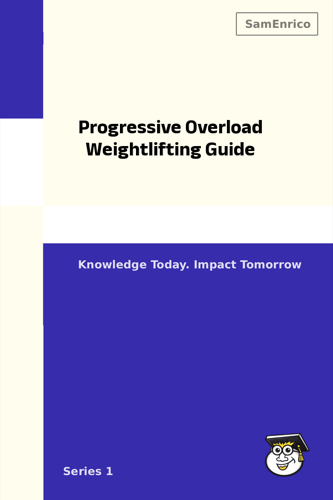
Progressive Overload Weightlifting Guide eBook
Add weight or reps systematically to force continu
Add weight or reps systematically to force continuous muscle adaptation.
Formats
Free sample
Chapter 1: The 100-Pound Lie--–- You have been lied to. Not maliciously, not by any single person, but by the collective whisper of the fitness industry, social media influencers, and well-meaning gym bros who have repeated the same phrase so many times that it has hardened into scripture: Just add more weight. Lift heavier. Go hard or go home.The lie is not that adding weight fails. The lie is that adding weight is the only way, the first way, and the best way to force your muscles to grow.
And for a small, specific window of your lifting career—roughly the first three to six months—it works beautifully. Then it stops. And when it stops, most lifters do one of three things. They quit, convinced their genetics are poor. They grind harder, adding weight with bad form until something tears.
Or they hop from program to program, chasing the dopamine hit of novelty instead of the slow, patient work of adaptation.This book is for the third lifter—the one who suspects there is a smarter way. There is.You are holding a book about progressive overload, which is the single most important principle in all of strength training. Without it, you do not grow. Without it, you do not get stronger. Without it, you are simply moving weights around a room, burning calories, and wondering why your body looks the same month after month.
But here is the twist that most books get wrong: progressive overload is not a thing you do. It is a thing you observe.Let me say that again because it is the foundation of everything that follows.Progressive overload is not the action of lifting a heavier weight. It is the observation that your performance has increased due to prior adaptation.This distinction—between action and observation—is the difference between training and guessing. Between a career of progress and a lifetime of plateaus. Between you and the version of yourself that walks into the gym five years from now still adding five pounds to the bar, or the version that has learned to manipulate six different variables to force adaptation when weight alone fails.This chapter will dismantle what you think you know about getting bigger and stronger.
It will take you from the muddy gym floor to the laboratory, from the 1940s rehabilitation wards of Boston to the modern science of mechanotransduction. By the end, you will understand why your body fights growth, why newbie gains feel like magic, and why the difference between "working out" and "training" is the difference between spinning your wheels and building a machine that never stops improving.Let us begin with a dead body.The Corpse That Changed Everything In 1946, the Second World War had just ended, and thousands of young soldiers were returning home with legs that had been immobilized for months in casts and traction. Their muscles had atrophied to the point where some could not walk. The medical establishment had no reliable protocol for rebuilding wasted muscle. Bed rest was the prescription, which only made the atrophy worse.Enter Dr.
Thomas De Lorme, a young physician at the Army’s rehabilitation hospital in Framingham, Massachusetts. De Lorme was frustrated. The standard approach—low-resistance, high-repetition exercises with tiny weights—produced negligible results. Soldiers would grind through hundreds of reps with five-pound ankle weights and emerge weeks later with essentially the same stick-thin legs.De Lorme did something radical. He asked a question that seems obvious in retrospect but was heretical at the time: What if the weight is the medicine?
What if the dose needs to increase as the patient heals?He designed a protocol that sounds laughably simple today. A soldier would perform one set of ten repetitions at a weight that was 50% of his maximum capacity. Then a set of ten at 75%. Then a final set of ten at 100%—the heaviest weight he could lift exactly ten times. Every session, De Lorme tested that maximum again.
And every session, for weeks on end, the maximum crept upward.The soldiers regained muscle mass at rates that had never been documented. De Lorme called his method "progressive resistance exercise," and he published his findings in a 1945 paper that would become the foundational text of modern strength training. Within a decade, his protocol had spread from rehabilitation hospitals to college weight rooms to the burgeoning physical culture movement. By the 1960s, it had a new name: progressive overload.Here is what De Lorme understood that most lifters today still do not: the human body is a adaptation machine, but it is a lazy one. It will do exactly enough to survive and no more.
If you lift the same weight for the same number of reps every week, your body will eventually say, "I have built exactly enough muscle to handle this task. Any more is a waste of precious metabolic resources. I am done."Progressive overload is the art of convincing your body that it is not done. That the task has gotten harder. That more muscle is required.But here is where most people get lost.
They hear "progressive overload" and they think "add weight." And for De Lorme's soldiers—who were starting from absolute zero muscle mass—adding weight worked brilliantly. For you, reading this book, it may not. Because you are not a soldier emerging from a cast. You are a human being with a history of lifting, with connective tissue that adapts at a different rate than muscle, with a nervous system that gets tired before your muscles do, and with a life that includes stress, poor sleep, and days when the bar feels heavier than it should.Adding weight is one form of progressive overload. It is not the only form.
It is not even the best form for most lifters most of the time. And this book is going to teach you the other five.Overload vs. Progressive Overload: The Critical Distinction You Have Never Heard Before we go any further, we need to etch two definitions into your brain. They will appear in every chapter of this book, and confusing them is the single most common mistake lifters make.Overload is the immediate act of challenging your muscle beyond its current capacity. You walk into the gym.
You load the bar with 200 pounds. You perform 8 reps, and on the 8th rep, the bar slows down. You have achieved overload. You have created a stimulus. Good.Progressive Overload is the observation that your performance has increased due to prior adaptation.
Next week, you load the bar with the same 200 pounds. This time, you perform 10 reps before the bar slows down. That increase from 8 reps to 10 reps is progressive overload. It is the evidence that your body adapted to the previous stimulus.Here is the mind-bending implication: You cannot do progressive overload. You can only create the conditions for it to occur, and then observe whether it happened.This is why chasing "more weight" every single session is a fool's errand.
Your body does not adapt on a linear schedule. Some weeks you will be well-rested, well-fed, and motivated, and you will crush your logbook. Other weeks…
This is the end of the free sample. Get the eBook to keep going. Buy now
About this book
Details
- Author
- Forsyth Machelle
- Publisher
- SamEnrico
- Language
- English
- Genre
- Non-Fiction, Health & Wellness, Exercise Science
- Released
- 2026-06-07
- Pages (approx.)
- 143
- Available as
- eBook, Audiobook

Read better in the ZLOADR app
Your eBooks on your phone or tablet. Sign in with your SamEnrico account and start reading.
More by Forsyth Machelle
 Weekly Review TemplateForsyth Machelle$11.99
 Mindfulness Sleep Training CourseForsyth Machelle$11.99
 Values And Mission Alignment Annual PlanningForsyth Machelle$11.99
 The Last Stand of the Icebound: How a Doomed Arctic Expedition Outlasted the ImpossibleForsyth Machelle$11.99
 Understanding Hypoadrenocorticism Hypoparathyroidism MoniliasisForsyth Machelle$17.99
 Healthcare IoT Sensor NetworksForsyth Machelle$12.99
 Ecommerce Fulfillment Career ManualForsyth Machelle$12.99
 How to Start a Patents Preparation Business (Beginners Guide)Forsyth Machelle$11.99
You may also like
 Hong Kong Handover 1997Dunn Johnnie$11.99
 Zumba For Postnatal Recovery CourseNeal Christian$11.99
 Zumba for BeginnersLadner Nikia$11.99
 YouTube Comment Mining GuideHumes Pandora$12.99
 Worry Box MeditationCarlin Rudy$11.99
 Workplace Stress MeditationNguyen Lynn$11.99
 Workplace Stress and Sleep RepairHawley Ivory$11.99
 Workplace Perfectionism CureDelaney Jeffry$11.99
 Workplace Injustice Anger GuideWallen Isabelle$11.99
 Work Addiction and Burnout LinkGreenwood Ester$11.99
 Women in Yoga and WellnessBeattie Galina$11.99
 Women in Stand Up ComedyChun Evangeline$11.99