
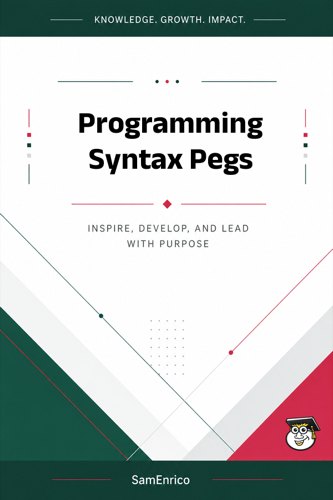
Programming Syntax Pegs eBook
Uses number pegs to recall language syntax, comman
by Page Duane
Uses number pegs to recall language syntax, commands, and functions.
Formats
Free sample
Chapter 1: The Lobster Principle--–- The interview was going perfectly until it wasn't. Maya had aced the algorithm questions, explained her past projects with clarity, and even made the senior engineer laugh twice. Then came the live coding section. The problem was straightforward: "Write a function that takes an array of numbers and returns a new array with each number doubled." Maya opened the editor, her fingers found the home row, and she typed:const doubled = array.map(n => n * 2);But she didn't type that. She typed:const doubled = array.map(n => n * 2)She forgot the semicolon.The code ran anyway.
Java Script's automatic semicolon insertion (ASI) saved her. But then the interviewer asked, "Can you explain why that semicolon is optional here but required in other contexts?" Maya's mind went blank. She had used semicolons for years, but she had never thought about why. She stammered something about line breaks and return statements, but she could see the interviewer's expression shift from interest to concern. She didn't get the job.
The feedback email arrived three days later: "Strong technical skills, but attention to detail on language specifics needs improvement."Maya's story is not about failure. It's about a mismatch between how we learn syntax and how our brains actually work. Maya had written thousands of semicolons. She had read articles about ASI. She had even fixed semicolon bugs in production.
By every measure, she had practiced. And yet, under the mild pressure of an interview question, her knowledge evaporated like morning dew. The problem wasn't practice. The problem was encoding.The Ten Thousand Hour Misunderstanding We have been told a comforting lie: that mastery comes from repetition. Ten thousand hours of practice.
Drill until you can't get it wrong. Type the code until your fingers remember what your brain forgets. This advice works—just well enough to be dangerous. It works for basic motor skills. It works for simple facts.
It works long enough to get you through a tutorial or a homework assignment. But it fails catastrophically when you need recall under pressure, when you switch between languages, or when the syntax is just similar enough to confuse.The reason is neurological. Your brain has two fundamentally different memory systems, and only one of them is suited for arbitrary symbols like semicolons and curly braces.Semantic Memory: The Librarian The first system is semantic memory. Think of this as a vast, well-organized library inside your head. It stores facts, concepts, meanings, and relationships.
You know that Paris is the capital of France. You know that water freezes at 0°C. You know that map transforms each element of an array. This knowledge is abstract, context-independent, and endlessly useful. The librarian never sleeps, never complains, and never forgets a fact—once that fact is properly filed.But here's the problem: the librarian files facts by meaning, not by appearance.
When you learn that console.log outputs text, the librarian files this under "output methods," "debugging tools," "Java Script basics." The letters c-o-n-s-o-l-e-.-l-o-g are filed as a single chunk, but the librarian doesn't care about the exact sequence. If you type console.loge, the librarian says, "Close enough. That's the debugging output thing, right?" The librarian is generous to a fault. It assumes that similar meanings imply similar symbols.This is why you can explain what splice does while typing slice—or vice versa. The meanings are adjacent in semantic space.
The symbols are not. Your semantic memory has betrayed you by being too helpful.Episodic Memory: The Filmmaker The second system is episodic memory. This is not a librarian. This is a documentary filmmaker with an unlimited budget and a taste for the absurd. Episodic memory records events: specific moments in specific places at specific times, rich with sensory detail.
You remember eating breakfast this morning. You remember your first day of school. You remember, with painful clarity, the moment you accidentally deleted a database table in production.The filmmaker doesn't care about abstract categories. The filmmaker cares about what happened. And what the filmmaker records, the filmmaker keeps.
A single emotionally charged event can be recalled decades later with near-photographic clarity. A fact repeated one hundred times can vanish in a week.Why such a stark difference? Evolution. Your ancestors needed to remember where the tiger attacked (episodic: "Tuesday afternoon, near the watering hole, the tiger with the scarred ear") more than they needed to remember the abstract concept that tigers are dangerous (semantic). The tiger's location, the time of day, the smell of dust and blood—these were survival details.
Abstract categories were not. Your brain is an episodic memory machine that tolerates semantic memory as a useful side effect.Now consider how you currently learn syntax. You read documentation (semantic). You type the code (procedural memory, a third system that governs motor skills). You repeat.
You never attach the syntax to a specific time, place, or sensory event. You never give your filmmaker a scene to record. Then, under pressure, your brain defaults to semantic recall—which gives you the meaning of the syntax but not the exact symbol sequence. Hence console.loge. You knew what it meant.
You knew it was close. But the precise letters slipped away because they were never encoded as an episode.The Lobster Principle Let me introduce you to a lobster. Not a real lobster—a mental lobster. A giant, crimson lobster the size of a golden retriever. This lobster wears a tiny chef's hat and carries a semicolon in each claw.
Not a printed semicolon. A physical, three-dimensional, glowing semicolon made of polished silver. The lobster stands on a white-sand beach at sunset. The waves are purple. The sky is green.
Everything is slightly wrong.The lobster raises its right claw and stabs the semicolon into the sand. The sand sizzles like a frying pan. The semicolon stands upright, glowing brighter. The lobster turns to you, clicks its claws twice, and says in a voice like gravel and butter: "Java Script statements end with ME."Then the lobster disappears.If you actually visualized that—if you saw the lobster, the beach, the glowing semicolon, the sizzling sand—you will never forget that Java Script uses semicolons. Not because you understood a rule.
Because you experienced an event. Your filmmaker recorded a scene: a lobster chef, a beach at sunset, an absurd declaration. That scene has a time (just now), a place (the beach), characters (the lobster), and action (the stabbing). Four hooks where before there were none.This is the Lobster Principle: any abstract syntax element can be transformed into an unforgettable episodic memory by embedding it in a vivid, absurd, action-packed scene with a recurring character. The lobster is one such character.
Over the course of this book, you will meet many others: a nun who enforces if statements, a mummy who wraps for loops, a bear who roars print commands into existence. Each character is a peg—a mental hook that you can attach to any syntax element you need to remember.Why Absurdity Works You might wonder: why a lobster? Why not a serious, dignified image that reflects the importance of coding? Because seriousness is forgettable. Absurdity is…
This is the end of the free sample. Get the eBook to keep going. Buy now
About this book
Details
- Author
- Page Duane
- Publisher
- SamEnrico
- Language
- English
- Genre
- Non-Fiction, Self-Help, Coding Mnemonics
- Released
- 2026-06-06
- Pages (approx.)
- 141
- Available as
- eBook, Audiobook

Read better in the ZLOADR app
Your eBooks on your phone or tablet. Sign in with your SamEnrico account and start reading.
More by Page Duane
 Mindfulness Meditation for Creativity BlockPage Duane$11.99
 Benzodiazepine Taper SleepPage Duane$11.99
 Gratitude Meditation Nightly PracticePage Duane$11.99
 Bipolar Support Group GuidePage Duane$11.99
 TM for Better Sleep QualityPage Duane$11.99
 Bulgaria Remote Tax GuidePage Duane$11.99
 Neuropathic Pain ChecklistPage Duane$11.99
 The Quantum Leap: How Richard Feynman’s Crazy Idea Changed the WorldPage Duane$11.99
 The Last Broadcast: The Day the Beatles Broke UpPage Duane$11.99
 The Last Breath: The Miraculous Survival of the S.S. Central AmericaPage Duane$11.99
 Growing EritrichiumPage Duane$11.99
 How to Start a Hobby in Go Kart RacingPage Duane$11.99