
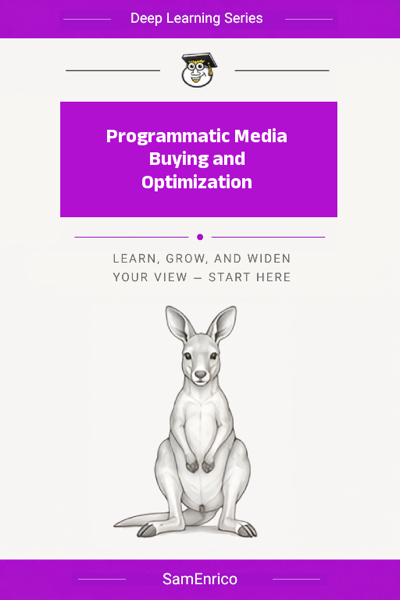
Programmatic Media Buying and Optimization eBook
A Coursebook on Programmatic Media Buying and Opti
A Coursebook on Programmatic Media Buying and Optimization
Formats
Free sample
Chapter 1: The 40% Heist...--If you are reading this book, someone has probably already wasted a significant portion of your advertising budget. I do not say this to alarm you. I say it because the programmatic advertising industry has built a beautiful, complex, and highly profitable machine designed to obscure a single, uncomfortable truth: a staggering percentage of your digital ad spend never reaches a human being who might buy your product.I have sat across the table from dozens of marketers who proudly showed me their programmatic dashboards. They pointed to charts showing millions of “impressions,” thousands of “clicks,” and a steadily declining “cost per acquisition.” They believed they had mastered the machine. Then, together, we pulled back the curtain.
We ran a simple invalid traffic report. We looked at the list of websites where their ads had supposedly run. We checked the viewability data.The silence in the room was always the same. There, in black and white, was the evidence of the heist. Ads served to data centers in North Carolina.
Ads “viewed” for zero seconds on made-for-advertising websites with names like “Best Recipes24-7.com.” A retargeting campaign that had spent thousands of dollars chasing the same fifty people around the internet. The dashboard had been a beautiful lie.This book is your flashlight in that dark room. It will not teach you to simply “do” programmatic. It will teach you to own it. You will learn not just how to launch a campaign, but how to audit every dollar, question every metric, and build a machine that actually prints money by driving real, measurable business outcomes.Before we can fix the machine, you must understand the revolution that created it.
And to understand the revolution, you need to know what it replaced.The Old World: Faxes, RFPs, and the Three-Martini Lunch The digital advertising industry before approximately 2009 was not slow because the people in it were lazy. It was slow because the infrastructure required human beings to negotiate every single transaction. If a brand wanted to buy a banner ad on the homepage of ESPN.com, the process followed a ritual as old as Madison Avenue itself.First, the brand’s media agency would write a Request for Proposal, or RFP. This document, often twenty or thirty pages long, detailed the target audience (e.g., “Men 18-34”), the desired dates, and the budget. The agency would fax or email this RFP to the “ad sales” department at ESPN.
A human salesperson at ESPN would then craft a proposal, negotiate the price, and send back an Insertion Order, or IO. An IO is a legally binding contract. It specified the exact dates, the exact placement (e.g., “300x250 banner, above the fold”), and the exact cost (e.g., $10 Cost Per Thousand Impressions, or CPM).This manual process had three crippling flaws that programmatic was designed to solve, and solving them was the industry’s original noble goal.First, it was agonizingly slow. What takes a machine 100 milliseconds could take a human team several weeks. By the time the IO was signed and the campaign launched, the “Men 18-34” target might have moved on to a different website or a different trend.Second, it was horribly inefficient for publishers.
ESPN could not sell every single ad on every single page view through direct sales. They had “remnant inventory”—the digital equivalent of empty seats on an airplane. Once the direct, high-priced ads were sold, the remaining space was nearly worthless. Publishers had to dump it into ad networks for pennies on the dollar.Third, it was completely untargeted. A brand buying the ESPN.com homepage was buying the context (sports fans), not the person.
They had no way to know if the specific user loading the page was a 25-year-old car shopper or a 60-year-old retiree. They paid for the page, not the audience.Then, in the mid-2000s, a series of technological breakthroughs began to converge. Ad servers became sophisticated enough to decide which creative to show in real time. Data companies figured out how to track users across websites using small text files called cookies. And the major ad exchanges—the stock markets for digital ads—launched the technology that changed everything: Real-Time Bidding.The Birth of the Millisecond Auction The first time I saw a Real-Time Bidding (RTB) auction in action, I felt like I was watching the opening scene of a science fiction movie.
In the time it took you to blink your eyes, an entire economic transaction had occurred.Here is what actually happens in those 100 to 200 milliseconds.A user—let’s call her Sarah—opens a news app on her phone. The app is free because it sells advertising space. As the app loads, the publisher’s technology (a Supply-Side Platform, or SSP) prepares a “bid request.” This is a tiny digital package that contains critical information about the opportunity. It does not contain Sarah’s name or address. But it does contain anonymized clues: her general location (ZIP code), the type of device (i Phone 15), the operating system (i OS 17), the app she is using (News App), and—critically—a cookie or mobile ad ID that represents her anonymous profile.This bid request is instantly sent to an Ad Exchange, which acts as the auctioneer.
The exchange then broadcasts that request to dozens of Demand-Side Platforms (DSPs) representing different advertisers. Each DSP has less than 100 milliseconds (often as little as 1/10th of a second) to decide: Do we want to show Sarah an ad? And if so, how much do we bid?The DSP makes this decision using powerful algorithms. It checks its internal data: Has Sarah visited the advertiser’s website before? Has she added a product to a cart?
Does her anonymous profile match the advertiser’s target audience of “luxury travelers”? The algorithm calculates a predicted likelihood that Sarah will convert (the p Conversion) and multiplies that by the advertiser’s maximum willingness to pay for a conversion. The result is a real-time bid.The DSP sends its bid—say, $1.50—back to the exchange. All the other DSPs do the same. The exchange runs the auction.
The highest bidder wins. In the earliest days, this was a simple second-price auction (the winner pays one cent more than the second-highest bid). Today, most exchanges use a first-price auction (the winner pays exactly what they bid). The winning DSP’s creative is then delivered to Sarah’s phone. She sees the ad.All of this happens before her news article finishes loading.This was the Programmatic Era 1.0.
Its sole purpose was Efficiency. It replaced the weeks-long human negotiation with a machine-driven auction. It allowed publishers to sell every single impression, not just the premium ones. And it allowed advertisers to buy that inventory instantly, without a contract. The machine had solved the problem of speed.But the real revolution was just beginning.The Golden Age of the Cookie: Era 2.0Once you have a machine that can make a buying decision in 100 milliseconds, you realize you can feed that machine almost any kind of data.
And in the early 2010s, the richest data source was the third-party cookie.To understand the power of Era 2.0, you…
This is the end of the free sample. Get the eBook to keep going. Buy now
About this book
Details
- Author
- Townsend Sadie
- Publisher
- SamEnrico
- Language
- English
- Genre
- Non-Fiction, Informative, Educational
- Released
- 2026-05-09
- Pages (approx.)
- 140
- Available as
- eBook, Audiobook

Read better in the ZLOADR app
Your eBooks on your phone or tablet. Sign in with your SamEnrico account and start reading.
More by Townsend Sadie
 Group Creative Risk Taking CourseTownsend Sadie$11.99
 Chinese Student Return TrendsTownsend Sadie$11.99
 Gambling Withdrawal HelpTownsend Sadie$11.99
 Intuitive Eating Weight GuideTownsend Sadie$11.99
 Core Beliefs That Fuel AngerTownsend Sadie$11.99
 The Siege of the Grand Hotel: The Day a Terrorist Took a City HostageTownsend Sadie$11.99
 The Phantom of the Dark WebTownsend Sadie$11.99
 Local Meetup Validation GuideTownsend Sadie$12.99
 Industrial Manufacturing BuyersTownsend Sadie$12.99
 Understanding Chromosome 6, Monosomy 6q1Townsend Sadie$17.99
 How to Start a Farm Supplies Merchant Wholesaler BusinessTownsend Sadie$11.99