
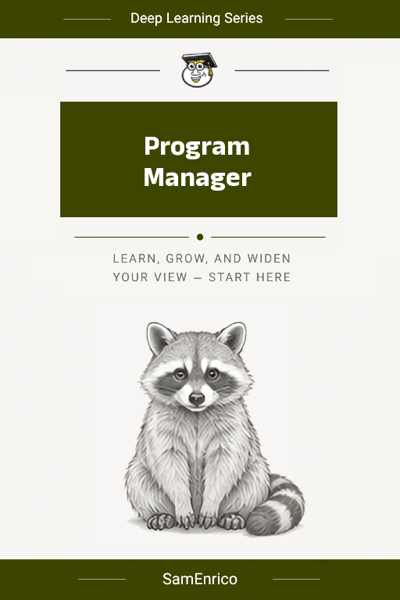
Program Manager eBook
A Coursebook on Program Manager
by Wynn Isaiah
A Coursebook on Program Manager
Formats
Free sample
Chapter 1: The Fifty-Million-Dollar Mistake--–- In 2017, a global retailer with over $10 billion in annual revenue completed a technology initiative that every project metric declared a success. The project was delivered on time. It was delivered under budget. Every milestone on every Gantt chart had been checked off with the satisfying finality of a completed task. The steering committee applauded.
The project manager received a bonus. The implementation team moved on to their next assignments, proud of their craftsmanship and efficiency.Six months later, the system was shut down.Not because it failed technically. The software worked exactly as specified. The data migrated correctly. The integrations held steady.
The system was, by every traditional measure of project success, a triumph.And yet, not a single business metric had improved. Customer wait times remained unchanged. Inventory costs stayed flat. Employee satisfaction scores actually dropped, because the new system required more clicks to complete the same tasks. The retailer had spent fifty million dollars to achieve nothing of value.The post-mortem revealed one word, scrawled across the whiteboard by a frustrated executive who had approved the funding: program.They had managed a project when they needed a program.The Quiet Catastrophe of Project Thinking This story is not an outlier.
It is the rule.Research consistently shows that somewhere between 50 and 70 percent of strategic initiatives fail to achieve their intended benefits. Not because the work wasn't done, but because the work was done inside the wrong container. Organizations pour billions of dollars into "successful" projects that deliver exactly what was asked for—and then discover that what was asked for never actually created value.The problem is not poor execution. The problem is a category error so fundamental that most organizations never even notice they are making it.Here is the category error in its simplest form: a project produces an output. A program produces an outcome.
An output is a thing delivered—software installed, a building constructed, a report written. An outcome is a change in the world—customers served faster, costs reduced, quality improved.Projects are good at outputs. Projects are terrible at outcomes.This chapter exists because most people who call themselves program managers are actually managing very large projects. They have bigger budgets, longer timelines, and more team members than their project manager colleagues. But they are still thinking in project terms: tasks, milestones, deliverables, completion.
They are still measuring success by whether they did what they said they would do, not by whether anything actually got better as a result.The fifty-million-dollar retailer learned this lesson the hard way. You are about to learn it for free.The Three Boxes: Project, Program, Portfolio Before we can understand what a program manager does, we must understand what a program actually is. And to understand a program, we must first distinguish it from its two close cousins: the project and the portfolio.Imagine three boxes, nested inside one another like Russian dolls.The Project Box The smallest box contains the project. A project is a temporary endeavor undertaken to create a unique product, service, or result. It has a defined beginning and end.
It has a defined scope, budget, and schedule. It is judged by whether it delivers what it promised, when it promised, for how much it promised.Examples of projects: build a mobile app, construct a warehouse, implement a new payroll system, run a marketing campaign. Each of these has a clear finish line. Each produces a tangible output.The project mindset is linear. You plan, you execute, you monitor, you close.
The project manager's job is to keep the train on the tracks. That is a valuable job. But it is not program management.The Program Box The middle box contains the program. A program is a group of related projects managed in a coordinated way to obtain benefits not available from managing them individually.That last phrase is the key. A program exists because the sum of the projects is greater than the parts.
The dependencies between projects create value that no single project could produce alone.Examples of programs: an ERP implementation that includes software development, data migration, process reengineering, and training projects. A product launch that includes engineering, marketing, sales enablement, and distribution projects. A merger integration that includes IT integration, cultural integration, brand consolidation, and workforce reduction projects.The program mindset is systemic. The program manager's job is not to keep individual trains on their tracks. The program manager's job is to ensure that when all the trains arrive, the passengers are actually somewhere useful.The Portfolio Box The largest box contains the portfolio.
A portfolio is a collection of programs, projects, and operational work grouped together to achieve strategic business objectives. The portfolio is not about execution. The portfolio is about investment.Examples of portfolio decisions: Should we fund the ERP program or the new product launch program? Should we continue funding the merger integration or redirect those resources to customer retention? The portfolio manager asks: given our limited resources, what is the optimal mix of initiatives to achieve our strategic goals?The portfolio mindset is strategic.
The portfolio manager does not care about Gantt charts or dependency matrices. The portfolio manager cares about return on investment, strategic alignment, and risk-adjusted value.Why This Distinction Matters Most organizations use these three words interchangeably. That is a mistake with real financial consequences.When you treat a program as a project, you do three things wrong.First, you measure success by outputs instead of outcomes. You celebrate when the software is deployed, even if no one uses it. You throw a party when the training is delivered, even if no behavior changes.
You check the box and move on.Second, you miss interdependencies. Projects managed in isolation optimize locally—each project manager makes their project look good, even if that means making the overall program worse. A project manager might rush to finish their deliverable early, only to discover that their early delivery forces another project to start before it is ready, creating rework and delay for everyone.Third, you fail to govern at the right level. Projects have project managers. Programs need program governance—a structure that can make trade-offs across projects, resolve conflicts, and reallocate resources when priorities shift.
Without that governance, you get exactly what the retailer got: fifty million dollars of individually successful projects that collectively achieved nothing.The Program Manager's Primary Mandate: Turning Chaos into Clarity If you take only one idea from this chapter, take this one.The program manager's primary mandate is turning chaos into clarity.This phrase comes from Russ Martinelli and Jim Waddell's The Handbook of Program Management, and it captures something essential about the role. Program managers do not inherit tidy, well-defined problems. They inherit ambiguity, contradiction, and uncertainty. They inherit initiatives that have been approved without a clear business case, staffed without clear authority, and launched without clear success criteria.The chaos is not a bug. It is a feature.
Programs exist precisely because the problem is too complex, too cross-functional, and too uncertain to be solved by a single project. The program manager's job is to impose just enough structure on that…
This is the end of the free sample. Get the eBook to keep going. Buy now
About this book
Details
- Author
- Wynn Isaiah
- Publisher
- SamEnrico
- Language
- English
- Genre
- Non-Fiction, Informative, Educational
- Released
- 2026-06-02
- Pages (approx.)
- 147
- Available as
- eBook, Audiobook

Read better in the ZLOADR app
Your eBooks on your phone or tablet. Sign in with your SamEnrico account and start reading.
More by Wynn Isaiah
 ABCDE for Event Planners GuideWynn Isaiah$11.99
 Immigrant Tech Accelerator GraduatesWynn Isaiah$11.99
 Suicide Attempt After Steroid Withdrawal StoryWynn Isaiah$11.99
 The Pulsatile HGH PatternWynn Isaiah$11.99
 AI Recommendation Letter WriterWynn Isaiah$11.99
 The Sand Serpent's Curse: A Pharaoh's Forgotten OathWynn Isaiah$11.99
 A Beginners Guide to Cornish hurling (Volume 1)Wynn Isaiah$11.99
 USA Raise Quick ReferenceWynn Isaiah$12.99
 Data Literacy Workforce GuideWynn Isaiah$12.99
 Understanding MedulloblastomaWynn Isaiah$17.99