
Non-FictionHealth & WellnessHRT
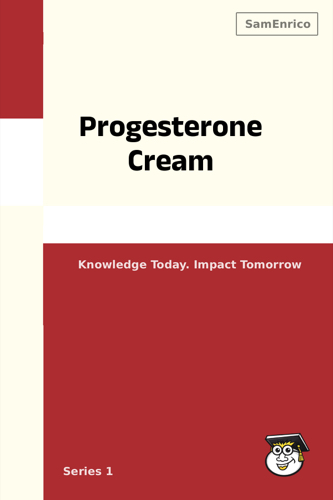
Progesterone Cream eBook
Explains balancing estrogen with bioidentical prog
Explains balancing estrogen with bioidentical progesterone.
Formats
Free sample
Chapter 1: The 3 AM Question...--–- It happens somewhere between 3:00 and 3:30 in the morning. You are not asleep, but you are not quite awake either. You are in that liminal space where the anxieties of the day melt into the fears of the night. Then, without warning, your heart begins to race. Not a flutter.
A full-throttle, why-is-this-happening, is-this-a-heart-attack kind of racing. You lie perfectly still, hoping your heartbeat will slow. It does not. You check your phone. 3:14 AM.
You think about the presentation tomorrow, the argument you had with your partner three years ago, the lump you felt in your breast last month (it was nothing, the doctor said, but what if), and the simple, terrifying question: What is wrong with me?You are not having a heart attack. You are not going crazy. And you are not alone.Millions of women wake up at precisely this hour every single night, drenched in sweat or frozen in panic, staring at the ceiling. They have been told by their doctors that their blood work is "normal." They have been prescribed sleeping pills that leave them groggy, antidepressants that kill their libido, and birth control pills that mask the symptoms without solving the root cause. They have been told to "reduce stress" by people who have no idea how much stress they are actually under.Here is the truth they have not been told: your 3 AM panic attack is not a psychological failure.
It is a biochemical signal. And the molecule that could quiet it is one your doctor has likely never mentioned to you.This book is about that molecule. It is about progesterone—not the synthetic imposter your gynecologist might prescribe, but the real, bioidentical hormone that your body recognizes, your brain craves, and modern medicine has largely forgotten. It is about the epidemic of estrogen dominance that is silently affecting one in two women over the age of thirty-five, and how a simple cream applied to your skin can reverse the tide.But before we get to the solution, we have to name the enemy. And the enemy is not estrogen.
Estrogen is not bad. Estrogen is what makes you a woman. It gives you your curves, your libido, the softness of your skin, the sharpness of your mind. The problem is not estrogen itself. The problem is unopposed estrogen—estrogen that circulates freely without its natural counterbalance, progesterone.
Think of estrogen as the accelerator pedal and progesterone as the brake. A car with a stuck accelerator is a terrifying ride. A body with unopposed estrogen is a hormonal disaster.This chapter is called "The 3 AM Question" because that question—What is wrong with me?—is the gateway. The answer, for most women, is estrogen dominance. And the solution begins with understanding why your doctor missed it, why your "normal" lab results are lying to you, and why a cream that costs less than your monthly coffee habit could be the key to reclaiming your life.The Hormone Conversation Nobody is Having Let me ask you a question.
When was the last time your doctor asked you about your progesterone levels?Not your thyroid. Not your cholesterol. Not your vitamin D. Progesterone.If you are like ninety-nine percent of women, the answer is never. You might have had your estrogen checked.
You might have had your FSH (follicle-stimulating hormone) checked to see if you were in menopause. But progesterone? That hormone that governs your sleep, your mood, your bleeding, your fertility, and your anxiety? That one rarely makes it onto the lab order.This is not an accident. It is a systemic blind spot in conventional medicine.Medical education spends hundreds of hours on the thyroid, the pancreas, the adrenal glands.
It spends almost no time on the nuanced dance between estrogen and progesterone. Why? Because the pharmaceutical industry has spent decades developing drugs that replace hormones (birth control pills, synthetic progestins, estrogen patches) but very few drugs that balance hormones. There is no patent on bioidentical progesterone. It is a molecule found in nature, synthesized from the Mexican yam, and it cannot be owned by any corporation.
So it is not taught. It is not marketed. And it is not prescribed.Instead, women are offered a menu of symptom-specific medications. Can't sleep? Here is Ambien.
Anxious? Here is Xanax. Heavy periods? Here is an IUD. Migraines?
Here is a triptan. Hot flashes? Here is a low-dose antidepressant that might help. Each of these medications addresses a single symptom. None of them address the underlying hormonal imbalance that is causing all of the symptoms simultaneously.This is what I call the "pill for every ill" model of medicine.
It is profitable. It is convenient for doctors who have fifteen minutes per patient. And it is failing women.Consider the statistics. One in four women will take an antidepressant at some point in their lives. One in three will suffer from a sleep disorder.
One in two will experience heavy menstrual bleeding. Endometriosis affects one in ten women, yet the average time to diagnosis is seven to ten years. Polycystic ovary syndrome (PCOS) affects up to fifteen percent of women of reproductive age, yet most are told to "lose weight and come back later." Migraines affect three times as many women as men, yet the standard treatment is still trial-and-error with drugs designed for male bodies.What if all of these conditions shared a common thread? What if the root cause was not a dozen different diseases but one underlying imbalance: too much estrogen relative to progesterone?This is not speculation. This is the conclusion of decades of research, much of it ignored by mainstream medicine.
When estrogen is high and progesterone is low, the body responds in predictable ways. The uterine lining grows too thick, leading to heavy bleeding and fibroids. The brain becomes overstimulated, leading to anxiety and insomnia. The immune system becomes dysregulated, leading to autoimmune flares. The breast tissue becomes dense and tender, leading to pain and an increased risk of cancer.The good news is that this is reversible.
The bad news is that you have probably been looking in the wrong direction for solutions.The 20 Signs of Estrogen Dominance Before we go any further, I want you to take a honest inventory of your body. Below is a list of twenty symptoms associated with estrogen dominance. These are drawn from the clinical observations of Dr. John Lee, the pioneer of the progesterone movement, as well as thousands of case studies from functional medicine practitioners worldwide.Read each one carefully. Put a check mark next to every symptom you have experienced in the past six months.
Do not downplay your symptoms. Do not tell yourself "everyone has that." Do not rationalize. Just check.Physical Symptoms:Heavy or prolonged menstrual bleeding – Soaking through a super-plus tampon in less than two hours, passing clots larger than a quarter, bleeding lasting more than seven days.Severe PMS – Mood swings, irritability, or rage that makes you feel like a stranger to yourself in the week before your period.Breast tenderness or swelling – Breasts that hurt to touch, feel lumpy, or increase by a full cup size before your period.Fibrocystic…
This is the end of the free sample. Get the eBook to keep going. Buy now
About this book
Details
- Author
- Torrence Eartha
- Publisher
- SamEnrico
- Language
- English
- Genre
- Non-Fiction, Health & Wellness, HRT
- Released
- 2026-06-10
- Pages (approx.)
- 148
- Available as
- eBook, Audiobook

Read better in the ZLOADR app
Your eBooks on your phone or tablet. Sign in with your SamEnrico account and start reading.
More by Torrence Eartha
 Wasco County Takeover PlotTorrence Eartha$11.99
 Grocery Shopping ContrastTorrence Eartha$11.99
 Distraction Proof Team Norms GuideTorrence Eartha$11.99
 Financial Advisor SelectionTorrence Eartha$11.99
 Delegation Tracking ToolTorrence Eartha$11.99
 Anger Rebound RelationshipTorrence Eartha$11.99
 The Silk Road Pioneers: Byzantine Navigators of the Medieval WorldTorrence Eartha$11.99
 The Last Broadcast: The Mysterious Vanishing of Station SOHCAHTOATorrence Eartha$11.99
 Understanding Incontinentia PigmentiTorrence Eartha$11.99
 How to Produce Skin CareTorrence Eartha$11.99
 WIPO Madrid Applicant GuideTorrence Eartha$12.99
 CS Degree Prerequisite GuideTorrence Eartha$12.99
You may also like
 Hong Kong Handover 1997Dunn Johnnie$11.99
 Zumba For Postnatal Recovery CourseNeal Christian$11.99
 Zumba for BeginnersLadner Nikia$11.99
 YouTube Comment Mining GuideHumes Pandora$12.99
 Worry Box MeditationCarlin Rudy$11.99
 Workplace Stress MeditationNguyen Lynn$11.99
 Workplace Stress and Sleep RepairHawley Ivory$11.99
 Workplace Perfectionism CureDelaney Jeffry$11.99
 Workplace Injustice Anger GuideWallen Isabelle$11.99
 Work Addiction and Burnout LinkGreenwood Ester$11.99
 Women in Yoga and WellnessBeattie Galina$11.99
 Women in Stand Up ComedyChun Evangeline$11.99