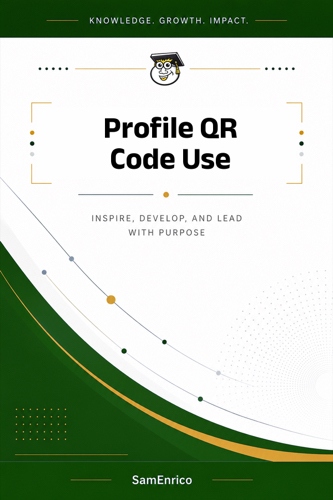
Profile QR Code Use eBook
Teaches generating and using LinkedIn QR code for
Teaches generating and using LinkedIn QR code for networking events.
Formats
Free sample
Chapter 1: The Paper Funeral--–- On a rainy Tuesday evening in March, a senior vice president named Diane stood over her office trash can and dropped 147 business cards into it. One by one. She had collected them over three days at the largest industry conference of the year. She had spent thousands on the ticket, the flight, the hotel, the new suit, and the expensive dinners. She had shaken 147 hands.
She had listened to 147 elevator pitches. She had smiled 147 times. And now, less than a week later, she could not remember the face associated with a single card. The name tags blurred together. The company logos meant nothing.
The handwritten notes on the backs of the cards—“great convo,” “follow up Tuesday,” “loves golf”—were too vague to trigger any real memory. So she threw them away. All of them. And then she closed the lid, sat back down at her desk, and opened her email to find 847 unread messages waiting for her. She had attended the conference, but she had not networked.
She had collected paper, and then she had buried it.This chapter is not about QR codes. Not yet. This chapter is about the funeral you have been attending every time you walk out of a networking event with a pocket full of paper. The funeral is quiet. It happens in offices, in kitchen drawers, in the glove compartments of cars, and in the bottom of purses.
It happens every single day, millions of times, across every industry, in every country. And the eulogy is always the same: “I meant to follow up. I really did. But then the week got away from me.”The problem is not that you are lazy or disorganized or bad at networking. The problem is the tool itself.
The paper business card is a relic designed for a world that no longer exists. It was invented in 17th-century Europe, called “visiting cards,” and used by aristocrats to announce their arrival at a social engagement. The servant would carry the card on a silver tray to the host. The host would decide whether to receive the guest. That was the original purpose: a gatekeeping mechanism for the wealthy.
It has nothing to do with lead generation, relationship building, or career growth. And yet, three centuries later, you are still using the same technology to manage your professional future.The statistics are damning, and they have been consistent across every study conducted in the last decade. According to research from the International Association of Conference Centers, over 90 percent of business cards collected at networking events are thrown away within one week. Not filed. Not entered into a CRM.
Not followed up on. Thrown away. A separate study by the University of Southern California’s Marshall School of Business found that the average professional carries 47 cards in their wallet or bag at any given time, but only contacts 2.3 people from that stack. That is a follow-up rate of less than 5 percent. To put that in perspective: if you attended ten events this year and collected 500 cards, you would follow up with exactly 12 of those people.
The other 488 would never hear from you again. And you would never hear from them.The financial impact is staggering. Let us do the math together, because the numbers will shock you. Assume that each meaningful business connection has a lifetime value of $500. That is a conservative estimate.
For a salesperson, a single client relationship can be worth $50,000 or more. For a job seeker, a single connection can lead to a role worth $20,000 in additional annual salary. For a freelancer, a single referral can generate $5,000 in contract work. But let us use $500 as the floor. If you collect 500 cards per year and follow up with only 12 of them, you are leaving 488 connections on the table.
Multiply 488 by $500, and you have lost $244,000 in potential value. Every single year. That is not a rounding error. That is a second income.But the problem is even worse than the math suggests, because the 90 percent throwaway rate does not account for the people who never give you a card in the first place. At every event, there are people who “ran out of cards,” people who “forgot their cards,” and people who have simply stopped carrying them because they have realized the futility.
You have met these people. You have fumbled for your own card while they shrugged apologetically. Those interactions die before they even begin. You leave with nothing but a memory, and memories fade within hours.This is what the author and networking expert Keith Ferrazzi, in his bestselling book Never Eat Alone, calls the “transactional trap.” Most professionals treat networking as a transaction: you give me your card, I give you mine, and we have done the thing called networking. But the card exchange is not networking.
It is the illusion of networking. Real networking, Ferrazzi argues, is not about collecting contacts. It is about cultivating relationships. And relationships require follow-up, context, and repeated interaction over time. The paper card provides none of those things.
It provides a name and a phone number. That is it. It does not tell you what you talked about. It does not remind you why you liked the person. It does not schedule the next conversation.
It is a dead end disguised as a beginning.Consider for a moment the hidden costs of paper networking, beyond the financial. There is the time cost: the minutes spent each week sorting through cards, deciding which to keep, typing numbers into your phone, and then inevitably throwing most of them away. There is the environmental cost: an estimated 7 million trees are cut down each year to produce business cards in the United States alone, and the vast majority of those cards end up in landfills within 12 months. There is the professional cost: the implicit message you send when you hand someone a piece of paper in 2026 is that you have not updated your professional toolkit in years. It signals nostalgia, not innovation.
It signals that you are comfortable with inefficiency.The most insidious cost, however, is psychological. Every time you collect a card and fail to follow up, you experience a small, almost imperceptible erosion of self-trust. You made a promise to yourself—or at least an intention—that you would reach out. You did not. That gap between intention and action accumulates.
After a few hundred cards, you begin to believe that you are simply “bad at networking,” that follow-up is a personality trait you lack, that some people are born networkers and you are not. This is not true. You are not bad at networking. You have been using a bad tool. Give a carpenter a rock and tell them to drive a nail, and they will seem incompetent.
Give them a hammer, and they will succeed. The paper business card is the rock. The QR code is the hammer.The QR code, specifically the Linked In QR code, solves every single problem outlined above. First, it eliminates the physical object entirely. There is nothing to lose, nothing to throw away, nothing to file.
Second, it connects directly to a living, breathing professional profile that contains your photo, your work history, your recommendations, your…
This is the end of the free sample. Get the eBook to keep going. Buy now
About this book
Details
- Author
- Mercer Alaina
- Publisher
- SamEnrico
- Language
- English
- Genre
- Non-Fiction, Professional's Cheat Sheet, Networking
- Released
- 2026-06-06
- Pages (approx.)
- 121
- Available as
- eBook, Audiobook

Read better in the ZLOADR app
Your eBooks on your phone or tablet. Sign in with your SamEnrico account and start reading.
More by Mercer Alaina
 Women's Biohacking MovementMercer Alaina$11.99
 Dubai Student VolunteeringMercer Alaina$11.99
 Bhagwan Oregon Ruins TodayMercer Alaina$11.99
 New Zealand Green CreditsMercer Alaina$11.99
 Cannabis Use Disorder and Occupational FunctioningMercer Alaina$11.99
 Circadian Rhythm Autism GuideMercer Alaina$11.99
 Caregiver Grief AnticipatoryMercer Alaina$11.99
 The Great Cyber Escape: How a Hacker Outsmarted Dubai’s High-Tech PrisonMercer Alaina$11.99
 The Blackout: The Night the Lights Went Out in New YorkMercer Alaina$11.99
 Understanding NarcolepsyMercer Alaina$11.99
 How to Produce Garment Steamer AccessoriesMercer Alaina$11.99
 Spot Factoring Emerging Markets HandbookMercer Alaina$12.99