
researchInformativeEducational
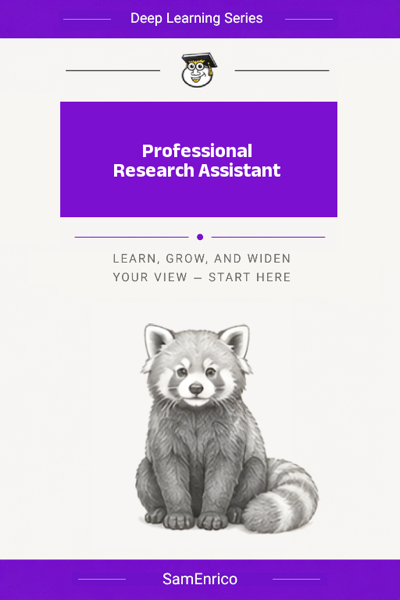
Professional Research Assistant eBook
A Coursebook on Professional Research Assistant
by Wall Dagny
A Coursebook on Professional Research Assistant
Formats
Free sample
Chapter 1: The Invisible Profession--–- Every year, tens of thousands of people begin work as research assistants. They walk into labs, archives, survey centers, and field offices. They are given a desk, a computer, and a list of tasks. They are told to "help out" or "get up to speed" or "support the project." And within six months, nearly half of them will feel lost, overwhelmed, or quietly convinced they are failing.Not because they aren't smart. Not because they aren't working hard.
But because no one ever taught them what the job actually is.If you are reading this book, you are likely one of those people. Or you are about to become one. You might be an undergraduate who took a position in a psychology lab because it looked good for grad school applications. You might be a recent graduate working as a full-time RA in a medical school, wondering why you feel more like an administrative assistant than a researcher. You might be a Ph D student who suddenly realized that your dissertation advisor expects you to also manage three other projects and train two undergraduates.
Or you might be a professional RA, years into your career, who has mastered the tactics of the job but still cannot shake the feeling that you are playing a game whose rules no one will write down.You are not alone. And you are not the problem.The problem is that the research assistant role is one of the most important and least understood positions in all of academia and industry research. It is the engine room of the knowledge enterprise. Without RAs, clinical trials would stop enrolling. Datasets would corrupt and never be cleaned.
Literature reviews would remain half-finished in a folder called "new folder" on a desktop that will never be backed up. Grants would miss deadlines. PIs would drown.And yet, almost no one trains RAs systematically. Most learn through an unstructured apprenticeship model: watch what the last person did, ask questions when you get stuck, and figure out the rest through trial and error. This works for a lucky few.
For everyone else, it produces anxiety, burnout, and a quiet sense that everyone else somehow received a manual that you did not.This book is that manual.But before we get to the systems, the templates, the AI tools, and the project management frameworks, we have to do something more fundamental. We have to rename what you do.You are not a helper. You are not support staff. You are not an extra pair of hands.You are a research project manager in training. You are a professional problem-solver.
You are the person who stands between a brilliant but chaotic Principal Investigator and the abyss of missed deadlines, lost data, and unfunded grants.And the first step to becoming excellent at this job is to understand what the job actually is—not the job description you were hired with, but the real, hidden, unwritten job that determines whether you succeed or burn out.The Three Hidden Archetypes of RA Work Every research assistant, regardless of discipline, cycles through three fundamental modes of work. Think of these as the gears in a transmission. You will shift between them constantly, sometimes multiple times in a single day. The RAs who thrive are the ones who recognize which gear they are in and know how to shift intentionally. The RAs who struggle are the ones who stay stuck in one gear, or who shift randomly based on whatever task landed in their inbox most recently.The Lit Seeker This is the archetype most people imagine when they think of an RA.
You are searching for knowledge. You are reading papers, synthesizing findings, tracking down citations, and building the intellectual foundation that the rest of the project depends on.When you are in Lit Seeker mode, your primary output is curated information. An evidence table. An annotated bibliography. A literature review section in a grant proposal.
A summary of methods from twenty papers that your PI does not have time to read.The skills of the Lit Seeker include systematic searching, critical appraisal, reference management, and synthesis. The traps of the Lit Seeker include review bloat (downloading five hundred papers and reading none of them), citation hoarding (collecting references you will never use), and perfectionism (rewriting the same paragraph for three weeks because you cannot find the perfect source).Most new RAs spend too much time in Lit Seeker mode because it feels like what researchers are supposed to do. Reading is respectable. Reading is safe. Reading does not require you to make decisions that might be wrong.But research is not reading.
Research is doing.The Data Wrangler This archetype is about handling evidence itself, not just writing about it. You are cleaning spreadsheets, coding interviews, running analyses, checking for outliers, and transforming raw information into something that can be interpreted.When you are in Data Wrangler mode, your primary output is processed data. A cleaned dataset. A set of coded transcripts. A regression table.
A figure that shows a pattern that was invisible in the raw numbers.The skills of the Data Wrangler include data cleaning, statistical software proficiency, scripting, quality assurance, and visualization. The traps of the Data Wrangler include cleaning forever (endlessly preparing data instead of analyzing it), tool obsession (learning six different statistical packages instead of finishing one project), and the false comfort of busy work (reorganizing columns when you should be testing hypotheses).Many RAs who come from quantitative backgrounds feel most comfortable in Data Wrangler mode. It feels objective. It feels technical. It feels like real science.But data without interpretation is just noise.
And interpretation requires understanding the question, not just the numbers.The Coordinator This archetype is about making research happen. You are scheduling meetings, managing IRB submissions, tracking deadlines, onboarding new team members, and ensuring that the project stays on rails.When you are in Coordinator mode, your primary output is structure. A project timeline. A signed consent form. A completed amendment.
A meeting agenda. A handoff document for the next RA who will inherit your work.The skills of the Coordinator include project management, communication, documentation, compliance, and logistics. The traps of the Coordinator include becoming a pure administrator (doing nothing but scheduling and paperwork), invisible work (spending hours on coordination that no one notices), and the martyr complex ("If I don't do everything myself, it will fall apart").The cruel irony of the Coordinator archetype is that it is the most essential and the least respected. A lab with a great coordinator runs smoothly. A lab with a poor coordinator collapses into chaos.
But the coordinator is rarely celebrated because when things go right, everyone assumes that is just how research works.Here is the truth that experienced RAs learn: you will cycle through all three archetypes. A single project might require you to spend Monday morning seeking literature, Monday afternoon wrangling data, and Tuesday morning coordinating with your PI. A single week might see you shift gears a dozen times.The most successful RAs do two things with these archetypes. First, they recognize which mode they are in at…
This is the end of the free sample. Get the eBook to keep going. Buy now
About this book
Details
- Author
- Wall Dagny
- Publisher
- SamEnrico
- Language
- English
- Genre
- research, Informative, Educational
- Released
- 2026-05-25
- Pages (approx.)
- 135
- Available as
- eBook, Audiobook

Read better in the ZLOADR app
Your eBooks on your phone or tablet. Sign in with your SamEnrico account and start reading.
More by Wall Dagny
 Polish Silent Unseen ParatroopersWall Dagny$11.99
 Downsizing Before Social Security BriefWall Dagny$11.99
 The Toxic Friend ConfrontationWall Dagny$11.99
 Remote Retreats Onboarding IntegrationWall Dagny$11.99
 Deep Work for Operations ManagersWall Dagny$11.99
 Frozen Light: The Quantum Pioneers of AntarcticaWall Dagny$11.99
 Echoes of the Iron Curtain: The Radio War That Shaped the Cold WarWall Dagny$11.99
 Understanding Christian SyndromeWall Dagny$17.99
 Seasonal Budget Adjustment GuideWall Dagny$12.99
 JEE Fluid Mechanics GuideWall Dagny$12.99
 How to Start a Post-secondary Non-tertiary Vocational Education Business (Beginners Guide)Wall Dagny$11.99
You may also like
 Scientific Research On TM GuideMartens Nathanial$11.99
 Research Proposal Methodology Section MasteryPauley Debroah$11.99
 Research Proposal Appendix CompilationRaines Tyisha$11.99
 Academic Researcher Distraction GuideFord Virgil$11.99
 TM Research and ScienceCovert Nicki$11.99
 Social Anxiety Research ReviewRoberge Cole$11.99
 Research Proposal Significance Section GuideBock Tory$12.99
 Research Proposal Reviewer PsychologyLugo Tawanda$11.99
 Research Proposal Research Questions DesignLara Robbi$11.99
 Research Proposal References and CitationsPatten Shanice$11.99
 Research Proposal Mixed Methods DesignCameron Omega$11.99
 Research Proposal Data Management PlanAnderson Roberto$12.99