
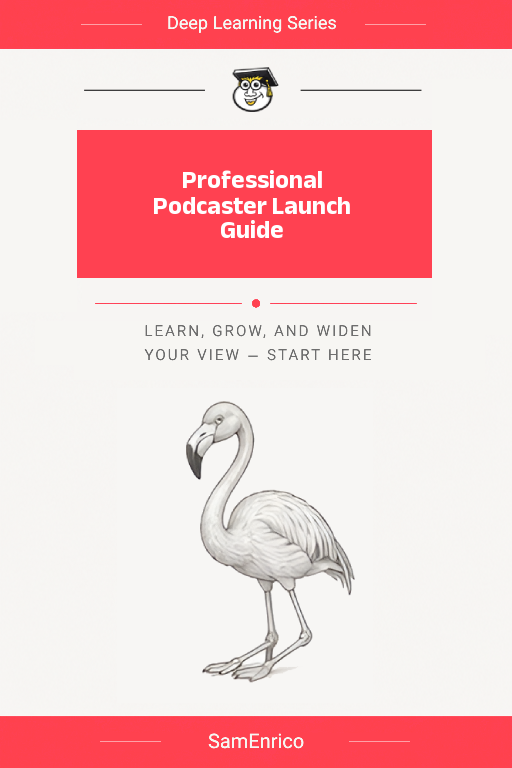
Non-FictionNon-Obvious CareerAudio MediaAction Guide
Professional Podcaster Launch Guide eBook
Turn your show into a full-time income via sponsor
Turn your show into a full-time income via sponsorships, affiliate marketing, and listener donations. Covers equipment under 200, distribution to Spotify/Apple, and download thresholds.
Formats
Free sample
Chapter 1: The Hobby Trap–- Most podcasts die before they ever have a chance to find their audience. That sounds like a dramatic opener, but it is simply the truth. According to data from Listen Notes and every major podcast hosting platform, over eighty percent of all podcasts never publish a seventh episode. Eighty percent. Let that number sink in for a moment.
For every ten people who buy a microphone, record an intro, and upload episode one, eight of them will disappear within two months. They will not be canceled due to scandal. They will not run out of interesting things to say. They will simply vanish, leaving behind a digital ghost of good intentions and a lingering sense of failure.I was almost one of them.My first podcast was called The Ambitious Generalist. The title alone should have been my first warning.
It was designed to be everything to everyone, which in practice meant it was nothing to anyone. I recorded episodes about productivity hacks, then about philosophical frameworks, then about marketing strategies, then about work-life balance. Each episode felt profound while I was recording it. Each episode felt like a gift I was bestowing upon an ungrateful universe. And each episode was downloaded exactly twelve times, eight of which were me checking the stats, two were my mother, one was my spouse, and the final one was probably a bot crawling for search engines.I quit after episode six.Not because I was lazy.
Not because I lacked passion. I quit because I had no idea who I was talking to. I had a microphone, a website, a logo, and a growing collection of audio editing scars. What I did not have was a single listener who would feel genuine disappointment if I stopped publishing. I had built a hobby disguised as a business.
And hobbies, no matter how passionately pursued, do not survive the inevitable collision with rent payments, day jobs, and the reality of有限 time.This chapter is about the difference between that failed version of me and the version who now makes a full-time living from a podcast about restoring rusty hand tools. Yes, you read that correctly. Rusty hand tools. A niche so specific that my friends laughed out loud when I told them. A niche so narrow that I assumed it would crash and burn like the others.
Instead, it became the thing that finally allowed me to quit my job and podcast full-time.The difference between those two outcomes has almost nothing to do with audio quality, marketing budget, or celebrity guests. The difference is the distinction between what I call the Hobby Trap and the Product Mindset. Once you understand this distinction, you will never waste time on an episode that no one listens to again.The Hobby Trap Defined The Hobby Trap is the single most common reason podcasts fail. It operates on a simple and seductive internal logic that sounds something like this: "I will record what I find interesting, and the right audience will eventually find me." This approach feels virtuous. It feels authentic.
It feels like the opposite of selling out. And it is almost always a path to abandonment.Here is why the Hobby Trap fails. Your curiosity is not a strategy. Your interests, no matter how eclectic or sophisticated, do not automatically translate into value for a stranger. When you record an episode because you feel like discussing a topic, you are serving yourself.
When you record an episode because your listener has a problem that needs solving, you are serving your audience. One leads to a hobby. The other leads to a business.The Hobby Trap kills podcasts through what I call Curiosity Drift. You start with a focused topic that actually has some market demand. Episode one is tight, valuable, and on-message.
Episode two is also solid. By episode four, you are getting a little bored with the repetition, so you introduce a "special interest" segment that feels fresh to you but irrelevant to your listener. By episode six, you have completely abandoned your original topic in favor of whatever crossed your mind that week. Your listener, who subscribed for the original focus, has no idea what you are doing now. They stop listening.
You notice the download numbers dropping. You feel discouraged. You quit.I have seen this pattern hundreds of times. A podcaster starts a show about vegan cooking. By episode eight, they are talking about their childhood trauma because they heard that vulnerability builds connection.
A podcaster starts a show about local real estate investing. By episode twelve, they are interviewing their friend about cryptocurrency because it seemed like a fun change of pace. A podcaster starts a show about marathon training. By episode fifteen, they are doing a ten-part series on the philosophy of running because they read a book by Haruki Murakami.None of these tangents are bad in isolation. They are just wrong for the show.
The vegan cooking listener wants recipes, not therapy. The real estate listener wants cap rates, not crypto. The marathon listener wants training plans, not literary analysis. When you serve your own curiosity instead of your listener's needs, you are effectively telling your audience, "I am bored with you, so I am going to do something else now." And they respond by leaving.The Curiosity Drift in Action Let me give you a concrete example from a podcaster I coached last year. We will call her Maria.
Maria started a podcast about helping first-generation college students navigate financial aid. She had been a first-gen student herself, and she knew exactly how confusing the FAFSA, scholarship applications, and student loan paperwork could be. Her first five episodes were excellent. She explained the difference between subsidized and unsubsidized loans. She broke down the timeline for applying for need-based aid.
She interviewed a financial aid officer about common mistakes. Her downloads grew steadily from fifty to two hundred per episode.Then Maria got bored.She had explained the basics, and repeating herself felt tedious. So she decided to broaden her topic. Episode six was about imposter syndrome among first-gen students. Episode seven was about the mental health challenges of being the first in your family to attend college.
Episode eight was an interview with a therapist about anxiety management. These were important topics, and Maria genuinely cared about them. But they were not why her audience had subscribed. Her audience had subscribed to learn about financial aid forms and deadlines. When they heard episode six, many of them thought, "This is interesting, but I still need to know how to apply for the Pell Grant," and they stopped listening.Maria's downloads dropped from two hundred to forty in three weeks.
She felt rejected. She thought her content was bad. She almost quit. But the problem was not her content quality. The problem was her focus.
She had drifted away from the specific problem her audience needed solved.We re-centered her show on the original topic. She added a "Financial Aid Office Hours" segment where she answered listener questions about forms and deadlines. She saved the mental health topics for a separate spin-off show that…
This is the end of the free sample. Get the eBook to keep going. Buy now
About this book
Details
- Author
- Bustamante Soon
- Publisher
- SamEnrico
- Language
- English
- Genre
- Non-Fiction, Non-Obvious Career, Audio Media, Action Guide
- Released
- 2026-06-01
- Pages (approx.)
- 152
- Available as
- eBook, Audiobook

Read better in the ZLOADR app
Your eBooks on your phone or tablet. Sign in with your SamEnrico account and start reading.
More by Bustamante Soon
 Weekly Project ReviewBustamante Soon$11.99
 Operation Car Wash Corruption ChroniclesBustamante Soon$11.99
 Values And Mission Alignment Brand StrategyBustamante Soon$11.99
 Franchise Builder's Drive Thru OnlyBustamante Soon$11.99
 Whispers in the Wind: The Forgotten Ballad of the Sky DancersBustamante Soon$11.99
 The Day the Beatles Never Broke Up: A Multiverse of MelodiesBustamante Soon$11.99
 RNA Therapeutics Revolution GuideBustamante Soon$12.99
 How to Start a Patent Fuel Production Business (Beginners Guide)Bustamante Soon$11.99
 Marketing Operations AnalystBustamante Soon$11.99
 Understanding HypertropiaBustamante Soon$17.99
You may also like
 Hong Kong Handover 1997Dunn Johnnie$11.99
 Zumba For Postnatal Recovery CourseNeal Christian$11.99
 Zumba for BeginnersLadner Nikia$11.99
 YouTube Comment Mining GuideHumes Pandora$12.99
 Worry Box MeditationCarlin Rudy$11.99
 Workplace Stress MeditationNguyen Lynn$11.99
 Workplace Stress and Sleep RepairHawley Ivory$11.99
 Workplace Perfectionism CureDelaney Jeffry$11.99
 Workplace Injustice Anger GuideWallen Isabelle$11.99
 Work Addiction and Burnout LinkGreenwood Ester$11.99
 Women in Yoga and WellnessBeattie Galina$11.99
 Women in Stand Up ComedyChun Evangeline$11.99