
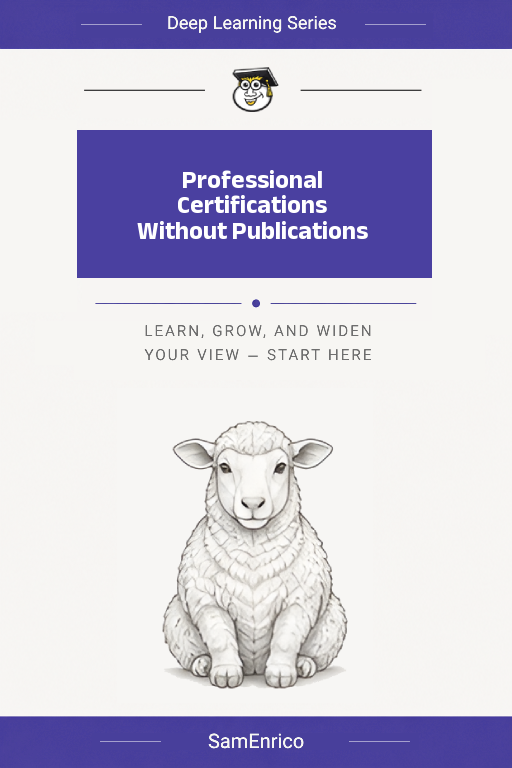
Professional Certifications Without Publications eBook
Highlight industry credentials like PMP or SAS cer
Highlight industry credentials like PMP or SAS certification that signal applied research skills.
Formats
Free sample
Chapter 1: The Gatekeeper‘s Lie--–- Every professional has heard the whisper. It comes from academic advisors, from senior colleagues, from the anonymous voices of internet forums. The whisper says: Without publications, you are not a real researcher. Without a thesis, your analysis is suspect. Without a Ph D, you will never lead a serious research project.This whisper is a lie.
But like all effective lies, it contains a sliver of truth. The truth is that research skills—the ability to formulate a hypothesis, design an experiment, collect and clean data, analyze results, and draw actionable conclusions—are genuinely rare and genuinely valuable. The lie is that academic publications are the only way to certify those skills, or even the best way for most industry roles.This book exists to expose that lie and to offer an alternative. A faster, cheaper, more directly applicable alternative. An alternative that Fortune 500 companies, government agencies, and leading contract research organizations are already using to screen and hire talent.
An alternative called professional certification.But before we dive into the mechanics of PMP, SAS, and other credentials, we need to understand the system we are challenging. We need to understand why academic publications became the gold standard for research credibility in the first place. We need to understand how that standard is cracking under the weight of industry demands. And most importantly, we need to understand why you—reading this book right now—have been systematically misled about your own potential as a researcher.The Medieval Origins of the Publication Standard The academic publication system, in its modern form, is surprisingly young. The first peer-reviewed journal, Philosophical Transactions of the Royal Society, began publication in 1665.
At the time, peer review was a courtesy extended by a handful of gentlemen scientists corresponding by letter. It took months. A paper on astronomy or anatomy might circulate among three or four experts before being deemed worthy of print.That system worked reasonably well for the seventeenth century. The volume of research was low. The pace of discovery was slow.
A gentleman scientist could afford to wait a year for feedback.Fast forward to 2025. The volume of research is astronomical. Over 5 million academic papers are published annually across thousands of journals. The average time from submission to publication has actually increased in many fields, now ranging from 6 to 24 months depending on the journal and the responsiveness of peer reviewers. A researcher conducting a clinical trial or a market analysis cannot wait two years for validation.
The trial ends. The market moves. The decision window closes.And yet, the academic system continues to operate as if speed is a luxury rather than a necessity. Publications are still measured in page counts and citation indices. Doctoral programs still require dissertations that take three to seven years to complete.
Postdoctoral fellows still spend years chasing first-author papers in high-impact journals, often at poverty-level wages, because the system tells them this is the only path to credibility.This is the first crack in the gatekeeper's wall. The academic publication system was not designed for the speed of modern industry. It was designed for a world that no longer exists.The Hidden Economics of Academic Publishing Let us talk about money, because the whisper about publications being the only path to credibility is also a whisper about who gets to be a researcher.A traditional publication track—say, a master's thesis followed by a Ph D dissertation followed by postdoctoral papers—costs between 30,000and30,000 and 30,000and150,000 in direct tuition and fees, plus three to seven years of forgone salary. A Ph D in the life sciences takes an average of 5.8 years. During that time, a stipend of 25,000to25,000 to 25,000to35,000 is common.
Meanwhile, a peer with a bachelor's degree working in industry might earn 50,000to50,000 to 50,000to70,000 per year. The cumulative opportunity cost of a Ph D is easily $200,000 or more.And for what? For a dissertation that will be read by an average of 12 people (including the committee). For first-author papers that will be cited a handful of times, if at all. For a system that increasingly relies on unpaid peer reviewers and for-profit publishers charging 30to30 to 30to50 per article for access.The economics are absurd.
They are also exclusionary by design. Doctoral programs have limited seats. Publication venues have limited pages. The gatekeepers—tenured professors, journal editors, grant reviewers—control access to both. They benefit from the scarcity they create.Professional certifications operate under a completely different economic model.
A PMP certification costs 405to405 to 405to555 for the exam fee, plus study materials that range from free (using online resources) to 1,000foracomprehensiveprepcourse.SAScertificationexamscost1,000 for a comprehensive prep course. SAS certification exams cost 1,000foracomprehensiveprepcourse.SAScertificationexamscost180 to 250each,withthe Baseand Advancedcertificationsrequiringtwoexamstotal.Evenstackingbothcredentials—PMPplus SASBaseplus SASExperimentation—rarelyexceeds250 each, with the Base and Advanced certifications requiring two exams total. Even stacking both credentials—PMP plus SAS Base plus SAS Experimentation—rarely exceeds 250each,withthe Baseand Advancedcertificationsrequiringtwoexamstotal.Evenstackingbothcredentials—PMPplus SASBaseplus SASExperimentation—rarelyexceeds3,000 in total out-of-pocket costs.Time investment? Three to six months of part-time study while working full-time is the standard. No forgone salary.
No multi-year opportunity cost. No dissertation committee demanding revisions for the fourth time.Gatekeeper Reality Check: What This Book Does and Does Not Claim Before we go further, a necessary pause for transparency. This book makes a specific claim: professional certifications can replace graduate degrees and publications for the majority of applied research roles in industry. This book does not claim that certifications replace a bachelor's degree.The reality is that most PMP and SAS certification holders already hold a bachelor's degree. PMP itself has explicit educational requirements: 36 months of project management experience within the past eight years if you have a four-year degree, or 60 months of experience if you have only a high school diploma.
SAS certification has no formal educational prerequisite, but in practice, employers hiring for SAS roles almost always require a bachelor's degree.This book is written for people who have a bachelor's degree (or are about to complete one) and who want to skip graduate school. It is written for professionals stuck in "report monkey" roles who need a credential to unlock promotion. It is written for Ph Ds in the wrong field who need to signal applied skills. It is not written for high school graduates seeking to bypass college entirely.That caveat established, the core argument remains powerful: for the vast majority of industry research roles—market research, clinical trial management, data analytics, program evaluation, operations research—a PMP or SAS certification signals the same or better applied research skills as a master's degree or Ph D, at a fraction of the time and cost.The Skills-Based Hiring Revolution Something remarkable has happened in the past five years. Major employers have begun to openly question the value of graduate degrees for research roles.Google led the way with its Career Certificates program, launched in 2018 and expanded repeatedly since.
The company explicitly states that its certificate programs are "equivalent to a four-year degree" for many technical roles. More importantly for our purposes, Google's Data Analytics Professional Certificate—which covers data cleaning, analysis, and visualization—is accepted in lieu of a degree for numerous roles across the…
This is the end of the free sample. Get the eBook to keep going. Buy now
About this book
Details
- Author
- Quinones Maurine
- Publisher
- SamEnrico
- Language
- English
- Genre
- Non-Fiction, Student's Shortcut
- Released
- 2026-05-29
- Pages (approx.)
- 155
- Available as
- eBook, Audiobook

Read better in the ZLOADR app
Your eBooks on your phone or tablet. Sign in with your SamEnrico account and start reading.
More by Quinones Maurine
 Addressing Infidelity DiscoveryQuinones Maurine$11.99
 Facebook Social Comparison TrapQuinones Maurine$11.99
 Carson Ecofeminism PioneerQuinones Maurine$11.99
 Rewiring Childhood MessagesQuinones Maurine$11.99
 Customer Effort Score ValidationQuinones Maurine$11.99
 Pro Bowl Leadership PresenceQuinones Maurine$11.99
 Imposter Syndrome Energy DrainQuinones Maurine$11.99
 Evening Habit RoutineQuinones Maurine$11.99
 Congress Master GuideQuinones Maurine$11.99
 Echoes of the Lost Colony: Roanoke's Vanishing ActQuinones Maurine$11.99
 Enki’s Great Deception: The Trickster God of the AbzuQuinones Maurine$11.99
 Plastic Fantastic: The Rise and Fall of the Furby CrazeQuinones Maurine$11.99
You may also like
 Hong Kong Handover 1997Dunn Johnnie$11.99
 Zumba For Postnatal Recovery CourseNeal Christian$11.99
 Zumba for BeginnersLadner Nikia$11.99
 YouTube Comment Mining GuideHumes Pandora$12.99
 Worry Box MeditationCarlin Rudy$11.99
 Workplace Stress MeditationNguyen Lynn$11.99
 Workplace Stress and Sleep RepairHawley Ivory$11.99
 Workplace Perfectionism CureDelaney Jeffry$11.99
 Workplace Injustice Anger GuideWallen Isabelle$11.99
 Work Addiction and Burnout LinkGreenwood Ester$11.99
 Women in Yoga and WellnessBeattie Galina$11.99
 Women in Stand Up ComedyChun Evangeline$11.99