
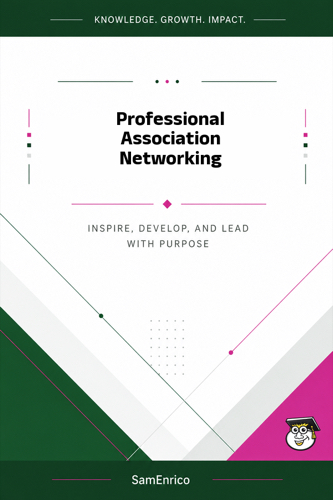
Non-FictionSelf-HelpProfessional Organizations
Professional Association Networking eBook
Maximize membership in industry groups through com
by Conroy Kyoko
Maximize membership in industry groups through committee work and conference attendance.
Formats
Free sample
Chapter 1: The Strategic Hunt--You are probably reading this book because you have already joined at least one professional association. Perhaps you are a member of three or four. You pay your dues every year, attend the occasional luncheon, and let the emails pile up in a folder labeled “Networking” that you promise yourself you will read “someday.” If this sounds familiar, you are not alone. In fact, you are in the majority. According to data from the American Society of Association Executives, the average professional belongs to 2.7 associations but actively participates in fewer than one.
The other 1.7 memberships are what we will call, without judgment, dead weight.Before we can teach you how to run the room, we must first ensure you are in the right room. This chapter is not about how to network. It is about how to choose. Strategic selection is the single most underrated skill in professional networking, and it is the foundation upon which every subsequent chapter of this book depends. You can execute every tactic in this book perfectly—volunteering for committees, mastering conference geometry, sending flawless follow-up emails—and still fail if you are investing your time in the wrong association.
Conversely, if you select the right association, even mediocre execution can yield extraordinary returns. The stakes are that high.Most professionals select associations by accident. A colleague invites them. Their employer suggests they join. They see a familiar name on a brochure.
These are not strategies; they are reactions. This chapter replaces reaction with a systematic, three-part framework for hunting the right association before you ever fill out a membership application. First, we will match associations to your specific career phase using the Career Phase Matrix. Second, we will audit the quality of an association’s membership using the Density Audit. Third, we will evaluate the structural rules that determine whether you can actually succeed inside the group, including the critical Professional Classification Rule that most members discover only after it is too late.
Finally, we will give you permission to quit the dead memberships you are already carrying.Let us begin by acknowledging an uncomfortable truth: most associations are not worth your time.The 80/20 Rule of Professional Associations The Pareto Principle applies mercilessly to industry groups. Roughly 20 percent of associations deliver 80 percent of the value available to professionals in any given industry. The other 80 percent of associations are either too broad to be useful, too narrow to have critical mass, too dominated by vendors to offer genuine peer connection, or simply poorly managed. Your job is not to join more associations. Your job is to identify the 20 percent that matter and invest your limited time there with intensity.Think of associations as investment vehicles.
You have three finite resources to invest: money (dues), time (meetings and events), and attention (mental energy spent on committee work). Each association demands all three. If you spread these resources across three or four mediocre groups, you will see mediocre returns from all of them. If you concentrate your resources on one excellent group, you will see exponential returns. This is not speculation; it is arithmetic.
A single committee chair role in the right association has launched more careers than a decade of attending luncheons in the wrong ones.So how do you find the right one?The Career Phase Matrix Your professional needs change dramatically over the course of a career. An association that serves a twenty-five-year-old individual contributor is almost certainly not the same association that serves a fifty-year-old senior executive. Yet most professionals join one association early in their careers and never reevaluate. They stay for twenty years out of inertia, long after the group has stopped serving them. The Career Phase Matrix solves this problem by matching association types to three distinct career phases.Phase One: The Entry-Level Professional (Zero to Five Years)At this stage, your primary need is exposure.
You need to understand how your industry works, who the major players are, and what career paths exist. You do not yet have deep expertise to offer, and that is perfectly fine. The right association for this phase is broad, local, and high-volume. Think city-based chambers of commerce, general industry associations (e.g., “The American Marketing Association” rather than “The Healthcare Marketing Specialists Association”), and groups with large, young memberships. Your goal at this phase is not to close deals or win board seats.
Your goal is to meet two hundred people, learn fifty names, and understand the basic topography of your professional landscape. You are a scout, not a general.Look for associations where the average meeting attracts at least fifty attendees, where the membership fee is low (under two hundred dollars annually), and where there is an explicit “Young Professionals” or “Emerging Leaders” track. Avoid highly specialized technical committees at this phase. They will reject you for lack of experience, and even if they do not, you will not have the context to contribute meaningfully.Phase Two: The Mid-Career Professional (Five to Fifteen Years)At this stage, you have expertise. You know your domain.
You have successes and failures you can share. Your primary need is no longer exposure; it is depth. You need to connect with peers who face the same technical challenges, who speak the same specialized language, and who can refer you business or collaborate on complex problems. The right association for this phase is niche, technical, and committee-driven. Think “The Society for Supply Chain Risk Management” rather than “The Business Leaders Network.” Think “The American Society of Training and Development’s Instructional Design Special Interest Group” rather than the parent organization.At this phase, you should prioritize associations that are organized around committees rather than general meetings.
A committee of twenty people who share your exact professional function is worth more than a luncheon of two hundred generalists. Your goal is to become known within that committee as a reliable, competent contributor. You are no longer scouting; you are building a reputation among people who can hire you, refer you, or partner with you.Phase Three: The Executive Professional (Fifteen Plus Years)At this stage, you no longer need technical depth. You have that. You do not need volume.
You have a network. Your primary need is influence. You need to shape the regulations, standards, and policies that govern your industry. You need board-level visibility that leads to speaking opportunities, media citations, and C-suite relationships. The right association for this phase is board-level, regulatory, or standard-setting bodies.
Think industry accreditation boards, lobbying groups, code committees, and foundation boards. These groups are often smaller, more selective, and more time-intensive than phase one or two associations.At this phase, your goal is not to meet people or even to serve on committees. Your goal is to hold an official title: Board Member, Treasurer, Chair-Elect, or Past Chair. These titles signal to the outside world that you are not just a participant in your industry but a leader of it. The work itself matters less than the governance role you occupy.Most professionals never progress through these phases intentionally.
They join an association in phase one and stay there until they retire, even though the association stopped serving them…
This is the end of the free sample. Get the eBook to keep going. Buy now
About this book
Details
- Author
- Conroy Kyoko
- Publisher
- SamEnrico
- Language
- English
- Genre
- Non-Fiction, Self-Help, Professional Organizations
- Released
- 2026-06-09
- Pages (approx.)
- 133
- Available as
- eBook, Audiobook

Read better in the ZLOADR app
Your eBooks on your phone or tablet. Sign in with your SamEnrico account and start reading.
More by Conroy Kyoko
 Loneliness and Nature TherapyConroy Kyoko$11.99
 Wholesaling Income Tracking GuideConroy Kyoko$11.99
 The Interruption Request FormConroy Kyoko$11.99
 Zumba Belly Dance InfusionConroy Kyoko$11.99
 Road Rage Self Talk GuideConroy Kyoko$11.99
 Wholesaling Title Company GuideConroy Kyoko$11.99
 The Animal Attack Cover UpConroy Kyoko$11.99
 School Of Turin HeistConroy Kyoko$11.99
 The Maverick and the Machine: How a Third-Party Candidate Almost Won the White HouseConroy Kyoko$11.99
 The Ghost in the Machine: How a Cyberattack Almost Stole the 2016 US ElectionConroy Kyoko$11.99
 The Forbidden Ice: Zheng He’s Lost Antarctic ExpeditionConroy Kyoko$11.99
 The Mineral Guide to StauroliteConroy Kyoko$11.99
You may also like
 Hong Kong Handover 1997Dunn Johnnie$11.99
 Zumba For Postnatal Recovery CourseNeal Christian$11.99
 Zumba for BeginnersLadner Nikia$11.99
 YouTube Comment Mining GuideHumes Pandora$12.99
 Worry Box MeditationCarlin Rudy$11.99
 Workplace Stress MeditationNguyen Lynn$11.99
 Workplace Stress and Sleep RepairHawley Ivory$11.99
 Workplace Perfectionism CureDelaney Jeffry$11.99
 Workplace Injustice Anger GuideWallen Isabelle$11.99
 Work Addiction and Burnout LinkGreenwood Ester$11.99
 Women in Yoga and WellnessBeattie Galina$11.99
 Women in Stand Up ComedyChun Evangeline$11.99