
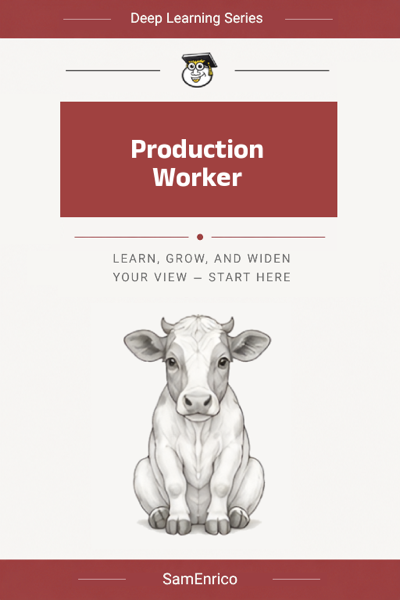
Non-FictionInformativeEducational
Production Worker eBook
A Coursebook on Production Worker
A Coursebook on Production Worker
Formats
Free sample
Chapter 1: The Aerial Map...--The first time you walked onto a production floor, what did you feel? For most new workers, the answer is a jumbled mix of awe, anxiety, and noise. Machines hiss and clatter. Lights flash red and green. Forklifts weave between pallets.
Someone yells something about a “deviation” and someone else runs toward a computer screen. In that moment, the factory feels like a chaotic, unpredictable organism—something to survive rather than understand.This chapter exists to erase that feeling forever.Before you learn to measure a micrometer, before you program a CNC, before you lead a Kaizen event, you need one thing above all others: context. You need an aerial map of the factory. You need to see the entire system from above, like a football player watching game film to understand why the quarterback made that throw. Without context, you are a passenger.
With context, you become a pilot.This chapter redefines your role. You are not a passive “cog in the machine.” You are an essential operator within a living business system. The difference between those two identities is the difference between showing up and understanding. And understanding begins with a single, deceptively simple question: Where does your part go after you make it?If you cannot answer that question for every part you touch, you are flying blind. By the end of this chapter, you will never be blind again.The Living Factory: Why Systems Matter More Than Machines Most new workers focus on the machines.
That is natural. Machines are loud, large, and obviously important. But a factory is not a collection of machines. A factory is a system—a set of interconnected parts that transform raw materials into finished goods that someone, somewhere, is willing to pay for.Here is the most important sentence in this entire book: A machine running perfectly while making parts nobody needs is worse than a broken machine.That sounds backward. But once you understand systems, it makes perfect sense.
A broken machine can be fixed. A machine making unnecessary parts is creating waste—consuming material, energy, and labor for zero value. Systems thinking teaches you to see beyond your immediate workstation. It asks you to look left (where did this material come from?) and right (where is it going next?) constantly.Consider a simple example. You operate a drill press that makes holes in aluminum brackets.
You are fast. Very fast. You produce 200 brackets per hour, which is 50 more than your target. Your supervisor smiles. You feel proud.
But what if the assembly station downstream can only handle 120 brackets per hour? Those extra 80 brackets per hour do not become finished products. They become Work in Process (WIP) —a pile of inventory that sits on a cart, taking up space, collecting dust, and potentially getting damaged. You worked hard to make them. The company paid for material and your labor.
And they are just waiting.Systems thinking would ask a different question: not “How many can I make?” but “How many does the next person need, right now?”This shift in perspective—from individual output to system flow—is what separates a production worker from a production professional. And it begins with understanding the three fundamental factory environments.The Three Factory Environments: Where You Work Changes How You Work Not all factories are the same. A factory that builds jet engines operates very differently from one that fills soda bottles. The difference comes down to two variables: volume (how many parts you make) and variety (how many different parts you make). These two forces shape everything: your daily routine, your tolerance for error, your setup time, and even your stress level.Let us walk through the three environments.Job Shops: The High-Variety, Low-Volume World Imagine a machine shop that makes custom parts for mining equipment, medical devices, and defense contractors.
Today you might machine a titanium hip implant. Tomorrow, a steel bracket for an excavator. Next week, a prototype sensor housing that has never existed before.This is a job shop. Volume is low. Variety is high.
Changeovers—the time spent switching from one product to another—are frequent and time-consuming. You might spend an hour setting up a machine to run 20 parts, then tear it down and start over.What this means for you: You need to be a generalist. You will read new blueprints constantly. You will use different tools every day. Your tolerance for ambiguity must be high.
The upside? You never get bored. The downside? Mistakes are costly because each setup is unique and hard to replicate.Daily rhythm: Frequent starts and stops. Long setup windows.
Small batches. Your supervisor cares more about first-piece quality (getting the first part right) than about speed.Batch Processing: The Middle Ground Now consider a factory that makes automotive brake rotors. They produce 5,000 units of one design, then change over to produce 3,000 units of another design, then switch again. The changeover takes 30 minutes—not an hour, but not instantaneous.This is batch processing. Volume is medium.
Variety is medium. Changeovers happen regularly but predictably. You will likely run the same family of parts repeatedly, with variations in dimensions or materials.What this means for you: You need to be efficient at changeovers. The company will measure your uptime (percentage of time the machine is making good parts). You will develop muscle memory for your product family.
The upside? You can become very fast. The downside? Repetition can breed complacency, and complacency breeds defects.Daily rhythm: Predictable cycles. Set schedules.
Your supervisor cares about cycle time (how long to make one part) and changeover time (how long to switch products).Continuous Flow: The High-Volume, Low-Variety World Finally, imagine a beverage bottling plant. The line runs 24 hours a day, seven days a week. It fills the same 12-ounce cans with the same soda formula for weeks at a time. Changeovers happen rarely—perhaps to switch to a different flavor or can size.This is continuous flow or assembly line production. Volume is very high.
Variety is very low. Changeovers are infrequent but highly orchestrated when they occur.What this means for you: You are a specialist. You will perform the same task thousands of times per shift. Your machine is optimized for one job. The upside?
You can achieve incredible speed and consistency. The downside? The work is repetitive, and when something goes wrong, the entire line stops—which is enormously expensive.Daily rhythm: Constant motion. No breaks in the line. Your supervisor cares about line speed (units per minute) and downtime (every second the line is stopped).Identifying Your Environment Before you read another chapter, identify which environment describes your factory.
Look around. Do you see many different types of parts waiting to be run? That is likely a job shop. Do you see the same few part families rotating? That is batch processing.
Do you see a river of identical products flowing without interruption? That is continuous flow.Knowing your environment changes how you apply every skill in this book. A Lean tool that works brilliantly in continuous flow may need adjustment in a job shop. A quality method that catches defects in batch processing might be…
This is the end of the free sample. Get the eBook to keep going. Buy now
About this book
Details
- Author
- Kowalski Eugenie
- Publisher
- SamEnrico
- Language
- English
- Genre
- Non-Fiction, Informative, Educational
- Released
- 2026-06-02
- Pages (approx.)
- 150
- Available as
- eBook, Audiobook

Read better in the ZLOADR app
Your eBooks on your phone or tablet. Sign in with your SamEnrico account and start reading.
More by Kowalski Eugenie
 London Economics Online Degree GuideKowalski Eugenie$11.99
 The Indoor Air GuideKowalski Eugenie$11.99
 Nonverbal in Dating GuideKowalski Eugenie$11.99
 Burnout Prevention for PilotsKowalski Eugenie$11.99
 The Baghdad Gold Heist: The Prohibition-Era Robbery That Shaped a NationKowalski Eugenie$11.99
 How to Produce Bicycle Cleat BoltsKowalski Eugenie$11.99
 Limitations and Delimitations GuideKowalski Eugenie$12.99
 How to Become a Still-pump OperatorKowalski Eugenie$11.99
You may also like
 Hong Kong Handover 1997Dunn Johnnie$11.99
 Zumba For Postnatal Recovery CourseNeal Christian$11.99
 Zumba for BeginnersLadner Nikia$11.99
 YouTube Comment Mining GuideHumes Pandora$12.99
 Worry Box MeditationCarlin Rudy$11.99
 Workplace Stress MeditationNguyen Lynn$11.99
 Workplace Stress and Sleep RepairHawley Ivory$11.99
 Workplace Perfectionism CureDelaney Jeffry$11.99
 Workplace Injustice Anger GuideWallen Isabelle$11.99
 Work Addiction and Burnout LinkGreenwood Ester$11.99
 Women in Yoga and WellnessBeattie Galina$11.99
 Women in Stand Up ComedyChun Evangeline$11.99