
Non-FictionInformativeEducational
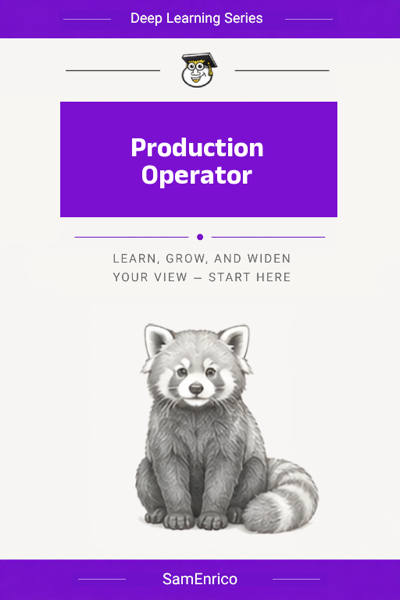
Production Operator eBook
A Coursebook on Production Operator
A Coursebook on Production Operator
Formats
Free sample
Chapter 1: Beyond the Assembly Line--– You have been a production operator for longer than you realize. Every time you have organized a chaotic space, diagnosed why a household appliance stopped working, or figured out the fastest sequence to complete a set of chores, you have used the same skills that make an excellent operator. The only difference is scale. Instead of fixing a toaster, you might troubleshoot a packaging machine. Instead of organizing a closet, you might arrange raw materials for just-in-time delivery.
The mindset—observing, analyzing, acting, improving—is identical.This chapter is not about machines. It is about the landscape in which those machines live. Before you can set up equipment, read a blueprint, or fill out a quality report, you need to understand the manufacturing environment: the different ways factories organize production, the departments you will interact with every shift, the metrics that determine whether your plant succeeds or fails, and where you fit in the hierarchy of value creation. By the end of this chapter, you will be able to look at any factory floor and recognize its production type, identify the internal customer-supplier relationships at your workstation, and calculate the most important performance metric in modern manufacturing.Manufacturing is not a single activity. It is a family of activities, each with its own rhythm, constraints, and measures of success.
A factory that makes millions of identical soda cans operates very differently from a job shop that machines one-of-a-kind turbine blades for power plants. One rewards speed and repetition. The other rewards flexibility and precision. Neither is better. They are just different.
And your job as an operator will vary dramatically depending on which type you work in.This chapter also introduces concepts that will recur throughout this book. The production types you learn here will inform how you approach machine setup (Chapter 4) and quality control (Chapter 5). The metrics you master here—especially OEE (Overall Equipment Effectiveness)—will appear again in your certification exam preparation (Chapter 11). The internal customer-supplier relationships you map here will determine how you communicate with maintenance, quality, and engineering (Chapter 9). Consider this chapter the foundation.
Everything else is built on it.Part One: The Five Faces of Production Manufacturing can be sorted into five primary production types. Most real-world factories are hybrids, but understanding the pure types helps you recognize the dominant logic of your plant.Discrete Manufacturing Discrete manufacturing produces individual, countable units. Cars, smartphones, furniture, and medical devices are discrete products. Each unit can be identified, tracked, and tested separately. The production process moves from station to station—weld here, assemble there, paint at the end.
If a defect is found, a single unit can be pulled from the line without stopping everything.As a discrete operator, your focus is on cycle time (how long each unit takes at your station) and first-pass yield (how many units pass inspection without rework). You will likely work on an assembly line, though not necessarily a moving one. You will become expert at your specific operation, whether that is installing a door panel or programming an electronic control module.Process Manufacturing Process manufacturing produces continuous, often undifferentiated outputs. Chemicals, petroleum, pharmaceuticals, beer, and paper are process products. The production runs continuously—24 hours a day, seven days a week—with shutdowns occurring only for maintenance or process changes.
Instead of counting units, you monitor flows, temperatures, pressures, and chemical compositions.As a process operator, your focus is on stability and efficiency. You work from a control room as often as you walk the floor. Your tools are SCADA systems (covered in Chapter 10) and laboratory reports. A small deviation in temperature or pressure can ruin an entire batch—sometimes worth hundreds of thousands of dollars. Your vigilance is the primary quality control.Batch Manufacturing Batch manufacturing produces groups of products that move through the process together in discrete lots.
Bakeries, breweries (ironically, brewing can be either process or batch depending on scale), pharmaceutical intermediates, and specialty chemicals use batch processes. Each batch is treated as a single unit for tracking purposes, even though it may contain thousands of individual items.As a batch operator, your focus is on changeover time—the minutes or hours required to switch from one product to the next. Changeover is non-productive time; every minute spent cleaning equipment or changing tooling is a minute not making product. The best batch operators are obsessive about preparation: staging materials, pre-heating equipment, and completing paperwork before the current batch finishes so that changeover takes fifteen minutes instead of two hours.Repetitive Manufacturing Repetitive manufacturing is a subset of discrete manufacturing dedicated to high-volume, low-variety production. Automotive assembly lines are the classic example, but so are appliance factories, electronics assembly, and many consumer goods.
Unlike discrete manufacturing in general, repetitive manufacturing uses dedicated production lines that rarely change over. The same product runs for days or weeks.As a repetitive operator, your focus is on cycle time and line balancing. If your station takes longer than the takt time (the rate at which products must be completed to meet customer demand), you will create a bottleneck. Your job is highly specialized—you may perform the same thirty-second operation hundreds of times per shift. The risk is repetitive motion injury (see Chapter 2).
The reward is that you can achieve extraordinary speed and quality through practice.Job Shop Manufacturing Job shop manufacturing produces custom, low-volume products. Machine shops, tool and die makers, prototype facilities, and repair depots are job shops. Each job is different, requiring unique setups, tooling, and sequences. There is no assembly line; instead, work centers are organized by function (lathes here, milling machines there, inspection in the corner).As a job shop operator, your focus is on flexibility and print reading (see Chapter 3). You may set up a machine three times in a single shift, each time for a different part.
You will spend more time reading blueprints and work orders than most operators. The pace is slower than repetitive manufacturing, but the cognitive demands are higher. You are less an operator than a craftsman, though the job title may not reflect it.Real-World Hybrids Most factories are hybrids. A car plant is primarily repetitive manufacturing, but the prototype shop inside it is a job shop. A pharmaceutical company may use batch manufacturing for active ingredients and then use process manufacturing for the final tablet press.
Do not try to force your plant into a single category. Instead, identify which type dominates your area. That dominant type determines your priorities: speed (repetitive), quality (process), flexibility (job shop), changeover speed (batch), or cycle time (discrete).Part Two: The Factory Ecosystem No operator works in isolation. Your workstation is a node in a network of departments, each with its own goals, constraints, and pressures. Understanding these departments helps you work with them rather than against them.Logistics (Inbound and Outbound)Logistics is responsible for material flow: raw materials coming in, finished products going out, and everything in between.
Inbound logistics stages raw materials at your workstation. Outbound logistics takes finished goods from the end of the line to the warehouse or shipping dock.As an operator, your relationship with logistics is critical. If inbound logistics brings the…
This is the end of the free sample. Get the eBook to keep going. Buy now
About this book
Details
- Author
- Mcnamara Adelaida
- Publisher
- SamEnrico
- Language
- English
- Genre
- Non-Fiction, Informative, Educational
- Released
- 2026-05-06
- Pages (approx.)
- 130
- Available as
- eBook, Audiobook

Read better in the ZLOADR app
Your eBooks on your phone or tablet. Sign in with your SamEnrico account and start reading.
More by Mcnamara Adelaida
 SPAC Mania IndicatorMcnamara Adelaida$11.99
 The Oxygen Mask PrincipleMcnamara Adelaida$11.99
 Resentment Release MeditationMcnamara Adelaida$11.99
 Caregiver Burnout for Sickle Cell CareMcnamara Adelaida$11.99
 Grace in Motion: The Visionaries Who Defied GravityMcnamara Adelaida$11.99
 Hybrid Agile Startup WorkbookMcnamara Adelaida$12.99
 How to Produce a Baby BathMcnamara Adelaida$11.99
 How to Start a Photographic Base Paper Business (Beginners Guide)Mcnamara Adelaida$11.99
You may also like
 Hong Kong Handover 1997Dunn Johnnie$11.99
 Zumba For Postnatal Recovery CourseNeal Christian$11.99
 Zumba for BeginnersLadner Nikia$11.99
 YouTube Comment Mining GuideHumes Pandora$12.99
 Worry Box MeditationCarlin Rudy$11.99
 Workplace Stress MeditationNguyen Lynn$11.99
 Workplace Stress and Sleep RepairHawley Ivory$11.99
 Workplace Perfectionism CureDelaney Jeffry$11.99
 Workplace Injustice Anger GuideWallen Isabelle$11.99
 Work Addiction and Burnout LinkGreenwood Ester$11.99
 Women in Yoga and WellnessBeattie Galina$11.99
 Women in Stand Up ComedyChun Evangeline$11.99