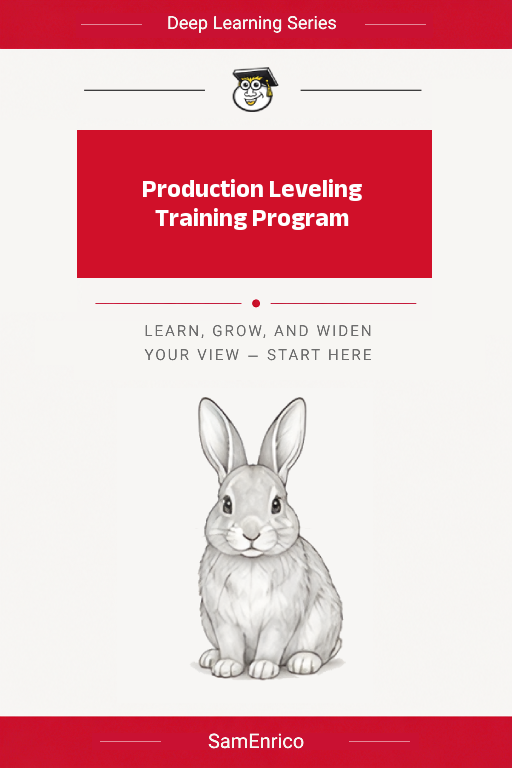
Production Leveling Training Program eBook
Structures a training curriculum for production pl
Structures a training curriculum for production planners on leveling and sequencing concepts, tools, and practical application exercises.
Formats
Free sample
Chapter 1: The $1.2M Epiphany--–- The phone rang at 11:47 PM on a Tuesday. Tom Dragowski, production planner for a mid-sized automotive supplier, already knew it was bad news before he picked it up. The caller ID read "Plant – Night Shift." He answered anyway, because that was the kind of person he was. The kind who answered at midnight. The kind who fixed problems.
The kind who, as he would later learn, was the single biggest obstacle to his own factory's success."Tom, it's Mike on the floor. Line 3 is down again. The changeover from the morning run isn't finished. We've lost four hours already, and the customer is expecting 2,400 units by 6 AM."Tom rubbed his eyes. He had been here before.
In fact, he had been here forty-seven times in the past twelve months. He pulled up his spreadsheet—the one with seventeen tabs and a complicated color-coding system that only he fully understood—and began the familiar routine. First, he called the warehouse to authorize overtime for the weekend shift, adding 8,400tothelaborbudget.Second,hecalledthelogisticscoordinatortoarrangeexpeditedshippingforthelateorder,another8,400 to the labor budget. Second, he called the logistics coordinator to arrange expedited shipping for the late order, another 8,400tothelaborbudget.Second,hecalledthelogisticscoordinatortoarrangeexpeditedshippingforthelateorder,another3,200. Third, he emailed the customer service manager with a carefully worded explanation that would protect the account but erode trust just a little bit more.
Fourth, he opened a bottle of antacid and stared at his ceiling for an hour before trying to sleep.What Tom did not know, what no one had ever taught him, was that he was not the hero of this story. He was not the indispensable firefighter saving the day. He was, in fact, the primary reason the fires kept starting in the first place.This book exists to prevent you from becoming Tom. Or, if you already are Tom, to give you a way out.The Consultant Who Changed Everything Six months after that midnight phone call, Tom's company hired a lean consultant to figure out why their on-time delivery had dropped to fifty-four percent, why overtime had increased forty percent year over year, and why the plant manager was being asked difficult questions by the corporate vice president. The consultant did not start by interviewing Tom.
She did not ask to see his seventeen-tab spreadsheet. She did not compliment his color-coding system.Instead, she pulled twelve months of production data and ran a simple analysis. She calculated the total overtime hours, expedited shipping costs, premium freight charges, customer penalty fees, and the soft cost of lost future business from the two customers who had recently left. The number she arrived at was $1,236,000. That was the cost of the factory's scheduling chaos over a single year.Then she ran a second analysis.
She looked at every single "emergency" that had triggered overtime or expediting. She traced each emergency back to its root cause. What she found shocked the plant manager and devastated Tom.Eighty-three percent of the emergencies were self-inflicted.They were not caused by suppliers failing to deliver. They were not caused by machine breakdowns, though those happened. They were not caused by quality problems, though those happened too.
They were caused by one thing: the production schedule itself.The factory was chasing demand. Every time a customer order came in—sometimes large, sometimes small, sometimes urgent, sometimes not—Tom would drop what he was doing and reprioritize. He would push jobs forward, push other jobs back, authorize overtime to catch up, and then do it all over again the next day. He was working harder than anyone in the building, and he was making everything worse.The consultant's diagnosis, delivered to a room of stunned managers, was simple: "You have confused activity with progress. Tom is very active.
But your production system is not progressing. It is convulsing."That was the moment Tom learned about leveling. That was the moment this book became necessary.The Arithmetic of Chaos: Why Overtime Is a Symptom, Not a Solution Before we go any further, let us be clear about something that most production planners never hear: overtime is not a solution to production problems. Overtime is a symptom of scheduling failure. It is the expensive bandage applied to a wound that never heals because no one has addressed the underlying cause.Here is the arithmetic that Tom never did.
His factory had an average daily demand of 1,000 units. But demand was not steady. It swung between 600 and 1,400 units depending on the day. On days when demand exceeded 1,200 units, the factory ran overtime—an average of three hours at one-and-a-half times the regular hourly rate. That happened eighty days per year.
The overtime alone cost the company $432,000 annually.Then there was the expedited shipping. When the factory fell behind schedule—which happened often, because chasing demand always creates a lag—Tom would pay to have finished goods shipped by air instead of by truck. Those premium freight charges added another $210,000 per year.Then there was the inventory. To protect against demand spikes, the factory held 20,000 units of finished goods safety stock. With an average unit cost of 50andanannualcarryingcostoftwentypercent,thatwas50 and an annual carrying cost of twenty percent, that was 50andanannualcarryingcostoftwentypercent,thatwas200,000 per year in inventory carrying costs alone.The total cost of not leveling was over $840,000 per year, plus the soft costs of lost customers and damaged morale that Tom could not put a number on but felt every time he looked at his declining on-time delivery metric.Now here is the question that changed Tom's life: What if the factory simply ignored the daily demand spikes and produced exactly 1,000 units per day, every day?Tom objected immediately.
"We would miss orders on high-demand days. Customers would be angry."The consultant nodded. "You would need to hold some finished goods inventory to cover the gap between your production rate and the demand spikes. But how much?"Tom calculated. The maximum daily demand was 1,400 units.
The average was 1,000. The maximum gap was 400 units. If he held 1,000 units of safety stock—about two and a half days of demand—he could cover any single-day spike. But more importantly, because he was producing at a steady rate, he could reduce his cycle stock dramatically. His total inventory dropped from 20,000 units to 6,000 units.
Carrying costs dropped from 200,000to200,000 to 200,000to60,000. Overtime disappeared. Expedited shipping disappeared.The total savings were over $780,000 per year.Tom's factory was not special. This calculation is repeatable in almost any manufacturing environment that currently chases demand. The numbers change, but the arithmetic works the same way: leveling reduces costs by eliminating the need for most overtime, most expediting, and most finished goods safety stock.The Three Enemies of Flow: Meet Your Adversaries Before we can understand leveling, we must understand what it fights.
Lean manufacturing, which emerged from the Toyota Production System, identifies three enemies of efficient production flow. They are known by their Japanese names, but you can think of them as characters in a story—villains that appear in every factory, every day, undermining your efforts to deliver quality products on time.Mura: The Unevenness Villain Mura is unevenness. It is irregularity. It is the spike in demand that hits on a Tuesday morning, the rush order…
This is the end of the free sample. Get the eBook to keep going. Buy now
About this book
Details
- Author
- Anthony Brianna
- Publisher
- SamEnrico
- Language
- English
- Genre
- Non-Fiction, Operational Efficiency Manual, Training
- Released
- 2026-05-30
- Pages (approx.)
- 156
- Available as
- eBook, Audiobook

Read better in the ZLOADR app
Your eBooks on your phone or tablet. Sign in with your SamEnrico account and start reading.
More by Anthony Brianna
 Fertility Acupuncture GuideAnthony Brianna$11.99
 Caregiver Stress Journal MethodAnthony Brianna$11.99
 Walking Meditation For Refugees GuideAnthony Brianna$11.99
 Cognitive Restructuring for Passive AggressionAnthony Brianna$11.99
 The Loyal Muslim Noblemen GuideAnthony Brianna$11.99
 The Battle of Bennington: Green Mountain Boys' DefianceAnthony Brianna$11.99
 How to Become a Test Driver IAnthony Brianna$11.99
 China Scholarship Deadline CalendarAnthony Brianna$12.99
 App DeveloperAnthony Brianna$11.99