
Non-FictionInformativeEducational
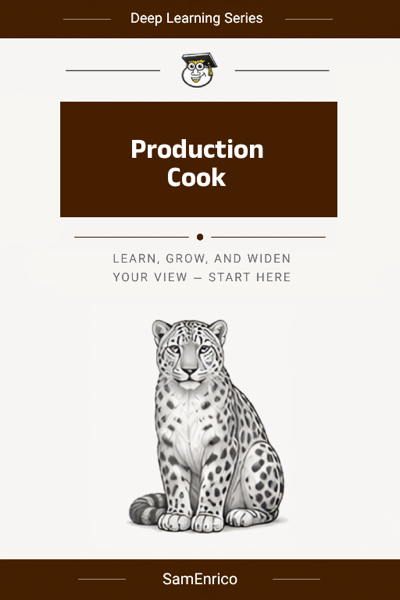
Production Cook eBook
A Coursebook on Production Cook
by Sigler Susy
A Coursebook on Production Cook
Formats
Free sample
Chapter 1: The Thousand-Plate Mind...--–- The alarm clock reads 4:47 AM. Not 4:45 when you set it, not 5:00 when you hoped. 4:47. You’ve been a production cook for six years, and your body no longer needs the alarm. It knows.
Somewhere across town, three hundred sheets of puff pastry are being pulled from walk-ins. Fifty gallons of stock are beginning their slow simmer. Twenty thousand eggs are still in their coolers, waiting. By 6:30 AM, the first tray of bacon—forty pounds of it—will slide into the first combi-oven. By 11:00 AM, you will have touched, seasoned, or inspected nearly two thousand individual portions of food.
Not one of those portions will have your name on it. Not one guest will know you woke up at 4:47. But every single one of them will know if you failed.This is the thousand-plate mind. It is not about ego. It is not about fame.
It is about the quiet, obsessive, almost mechanical precision required to feed hundreds or thousands of people every single day without a single catastrophic failure. The line cook at the fancy bistro downstairs worries about fifteen perfect plates an hour. You worry about fifteen hundred. Your stress is not the stress of the tweezers and the microgreen. It is the stress of the steam kettle that might scorch the bottom of two hundred gallons of soup.
It is the stress of the cooler that might fail overnight, destroying $4,000 worth of par-cooked chicken. It is the stress of knowing that when the vegetarian option runs out at the 450th plate, there is no running to the walk-in and slicing more salmon. The vegetarian option was planned three days ago, portioned two days ago, and cooked yesterday. When it is gone, it is gone.This chapter is not about how to hold a knife. You will learn that in Chapter 3.
This chapter is about how to hold yourself. Before you touch a single piece of produce, before you turn on a single piece of equipment, you must understand what it means to be a production cook—not a line cook, not a prep cook, not a celebrity chef, but the specific, indispensable, and often invisible professional who feeds the many.The Invisible Profession: Who the Production Cook Actually Is Let us clear up a persistent confusion. Walk into almost any restaurant kitchen, and you will find a line cook standing behind a hot line, working from a ticket printer, cooking one steak at a time, one salad at a time, one dessert at a time. That cook is an artist of the immediate. Their canvas is the plate, and their medium is urgency.
Now walk into the kitchen of a hospital, a university dining hall, a corporate cafeteria, a banquet facility attached to a convention center, or a prison. You will find a different creature entirely. This cook stands in front of a forty-gallon steam kettle, a tilting skillet the size of a small car, or a combi-oven with racks that roll out like filing cabinets. This cook does not wait for tickets. This cook works from a production sheet—a spreadsheet masquerading as a recipe—that tells them to prepare two hundred portions of chicken marsala, one hundred fifty portions of roasted root vegetables, and four hundred dinner rolls.
Every portion must be identical to every other portion. The first chicken breast plated at 11:00 AM must taste exactly the same as the last chicken breast plated at 1:30 PM. This is the production cook.For the purposes of this book, we define the production cook broadly and deliberately: a culinary professional who prepares food in large quantities for any high-volume setting, including buffets, catering, patient or student meals, and banquet-style plated service where one hundred to one thousand identical plates must be produced simultaneously. This definition is critical because it shapes everything that follows. If you are cooking for volume, you are not cooking for glory.
You are cooking for consistency, safety, speed, and cost control—in that order.Let us distinguish the production cook from three related but distinct roles:The Line Cook: Works à la carte, to order, from a ticket printer. Typical production volume: fifteen to fifty plates per hour. Typical batch size: one to four portions at a time. Primary stressor: speed and customization. Primary tool: the sauté station or grill.The Prep Cook: Works ahead of service, but typically in small batches for a single restaurant.
Typical production volume: fifty to two hundred portions of a single item per shift. Primary stressor: completing all tasks before service begins. Primary tool: the cutting board and robocoupe.The Production Cook: Works hours or days ahead of service, often for multiple meal periods simultaneously. Typical production volume: two hundred to two thousand portions of a single item per batch. Primary stressor: consistency across time and temperature, plus food safety at scale.
Primary tool: the steam kettle, tilting skillet, combi-oven, and production sheet.The production cook is not a lesser version of the line cook. That would be like saying a freight train is a lesser version of a sports car. They are different machines built for different purposes. The line cook needs reflexes. The production cook needs systems.
The line cook thrives on the adrenaline of the rush. The production cook thrives on the quiet satisfaction of a perfectly executed production schedule. Both are cooks. But they are not the same.The Architecture of the Kitchen: Where You Fit in the Brigade The classical Brigade de Cuisine was codified by Georges Auguste Escoffier in the late nineteenth century. It was designed for the grand hotels of Europe, where hundreds of covers were served nightly from sprawling, hierarchical kitchens.
The brigade remains useful today, though it has been adapted for modern volume cooking. Understanding the hierarchy helps you understand not only your place but also whom to ask when something goes wrong.At the top sits the Executive Chef. This person rarely cooks. They write menus, set budgets, manage suppliers, and answer to ownership or administration. In a hospital or university setting, the Executive Chef might oversee multiple production kitchens across a campus.
Below them is the Sous Chef (literally "under chef"). The sous chef is the bridge between the executive's vision and the line's execution. In production kitchens, the sous chef is often the one who creates the production sheets, orders the food, and troubleshoots when equipment fails.The Chef de Partie (station chef) oversees a specific area of production: the hot line, the cold pantry, the vegetable station, the butcher shop. In a large production kitchen, you might have a Chef de Partie for the steam kettle section alone. Below the Chef de Partie are the Commis (junior cooks) and the Production Cooks—that is you.But here is where the brigade diverges from the restaurant model.
In a production kitchen, you may also encounter specialized roles:The Banquet Chef: In hotels and convention centers, this person coordinates large plated events. They work directly with production cooks to ensure that five hundred plates of salmon all hit the pass at the same time.The Patient Services Manager: In healthcare kitchens, this person works with dietitians to ensure that modified-texture diets (pureed, mechanical…
This is the end of the free sample. Get the eBook to keep going. Buy now
About this book
Details
- Author
- Sigler Susy
- Publisher
- SamEnrico
- Language
- English
- Genre
- Non-Fiction, Informative, Educational
- Released
- 2026-05-18
- Pages (approx.)
- 148
- Available as
- eBook, Audiobook

Read better in the ZLOADR app
Your eBooks on your phone or tablet. Sign in with your SamEnrico account and start reading.
More by Sigler Susy
 The Comedians Tell AllSigler Susy$11.99
 Teen Boundaries Self EsteemSigler Susy$11.99
 Self Compassion DepressionSigler Susy$11.99
 The Foster Care CourtroomSigler Susy$11.99
 The Bipolar Mood Tracking GuideSigler Susy$11.99
 The Ballot Box Conspiracy: How a Forgotten Election Almost Toppled a DynastySigler Susy$11.99
 The Breeder's Guide to Silver Appleyard DucksSigler Susy$11.99
 Vesting for CTO GuideSigler Susy$12.99
 Domain Name Renewal RemindersSigler Susy$12.99
 How to Start a Board Making Machinery (except Chipboard) Business (Beginners Guide)Sigler Susy$11.99
You may also like
 Hong Kong Handover 1997Dunn Johnnie$11.99
 Zumba For Postnatal Recovery CourseNeal Christian$11.99
 Zumba for BeginnersLadner Nikia$11.99
 YouTube Comment Mining GuideHumes Pandora$12.99
 Worry Box MeditationCarlin Rudy$11.99
 Workplace Stress MeditationNguyen Lynn$11.99
 Workplace Stress and Sleep RepairHawley Ivory$11.99
 Workplace Perfectionism CureDelaney Jeffry$11.99
 Workplace Injustice Anger GuideWallen Isabelle$11.99
 Work Addiction and Burnout LinkGreenwood Ester$11.99
 Women in Yoga and WellnessBeattie Galina$11.99
 Women in Stand Up ComedyChun Evangeline$11.99