
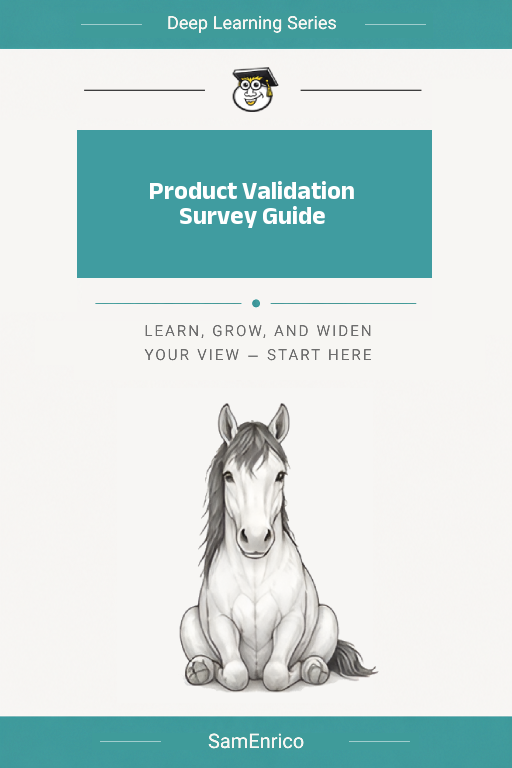
Product Validation Survey Guide eBook
Use surveys to validate product demand before buil
by Durr Reina
Use surveys to validate product demand before building. Ask potential buyers what they would pay.
Formats
Free sample
Chapter 1: The Validation Graveyard--–- The founder had spent eighteen months and two hundred thousand dollars building a smart dog collar that tracked location, activity, and heart rate. He had a patent. He had a warehouse full of inventory. He had a launch date. What he did not have was a single customer who had agreed to buy the product before he built it.Three weeks after launch, he had sold seven units.
Four of those were to his own employees. One was to his mother. The remaining two were to people who bought by accident, thought it was a different product, and immediately requested refunds.He had done everything wrong that could be done wrong. But the most damaging mistake was the one he never even knew he was making: he assumed that because he wanted the product to exist, other people would want to buy it.This chapter is about why that assumption destroys more businesses than any other single cause, and how you will never make that mistake again.The Graveyard Is Full of Beautiful Products Every year, approximately 65 to 75 percent of new products fail. Not struggle.
Not underperform. Fail. They are discontinued, written off, or abandoned by founders who run out of money and hope. The software never gets its second release. The physical product sits in a liquidation warehouse.
The Saa S platform quietly stops accepting new signups, then quietly stops existing at all.The most striking finding from decades of research on product failure is not the failure rate itself. It is the cause. When researchers ask failed founders why their product didn't succeed, the overwhelming majority cite the same reason: they built something nobody wanted.Not poor execution. Not bad marketing. Not lack of funding.
Not a competitive response. Building something the market does not want is responsible for roughly two thirds of all product failures. Execution problems account for most of the remaining third. Bad luck accounts for almost none.This means that the single most important decision you make about your product is not how well you build it. It is not how beautifully you design it.
It is not how cleverly you market it. It is the decision about what to build in the first place. Get that right, and you have a fighting chance. Get it wrong, and nothing else matters.The smart dog collar founder had built a technically impressive product. It worked.
The app was clean. The battery lasted ten days. None of that mattered because nobody wanted to pay for it. He had built a solution in search of a problem, and the market responded with the only honest answer it ever gives: silence.Why Smart People Skip Validation If building something nobody wants is the most common cause of failure, and if validation—the process of testing demand before building—is the most reliable way to avoid that fate, then why do so many founders, product managers, and entrepreneurs skip validation entirely?The answer is not that they are stupid, lazy, or naive. The answer is that validation feels wrong.
It violates every instinct that drives people to become entrepreneurs in the first place.The first instinct is confidence. Founders believe in their idea. They have to. The startup journey is too hard, too uncertain, and too long to survive without genuine conviction. But that same conviction becomes a liability when it prevents them from seeking disconfirming evidence.
Asking whether customers want your product feels like betraying your vision. It feels like admitting doubt. So instead, they build.The second instinct is speed. The market feels urgent. Competitors might be building the same thing.
The window of opportunity might close. Every day spent validating is a day not spent building, and every day not spent building feels like falling behind. This is almost always a illusion. A month of validation that saves you from six months of building the wrong product is not a delay. It is the fastest possible path to success.The third instinct is fear.
What if the validation says no? What if you ask customers whether they would buy your product and they tell you—honestly—that they would not? That is terrifying. It is much easier to live with the comfortable uncertainty of not knowing than to face the painful certainty of rejection. So founders avoid the question entirely, building in the warm cocoon of their own assumptions until the market coldly shatters them.The fourth instinct is confusion.
Many founders do not know how to validate properly. They ask their friends for opinions. They post on social media. They run a survey that asks "Would you buy this?" and they get back eighty percent yes answers. They feel validated.
They build. And then they fail, because asking your friends and your social media followers whether they would buy something is not validation. It is theater.The smart dog collar founder had done all of these things. He believed with absolute certainty that dog owners would want a smart collar. He moved fast, skipping any research that would slow him down.
He was afraid to hear no, so he never asked. And when he finally did ask, he asked the wrong people in the wrong way and got the wrong answers, which he misinterpreted as confirmation.He did not skip validation because he was lazy. He skipped validation because his instincts told him to. And his instincts were wrong.The Validation Toolkit: Where Surveys Fit Before we dive into the specific mechanics of survey design, sampling, and analysis, it is important to understand where surveys belong in the broader validation toolkit. Surveys are powerful, but they are not the only tool.
They are not always the right tool. And they are not a replacement for testing real behavior.The full validation toolkit includes several methods, each with different strengths, weaknesses, and appropriate use cases:Customer interviews are one-on-one conversations with potential buyers. They are unmatched for discovery: understanding the problem, the language customers use, and the emotional drivers of purchase. But interviews are expensive to conduct at scale and produce data that is difficult to aggregate and compare.Landing page tests involve creating a simple webpage that describes your product and measuring how many visitors click a call-to-action button. These tests capture revealed preference—actual behavior, not stated intention—which makes them more reliable than surveys for measuring demand.
However, they require driving traffic to the page, which costs money, and they provide limited diagnostic information about why people do or do not click.Smoke tests are a specific type of landing page test where the call-to-action button leads to a "notify me" page rather than a checkout page. They measure intent to purchase without requiring a fully functional product. Like landing page tests, they capture revealed preference but provide limited diagnostic information.Fake door tests are often confused with smoke tests. Here is the critical distinction: a fake door test is not an alternative to surveys. It is a follow-up.
You run a fake door test after you have survey data to confirm that the stated preferences you measured in the survey translate into actual behavior. The fake door…
This is the end of the free sample. Get the eBook to keep going. Buy now
About this book
Details
- Author
- Durr Reina
- Publisher
- SamEnrico
- Language
- English
- Genre
- Non-Fiction, First 30 Days
- Released
- 2026-06-01
- Pages (approx.)
- 150
- Available as
- eBook, Audiobook

Read better in the ZLOADR app
Your eBooks on your phone or tablet. Sign in with your SamEnrico account and start reading.
More by Durr Reina
 TMS for Depression GuideDurr Reina$11.99
 Uber Driver Fare CalculationDurr Reina$11.99
 Past Paper Practice GuideDurr Reina$11.99
 Career Transition for ManagersDurr Reina$11.99
 Afghanistan A10 PilotDurr Reina$11.99
 Citation Rules for Anonymous Works GuideDurr Reina$11.99
 T-34: The Tank That Changed WarfareDurr Reina$11.99
 Weekly Review For BalanceDurr Reina$11.99
 Rockefeller Standard OilDurr Reina$11.99
 Solar Flare: The Race to Harness the Sun’s FuryDurr Reina$11.99
 The Silent War: How the Stuxnet Worm Nearly Sparked World War IIIDurr Reina$11.99
 The Last Heist of the Velvet Bandit: The Untold Story of the 1975 SeaGrass Bank RobberyDurr Reina$11.99
You may also like
 Hong Kong Handover 1997Dunn Johnnie$11.99
 Zumba For Postnatal Recovery CourseNeal Christian$11.99
 Zumba for BeginnersLadner Nikia$11.99
 YouTube Comment Mining GuideHumes Pandora$12.99
 Worry Box MeditationCarlin Rudy$11.99
 Workplace Stress MeditationNguyen Lynn$11.99
 Workplace Stress and Sleep RepairHawley Ivory$11.99
 Workplace Perfectionism CureDelaney Jeffry$11.99
 Workplace Injustice Anger GuideWallen Isabelle$11.99
 Work Addiction and Burnout LinkGreenwood Ester$11.99
 Women in Yoga and WellnessBeattie Galina$11.99
 Women in Stand Up ComedyChun Evangeline$11.99