
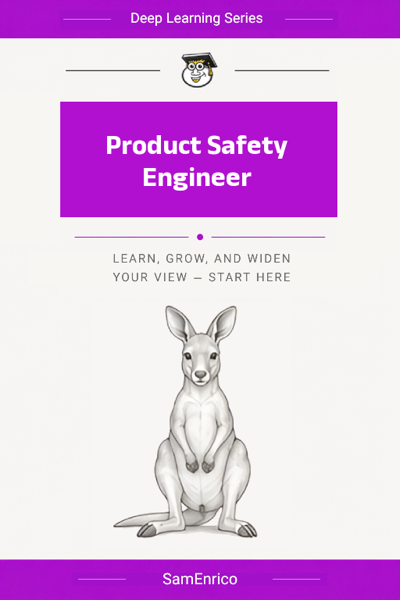
Non-FictionInformativeEducational
Product Safety Engineer eBook
A Coursebook on Product Safety Engineer
by Lugo Johnna
A Coursebook on Product Safety Engineer
Formats
Free sample
Chapter 1: What Killed the Engineer...--The stroller folded like a house of cards in slow motion.Not literally, of course. The latch released in milliseconds. The hinge mechanism pivoted. The aluminum frame telescoped downward. But for Dave Chen, the product safety engineer who had signed off on that stroller's design, watching the courtroom video felt like an eternity compressed into a single frame.
A toddler's hand—small, soft, impossibly fragile—was caught in the collapsing joint. The parents' scream came half a second later, first from the video, then from the gallery behind him.The child lost the tip of her middle finger. Not the whole finger. Not her life. Just the last centimeter, from the distal interphalangeal joint to the fingernail.
A piece of bone and tissue small enough to fit on a dime. The jury awarded $4.7 million. Dave's company settled before the verdict could be appealed. And Dave, who had passed every internal test, who had followed every checklist, who had done exactly what his job description required, sat in the witness chair thinking: I didn't know. I should have known.
I didn't know.That is the moment this book begins. Not with definitions or history or a polite overview of the product safety engineer's role. But with the sound of a parent's scream and the realization that a design decision—or the absence of a decision—had changed a family's life forever.Dave had tested the latch for vertical force. Push down on the stroller's handle, and the latch held. He had tested for horizontal force.
Pull the stroller sideways, and the latch held. He had tested for torque. Twist the frame, and the latch held. What he had not tested for was a partially folded stroller—the kind a tired parent might wrestle with while holding a child in the other arm—and a sideways force applied after the latch had been partially disengaged. That combination did not appear in any test protocol.
It did not appear because no one had imagined it. And that failure of imagination, more than any mechanical flaw, was the true defect.The Engineer Nobody Wanted to Be Product safety engineering is the least glamorous discipline in the engineering profession. Civil engineers build bridges that people photograph. Software engineers build apps that people use every waking hour. Mechanical engineers build engines that make people feel power.
Product safety engineers build things that don't hurt people—and when they succeed, absolutely no one notices. When they fail, they sit in courtrooms listening to parents scream.This is not a complaint. It is a factual description of the profession's fundamental asymmetry. If a safety engineer prevents a hundred thousand injuries, there is no parade. If she misses one hazard and a child swallows a button battery, her name appears in the recall database, the court filing, and the news article.
The asymmetry is brutal, and it drives many talented engineers away from the field. They prefer to work on products where success is visible—where the bridge stands, where the app launches, where the engine roars. Safety has no roar.But someone must do it. And that someone, historically, has not been well served by their training. Most engineering curricula teach students how to make things work.
They teach thermodynamics, fluid dynamics, materials science, circuit design, and software architecture. They teach students how to calculate stress, optimize efficiency, and minimize cost. What they do not teach—what they almost never teach—is how to imagine the ways a product might fail. How to anticipate the user who will ignore the instructions, remove the guard, and climb onto the unstable platform. How to foresee the environmental condition that was not in the test chamber.
How to ask the question that no one else is asking: What if we're wrong?Dave Chen had an undergraduate degree in mechanical engineering from a respected university. He had a master's degree in product design. He had passed the professional engineering exam. He had never taken a single course in product safety. Neither had most of his colleagues.
They learned on the job, by trial and error, by reading standards documents when a customer complained, by updating checklists after a recall. They learned reactively, which is to say they learned after someone was already hurt.This book exists because that model is broken. It is broken because the cost of reactive learning—measured in severed fingers, burned skin, fractured skulls, and wrongful death settlements—is too high to accept. It is broken because the pace of product development has accelerated beyond the capacity of trial-and-error to keep up. And it is broken because the traditional textbooks on product safety, while technically accurate and professionally valuable, read like tax code.
They are written for people who have already decided to become safety engineers. They are not written for the mechanical engineer who just discovered that her company has no safety process. They are not written for the software engineer whose code controls a medical infusion pump. They are not written for the founder who is about to ship a product that could kill someone.This chapter, and every chapter that follows, is written for those people. It begins with a story—the stroller, Dave Chen, the $4.7 million settlement—because stories are how engineers learn.
Not bullet points. Not checklists. Not RPN calculation formulas. Stories. Stories lodge in the brain differently than abstractions.
You will forget the precise definition of a design defect by the time you finish this chapter. You will not forget the toddler's hand.The Two Obligations Product safety engineering is often described as a balancing act between protecting users and serving the business. This description is wrong. It implies that safety and profitability are opposing forces, that every dollar spent on prevention is a dollar stolen from shareholders, that safety engineers are the killjoys who say "no" while everyone else says "go."The data say otherwise.A 2018 study by the consulting firm Mc Kinsey & Company analyzed 150 product recalls across six industries. The study found that companies spent an average of 12millionrespondingtoarecall—includinglogistics,replacementcosts,legalfees,andregulatoryfines.Thesamecompaniesspentanaverageof12 million responding to a recall—including logistics, replacement costs, legal fees, and regulatory fines.
The same companies spent an average of 12millionrespondingtoarecall—includinglogistics,replacementcosts,legalfees,andregulatoryfines.Thesamecompaniesspentanaverageof800,000 on pre-launch safety activities per product. Even accounting for multiple products, the ratio was stark: prevention cost roughly one-tenth to one-hundredth of recall response. The best predictor of recall cost was not the severity of the defect but the speed of response; companies that delayed reporting to regulators by even 30 days saw average costs increase by 40%, largely due to expanded scope (more units affected) and punitive damages in litigation.But the direct costs of recall are only the beginning. Brand damage is slower to quantify but often more devastating. A 2019 study in the Journal of Product Innovation Management tracked consumer sentiment for 50 recalled products over 24 months.
Brands that experienced a "preventable" recall—one where internal records showed the company had identified the hazard pre-launch but chose not to fix it—saw an average 18% decline in brand trust that persisted for 18 months. Brands that experienced an "unavoidable" recall—where the hazard could not have been reasonably…
This is the end of the free sample. Get the eBook to keep going. Buy now
About this book
Details
- Author
- Lugo Johnna
- Publisher
- SamEnrico
- Language
- English
- Genre
- Non-Fiction, Informative, Educational
- Released
- 2026-05-08
- Pages (approx.)
- 152
- Available as
- eBook, Audiobook

Read better in the ZLOADR app
Your eBooks on your phone or tablet. Sign in with your SamEnrico account and start reading.
More by Lugo Johnna
 Legacy Of Environmental Stewardship WorkbookLugo Johnna$11.99
 The Teenager ConfessionLugo Johnna$11.99
 Laci Peterson Cameras in CourtLugo Johnna$11.99
 Home Decor Addiction CureLugo Johnna$11.99
 The Liability Protection GuideLugo Johnna$11.99
 The Sydney Syndicate: Australia's Hidden Mafia WarsLugo Johnna$11.99
 Startup Visa Family InclusionLugo Johnna$12.99
 Terms of Service for Crypto AppsLugo Johnna$12.99
 Understanding Vitiligo Mental Retardation Facial Dysmorphism UremiaLugo Johnna$17.99
 How to Start a Night-club (licensed To Sell Alcohol) Business (Beginners Guide)Lugo Johnna$11.99
You may also like
 Hong Kong Handover 1997Dunn Johnnie$11.99
 Zumba For Postnatal Recovery CourseNeal Christian$11.99
 Zumba for BeginnersLadner Nikia$11.99
 YouTube Comment Mining GuideHumes Pandora$12.99
 Worry Box MeditationCarlin Rudy$11.99
 Workplace Stress MeditationNguyen Lynn$11.99
 Workplace Stress and Sleep RepairHawley Ivory$11.99
 Workplace Perfectionism CureDelaney Jeffry$11.99
 Workplace Injustice Anger GuideWallen Isabelle$11.99
 Work Addiction and Burnout LinkGreenwood Ester$11.99
 Women in Yoga and WellnessBeattie Galina$11.99
 Women in Stand Up ComedyChun Evangeline$11.99