
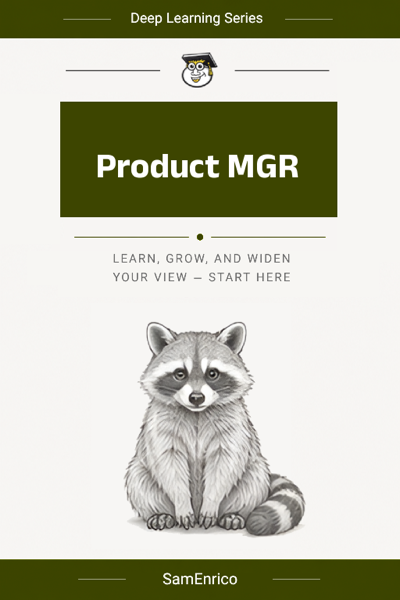
Non-FictionInformativeEducational
Product MGR eBook
A Coursebook on Product MGR
by Yoon Kattie
A Coursebook on Product MGR
Formats
Free sample
Chapter 1: The Influence Mandate...–- The conference room was silent. Fifteen engineers, designers, and product marketers stared at Priya, the newly hired Product Manager. She had just finished her 27-slide deck—complete with market research, user personas, and a detailed Gantt chart. “So,” she said, pointing at the timeline, “we need to launch the new dashboard by Q3. Engineering, that means you’ll need to work weekends in August.
Design, I need those mockups by next Friday. No exceptions.”The engineering lead, a veteran named Carlos who had been at the company for twelve years, leaned back in his chair. “Priya,” he said quietly, “we have three other projects already in flight. You don’t have authority over our capacity. And frankly, your timeline doesn’t account for the technical debt we’ve been warning about for six months.”Priya’s face flushed.
She had been told that Product Manager was the best job in tech—a “mini-CEO.” She had studied the frameworks, memorized the acronyms, and prepared for every objection. But she had missed one critical fact: she had no direct authority over anyone in that room.Six months later, Priya was fired. Her product launched three months late, missing every promised feature. The engineers resented her. The designers ignored her emails.
She had tried to command, and the organization had rejected her command.This book is written so you never become Priya.The Myth That Destroys Product Managers The “mini-CEO” myth is the single most damaging idea in product management. It appears in job descriptions (“We’re looking for a CEO of the product”), in MBA curricula (“The product manager owns the P&L”), and in career advice blogs (“Lead like a founder”). The metaphor is seductive because it promises power, clarity, and status. Who wouldn’t want to be a CEO?But the metaphor is a lie. And believing it will destroy your career.Here is the reality that no one tells you: In almost every technology company, a Product Manager has zero direct authority over the people required to build the product.
You do not hire engineers. You do not fire designers. You do not set their bonuses. You do not control their capacity. You cannot tell them what to do and expect automatic compliance.What you actually have is a mandate to deliver outcomes through influence.
That is not a weaker version of the CEO role. It is an entirely different skill set—one that the “mini-CEO” myth actively prevents you from developing.This chapter dismantles the myth, replaces it with a functional model of product management, and gives you the specific tools to lead through influence, not authority. By the end, you will understand why the “mini-CEO” fantasy fails, what the three real pillars of product work actually are, and how to ask the five questions that will make your team trust you.The Three Toxic Behaviors of the Mini-CEO Myth When a Product Manager believes they are a mini-CEO, they exhibit three predictable and destructive behaviors. These behaviors are not signs of leadership. They are symptoms of a fundamental misunderstanding of the role.Toxic Behavior #1: Becoming the Bottleneck The mini-CEO believes that all decisions must flow through them.
After all, the CEO is the final decision-maker. So the PM inserts themselves into every conversation, reviews every design, approves every pull request, and must be copied on every email.The result is a system where nothing moves without the PM’s permission. Engineers wait for approval on trivial decisions. Designers lose momentum while a ticket sits in the PM’s backlog. The team’s velocity collapses to the speed of one person.
And that person—the PM—burns out trying to keep up.Worse, the team becomes passive. Why suggest an improvement if the PM will just override it? Why take initiative if the PM has already decided everything? The mini-CEO creates a culture of dependency, not ownership.Toxic Behavior #2: Hoarding Strategy The mini-CEO believes that strategy is their exclusive domain. They create strategy decks in private, present finished plans to the team, and expect execution without debate.
The team is told the “what” but never the “why.”This behavior starves the team of context. Engineers and designers cannot make intelligent trade-offs if they don’t understand the strategic goals. When a technical limitation requires a decision, the engineer has no framework to guide them—so they stop and wait for the PM. Strategy hoarding is not power. It is a self-imposed bottleneck.Toxic Behavior #3: Command-and-Control Burnout The mini-CEO confuses authority with leadership.
When the team resists, the mini-CEO doubles down on command. “I own the roadmap,” they say. “Just build what I asked for.” This approach might work for a week or two. But humans are not machines. They resent being ordered around, especially by someone who does not control their career outcomes.Eventually, the team stops resisting openly.
They simply comply quietly, building exactly what was requested—no more, no less. They do not surface problems. They do not suggest improvements. They do not share risks. They wait for the inevitable failure, and when it comes, they are not surprised.
The PM, exhausted and isolated, takes the blame.These three behaviors form a predictable cycle: The PM commands authority they do not have. The team disengages. The product fails. The PM is replaced. The cycle repeats with the next “mini-CEO.”The Three Real Pillars of Product Management If the mini-CEO model is a fantasy, what is the actual job?
Product management sits at the intersection of three distinct, often competing, domains. Mastering this intersection is the real work.Pillar One: Value (User Experience and Desirability)Does anyone actually want this? That is the value question. It is not about whether the feature is technically possible or profitable in theory. It is about whether a real human being will change their behavior to use your product.The value pillar requires you to become an expert in your customer’s world.
What problems do they wake up with? What frustrations do they experience daily? What workarounds have they developed because existing solutions are inadequate? You answer these questions not through speculation, but through direct observation, interviews, and data analysis.Many PMs skip this pillar because it is messy. Customers are irrational.
They say one thing and do another. They cannot articulate their own needs. But the mess is the work. If you do not deeply understand value, you are building blind.Pillar Two: Viability (Business and Sustainability)Assuming customers want the product, does it work for the business? The viability pillar asks whether the product can be delivered profitably, legally, and sustainably.
This includes pricing models, go-to-market costs, regulatory compliance, brand alignment, and long-term maintenance.A feature that delights users but destroys your margin is not viable. A product that solves a real problem but exposes you to legal liability is not viable. A solution that requires a customer support team three times larger than your current capacity is not viable.The viability pillar forces you to think like a business owner, not just a customer advocate. You must understand your company’s cost structure, revenue model, and strategic constraints. This does not mean saying “no” to…
This is the end of the free sample. Get the eBook to keep going. Buy now
About this book
Details
- Author
- Yoon Kattie
- Publisher
- SamEnrico
- Language
- English
- Genre
- Non-Fiction, Informative, Educational
- Released
- 2026-05-09
- Pages (approx.)
- 136
- Available as
- eBook, Audiobook

Read better in the ZLOADR app
Your eBooks on your phone or tablet. Sign in with your SamEnrico account and start reading.
More by Yoon Kattie
 Workplace Coworker Anger GuideYoon Kattie$11.99
 Security System BreakdownYoon Kattie$11.99
 Hearing Loss Nutrition GuideYoon Kattie$11.99
 Serendipity Enhancement GuideYoon Kattie$11.99
 Behavioral Replacement Smoking CessationYoon Kattie$11.99
 The Silk Road’s Forgotten Cartographer: Zheng He’s Secret Maps of Central AsiaYoon Kattie$11.99
 Riding the Storm: The Untold Tale of Nat Love and the Great Cheyenne Flood of 1887Yoon Kattie$11.99
 Middle East Negotiation StrategiesYoon Kattie$12.99
 Grocery Shopping On BudgetYoon Kattie$12.99
 How to Start a Hobby in Mass-ObservationYoon Kattie$11.99
 Understanding Cardiac and Laterality DefectsYoon Kattie$17.99
You may also like
 Hong Kong Handover 1997Dunn Johnnie$11.99
 Zumba For Postnatal Recovery CourseNeal Christian$11.99
 Zumba for BeginnersLadner Nikia$11.99
 YouTube Comment Mining GuideHumes Pandora$12.99
 Worry Box MeditationCarlin Rudy$11.99
 Workplace Stress MeditationNguyen Lynn$11.99
 Workplace Stress and Sleep RepairHawley Ivory$11.99
 Workplace Perfectionism CureDelaney Jeffry$11.99
 Workplace Injustice Anger GuideWallen Isabelle$11.99
 Work Addiction and Burnout LinkGreenwood Ester$11.99
 Women in Yoga and WellnessBeattie Galina$11.99
 Women in Stand Up ComedyChun Evangeline$11.99