

Non-FictionInformativeEducational
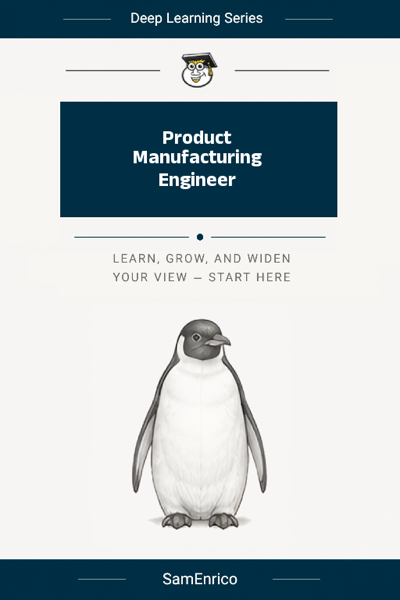
Product Manufacturing Engineer eBook
A Coursebook on Product Manufacturing Engineer
A Coursebook on Product Manufacturing Engineer
Formats
Free sample
Chapter 1: The Empty Blueprint...--The young manufacturing engineer stared at the drawing on her screen—a beautiful, elegant design for a plastic enclosure. Curved surfaces, thin walls, intricate snap-fits, and a perfect matte finish. The design engineer had spent six weeks perfecting every millimeter. It was a work of art.Sarah grinned and hit "send." The 3D model flew across the company network to the manufacturing engineering team in Shenzhen.Three weeks later, her phone rang at 2:00 AM."The tool doesn't work," said the voice on the other end. It was Tony, the senior manufacturing engineer at the contract manufacturer.
He sounded exhausted. "The snap-fits break when you try to close the case. The wall thickness varies from 1.5 mm to 0.8 mm in the corners, so the plastic doesn't fill properly. And the draft angle? You gave us zero degrees on the side walls.
We can't eject the part without destroying it. We need to re-cut the mold. That's $80,000 and eight weeks."Sarah sat up in bed. "But the drawing was perfect.""The drawing was perfect for a 3D printer," Tony said. "This isn't a 3D printer.
It's a production injection molding machine with 200 tons of clamping force. You designed a sculpture. We need to manufacture a part."That phone call changed Sarah's career. She spent the next six months learning what her engineering degree never taught her—how to design for manufacturability, how to think like a process, how to speak the language of the factory floor. This book exists because Sarah's story happens every single day, on every continent, in every industry.Welcome to the world of the Product Manufacturing Engineer.1.1 The Great Misunderstanding: Design vs.
Manufacturing Every physical product in the world—every phone, every car, every pacemaker, every toy, every airplane wing—goes through the same journey. Someone imagines it. Someone draws it. Someone builds it. And somewhere between the drawing and the building, things go wrong.The fundamental problem is not bad engineers.
The fundamental problem is a structural divide in how we train and organize engineering work.Design Engineering (the "what") is taught in universities as a creative discipline. Design engineers learn thermodynamics, stress analysis, fluid dynamics, materials science, and CAD modeling. They are rewarded for elegant solutions, novel mechanisms, and meeting performance specifications. Their world is theoretical, mathematical, and visual. They work in clean offices with large monitors and powerful workstations.Manufacturing Engineering (the "how") is barely taught at all.
Most engineering programs offer one elective on manufacturing processes, often taught by a professor who hasn't set foot on a factory floor in twenty years. Manufacturing engineers learn on the job—by making mistakes, by listening to machinists, by watching molds fail, by standing on concrete floors for twelve hours while a production line refuses to run.The result is what we call the "Over the Wall" syndrome.The Over the Wall Syndrome Here's how it works: Design Engineering finishes a drawing. They celebrate. They throw it over the wall to Manufacturing Engineering. Manufacturing Engineering looks at it and says, "We can't make this." Design Engineering says, "But it meets all the specs." Manufacturing Engineering says, "The specs are impossible." Design Engineering says, "Figure it out." Manufacturing Engineering says, "It will cost twice as much and take three months longer." Design Engineering says, "That's your problem." And then everyone goes to a meeting where no one says what they actually think, and the project gets delayed, and the product launches late, and the customer buys from a competitor.This is not a failure of individual competence.
This is a failure of systems. The Over the Wall syndrome exists because companies organize engineering into functional silos. Design sits in one building. Manufacturing sits in another. They report to different vice presidents.
They have different incentives. Design is measured on features and performance. Manufacturing is measured on cost and throughput. These goals are not aligned. They are, in fact, frequently opposed.The most expensive drawing in history was a beautiful, perfect, utterly unmanufacturable masterpiece that cost a Fortune 500 company $47 million in rework, scrapped tooling, and delayed revenue.
The design engineer who created it was promoted six months later because "she delivered the design on time."This book exists to ensure that never happens to you.The Integrated Product Team Solution The solution is as simple to state as it is difficult to execute: stop throwing drawings over walls. Instead, form Integrated Product Teams (IPTs) where manufacturing engineers sit alongside design engineers from day one. Not as reviewers. Not as consultants. As full, equal members of the product development team.In an IPT, the manufacturing engineer attends every design review.
She sees the CAD model evolve from the first sketch. She points out potential manufacturability problems when they are still lines on a screen, not hardened steel in a mold. She runs quick DFM analyses while the design is still flexible. She asks questions like, "What happens to this wall thickness when you round that corner?" and "Have you considered a snap-fit instead of four screws?" and "Is that tolerance really necessary or can we open it up by 0.1 mm and save 30% on machining?"The design engineer, in turn, learns to think like a manufacturer. He starts asking the same questions himself.
He learns that draft angles are not an annoyance but an essential feature of molded parts. He learns that blind holes are more expensive than through holes. He learns that standard fasteners are cheaper than custom ones. He learns that symmetry is free but indexing costs money.When IPTs work well, the product launches faster, costs less, has higher quality, and—counterintuitively—often has better design because the constraints of manufacturability force creative solutions that wouldn't have emerged otherwise.The Manufacturing Engineer's Core Mission: To ensure that every feature of every part can be produced repeatedly, at the required volume, at the target cost, with measurable quality.1.2 The Product Lifecycle: Where You Fit To understand the manufacturing engineer's role, you must first understand the journey every product takes from idea to grave. This is the Product Lifecycle, and your fingerprints will be on every stage.Stage 0: Concept and Feasibility Before any serious design begins, someone has an idea.
Maybe it's a new feature. Maybe it's a whole new product. Maybe it's a cost-reduction opportunity. At this stage, the manufacturing engineer's job is to answer one question: "Can we make this?"This sounds simple, but it's not. Feasibility assessment requires rapid estimation of tooling costs, cycle times, material availability, supplier capabilities, and capital requirements.
You need to know—often within a day, with very little information—whether a concept is viable.The tools of this stage are rough: order-of-magnitude cost models, supplier capability databases, historical benchmarks, and gut feel developed over years of experience. A junior manufacturing engineer will guess wrong half the time. A senior manufacturing engineer can smell an impossible feature from across the room.Your deliverable at this stage: A go/no-go recommendation with a confidence level and a list of the top three technical risks.Stage 1: Design and Development This is where the Integrated Product Team does its best work. The design engineer creates geometry. The manufacturing engineer provides continuous feedback.
They iterate. They argue. They compromise. They improve.During this stage, the manufacturing engineer performs several critical analyses:DFM Analysis: Reviewing every…
This is the end of the free sample. Get the eBook to keep going. Buy now
About this book
Details
- Author
- Joyner Scottie
- Publisher
- SamEnrico
- Language
- English
- Genre
- Non-Fiction, Informative, Educational
- Released
- 2026-05-08
- Pages (approx.)
- 152
- Available as
- eBook, Audiobook

Read better in the ZLOADR app
Your eBooks on your phone or tablet. Sign in with your SamEnrico account and start reading.
More by Joyner Scottie
 Personal Ing For Success Career PivotJoyner Scottie$11.99
 Intuitive Eating Body Trust WorkbookJoyner Scottie$11.99
 The Startup Visa Talent FlowJoyner Scottie$11.99
 Opioid Constipation ReliefJoyner Scottie$11.99Opioid Constipation ReliefJoyner Scottie$11.99
 Finding Hope Through Step Two ManualJoyner Scottie$11.99
 The Last Witness of the Trial of the CenturyJoyner Scottie$11.99
 The Last Broadcast: The 1938 War of the Worlds PanicJoyner Scottie$11.99
 Understanding Bhaskar Jagannathan SyndromeJoyner Scottie$17.99
 Manufacturing Cost Accounting AIJoyner Scottie$12.99
 Nevada LLC for Asset ProtectionJoyner Scottie$12.99
 How to Start a Sales Financing BusinessJoyner Scottie$11.99
You may also like
 Hong Kong Handover 1997Dunn Johnnie$11.99
 Zumba For Postnatal Recovery CourseNeal Christian$11.99
 Zumba for BeginnersLadner Nikia$11.99
 YouTube Comment Mining GuideHumes Pandora$12.99
 Worry Box MeditationCarlin Rudy$11.99
 Workplace Stress MeditationNguyen Lynn$11.99
 Workplace Stress and Sleep RepairHawley Ivory$11.99
 Workplace Perfectionism CureDelaney Jeffry$11.99
 Workplace Injustice Anger GuideWallen Isabelle$11.99
 Work Addiction and Burnout LinkGreenwood Ester$11.99
 Women in Yoga and WellnessBeattie Galina$11.99
 Women in Stand Up ComedyChun Evangeline$11.99