
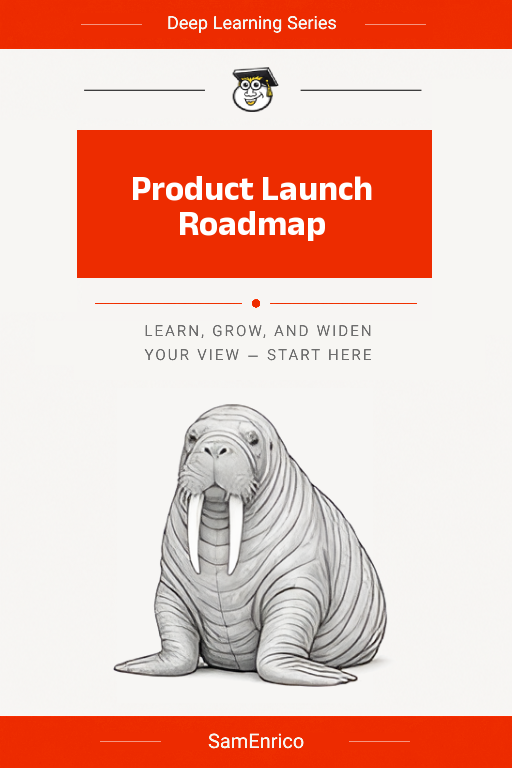
Product Launch Roadmap eBook
Sequence pre-launch, launch, and post-launch tasks
by Bunn Setsuko
Sequence pre-launch, launch, and post-launch tasks for a new product on one timeline.
Formats
Free sample
Chapter 1: The 180-Day Lie--–- Most product launches are dead before they begin. Not because the product is bad, not because the market isn’t ready, and not because the team lacked talent. The death happens quietly, months before the keynote, in a thousand small decisions that all point to the same flawed assumption: that launch is a day.This chapter dismantles that assumption. It reveals why 30–40% of rigorously researched new products fail, introduces the two archetypal failure modes that plague physical and digital launches, and presents the foundational alternative: the Unified Launch Clock (ULC), a 180-day continuous cycle that replaces the big bang with a process. By the end of this chapter, you will never again ask “When is launch day?” You will ask “Where are we on the clock?”The Graveyard of Good Products Let’s start with a paradox that haunts every product leader’s career.
According to meta-analyses of new product introductions across consumer packaged goods, software, durable goods, and B2B services, between 30% and 40% of new products fail within 18 months of launch. That is not a niche problem. That is an industrial-scale waste of talent, capital, and hope.The standard explanation points to product quality. “It wasn’t good enough,” goes the post-mortem. Or: “The timing was off.” Or the favorite: “We didn’t have enough marketing budget.” These explanations feel satisfying because they shift blame to a single controllable variable.
But they are almost always wrong.The real culprit is not a variable. It is a structure. Specifically, the structure of the “big bang” launch—a model that treats launch as a single-day event, preceded by buildup and followed by cleanup. This model was invented in an era of annual product cycles, three-martini lunches, and annual sales kickoffs. It survives today by inertia alone.
And it kills good products with mechanical regularity.To understand why, we need to visit two very different failure scenes: a big-box retail store in the American Midwest, and a Saa S dashboard in a venture-backed startup. The details differ. The underlying mechanism is identical.Failure Archetype One: The Shelf of Death Imagine a new consumer product—let’s call it a smart water bottle. It tracks hydration, syncs with an app, glows when you need to drink. The company has done everything right.
Focus groups loved it. Influencer pre-views generated waitlists. A major retailer committed to an endcap display in 500 stores.Launch day arrives. The endcaps are installed. The water bottles are stacked beautifully.
The company’s social media is on fire. But three weeks later, nothing has moved. The endcap is still full. Floor staff don’t know how to demo the bottle. The planogram—the official shelf map—was never shared with store associates.
The bottles arrived three days late and were stored in the back, unopened, until a manager finally noticed. By the time they hit the shelf, the launch buzz had already faded.This is the Shelf of Death. It is not a failure of demand. It is a failure of synchronization. The product was ready.
The marketing was ready. The retailer’s distribution centers were not. The floor staff were not. The planogram was a PDF buried in a corporate email, never translated into action at the store level.The shelf of death is particularly insidious because it produces misleading data. The retailer sees zero sell-through and assumes the product is a dud.
They mark it down at 60 days, then again at 90, then they return the unsold inventory. The manufacturer blames “weak demand” and kills the product line. But demand was never tested. The launch was strangled by operational chaos before the first customer could even try to buy.Failure Archetype Two: The Soft Launch Trap Now consider a very different context: a B2B Saa S startup. The team builds a beautiful product.
They decide to “soft launch” to a small group of beta customers, gather feedback, and then “hard launch” six months later. No press. No paid marketing. Just a few blog posts and a Product Hunt listing.The beta customers like the product but don’t love it. The team iterates.
The soft launch drags on. Three months in, internal momentum is gone. The CEO stops mentioning the product in all-hands. The sales team, never formally trained, falls back to selling the old product. The marketing team shifts budget to other initiatives.
By month six, the “hard launch” is a whimper. The product is quietly deprioritized, then killed, with the official explanation: “Adoption was too low to justify continued investment.”This is the Soft Launch Trap. It is the mirror image of the Shelf of Death. Where the physical product died from too much operational complexity, the Saa S product died from too little marketing oxygen. The team confused “testing” with “committing.” They starved the launch of the very thing a launch needs most: focused, cross-functional energy aimed at a single date on the calendar.The soft launch trap is seductive because it feels responsible.
“We’re testing,” “We’re being agile,” “We don’t want to waste money on marketing before we have product-market fit.” These are rationalizations for what is actually a failure of nerve. A soft launch is not a launch. It is a dress rehearsal that never opens on Broadway.The Common Enemy: The Big Bang Model These two failures seem opposite. One is about too much operational friction. The other is about too little marketing fuel.
But they share a single cause: the big bang model of launch.The big bang model assumes that launch is a discrete event. In this model, you spend months building product, then weeks building marketing assets, then one day you flip a switch. Pre-launch is preparation. Launch day is the main event. Post-launch is maintenance.
The timeline is a line with a single spike.This model is wrong in three fundamental ways.First, it treats synchronization as optional. In the big bang model, each team—R&D, operations, sales, marketing, support—works on its own schedule, converging only on launch day. But convergence without prior coordination is chaos. The Shelf of Death happens because operations and marketing never practiced together. The Soft Launch Trap happens because sales and marketing never aligned on what “launch” even means.Second, it treats post-launch as an afterthought.
In the big bang model, the weeks after launch are for “monitoring” and “optimization.” But the data that matters most—early adoption signals, friction points, channel performance—arrives in the first 30 days. If you treat those days as cleanup rather than as a second launch phase, you will miss the only window to fix what is broken before the market forms a permanent opinion.Third, it treats failure as a binary outcome. You either succeed on launch day or you don’t. But real launches are not binary. They are distributions.
A launch can succeed in one channel and fail in another. It can exceed expectations for the first week and crater in the second. It can generate massive awareness and zero conversion. The big bang model has no room for partial success, which means it has no room for targeted intervention. You either throw more money…
This is the end of the free sample. Get the eBook to keep going. Buy now
About this book
Details
- Author
- Bunn Setsuko
- Publisher
- SamEnrico
- Language
- English
- Genre
- Non-Fiction, Business Brief, Product Launch
- Released
- 2026-06-01
- Pages (approx.)
- 133
- Available as
- eBook, Audiobook

Read better in the ZLOADR app
Your eBooks on your phone or tablet. Sign in with your SamEnrico account and start reading.
More by Bunn Setsuko
 Flow State Measurement GuideBunn Setsuko$11.99
 Trypanophobia Needle FearBunn Setsuko$11.99
 Cloud Watching VisualizationBunn Setsuko$11.99
 Email Header Canva DesignBunn Setsuko$11.99
 The Senior Skin Care GuideBunn Setsuko$11.99
 Remote Technical CommunicationBunn Setsuko$11.99
 Acupuncture for Restless LegsBunn Setsuko$11.99
 Self Hypnosis for Burn PainBunn Setsuko$11.99
 The Shadow of Gold: The 1988 Seoul Olympics and the Doping Scandal That Shook the WorldBunn Setsuko$11.99
 The Seamstress and the Duchess: How a Rebel Designer Crowned a Queen (1950s)Bunn Setsuko$11.99
 Sun Bears: Smallest BearBunn Setsuko$11.99
 A Collector's Handbook to the Wolseley 15Bunn Setsuko$11.99
You may also like
 Persuasive Product Launch PlanFarrar Emogene$11.99
 One Page Product Launch PrimerGuinn Tonda$12.99
 One Page Launch Marketing PrimerBenson Rex$12.99
 Chinese Supplier New Product Introduction GuideEly Riva$12.99
 Product Launches via Pop UpsHickman Rufina$12.99
 Product Launch One Page GuideKitchens Hung$12.99