
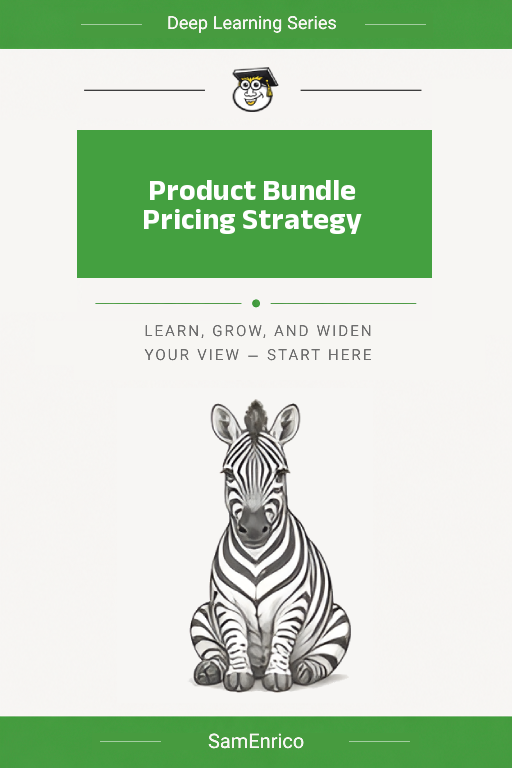
Non-FictionFirst 30 DaysBundling
Product Bundle Pricing Strategy eBook
Bundle products together to increase average order
Bundle products together to increase average order value and reduce item price sensitivity.
Formats
Free sample
Chapter 1: The Linear Pricing Trap--–- It was 3:47 on a Tuesday afternoon when Maria, founder of a modest but growing kitchenware brand, did something she would later call “strategically embarrassing.” She opened her own website as if she were a customer, added a high-quality chef’s knife to her cart, and then—like nearly 70% of her visitors—left without buying. The knife was beautiful. The price was fair. The reviews were glowing. And yet, staring at that single item in an otherwise empty cart, she felt something unexpected: hesitation.
Not because she couldn’t afford it. Not because she didn’t want it. But because buying just one thing felt… incomplete. Or perhaps it felt too complete. Too easy to compare.
Too easy to say “I’ll think about it.”That moment of hesitation is not a flaw in the customer. It is a flaw in the pricing model. Maria, like most business owners, had fallen into what this book calls the Linear Pricing Trap: the default assumption that products should be sold one at a time, at individual prices, and that customers will rationally assemble their own purchases. This assumption is wrong. It is costing you revenue, suppressing your average order value, and training your customers to be price-sensitive comparison shoppers rather than solution-seeking buyers.This chapter dismantles the linear pricing trap entirely.
You will learn why selling items individually invites friction, why too many choices paralyze buyers, and how shifting from a product vendor to a solution provider fundamentally changes the economics of every customer interaction. By the end of this chapter, you will never look at a single-item cart the same way again.The Mathematics of Abandonment Let us begin with a simple exercise. Open your e-commerce analytics dashboard. Look at two numbers: your average order value (AOV) and your average product price. Divide the first by the second.
If the result is less than 1.5, you have a linear pricing problem. That number tells you that most customers buy exactly one thing—and then they leave.Consider three businesses selling in the same home goods category:Business Average Product Price Average Order Value Ratio Diagnosis Store A$45$481.07Severe linear pricing trap Store B$45$671.49Borderline Store C$45$891.98Healthy bundling Store A sells 93% of its orders as single items. Store C sells most orders as 2-3 items. Which business is more profitable? Not necessarily the one with higher traffic or even higher conversion rates.
Store C has the same customer acquisition cost as Store A but nearly double the revenue per order. That means Store C can spend twice as much to acquire a customer and still break even. It can outbid Store A on every ad platform, every keyword, every placement. This is the hidden math of bundling: AOV is a competitive weapon.The linear pricing trap convinces you that your job is to drive traffic and optimize conversion rates. But conversion rate is a limited metric.
A 5% conversion rate on 100AOVproducesthesamerevenueasa2.5100 AOV produces the same revenue as a 2.5% conversion rate on 100AOVproducesthesamerevenueasa2.5200 AOV—but the latter leaves you with half the transaction costs, half the customer service tickets, and twice the room to bid on ads. Bundling does not just increase revenue. It changes the unit economics of your entire business.The Three Frictions of Linear Pricing Why does selling items individually fail? Because each single-item purchase must overcome three distinct psychological frictions that bundling neatly bypasses.Friction One: The Price Veto When a customer looks at a single product, they ask one question: “Is this worth that?” That question invites direct comparison. They will pull up Amazon.
They will check a competitor. They will remember seeing something similar at a lower price six months ago. The single-item price stands alone, naked and defenseless, inviting scrutiny.A bundle, by contrast, asks a different question: “Is this collection of items worth this total price?” That question is harder to answer. There is no direct competitor selling the exact same bundle. The components can be weighted against each other.
A slightly overpriced item can be carried by a slightly underpriced item. The customer stops comparing and starts evaluating—and evaluation favors the seller who has curated the solution.Friction Two: The Shipping Threshold Nearly every e-commerce operator has experienced the customer who adds 48worthofproductstotheircart,seesthatfreeshippingstartsat48 worth of products to their cart, sees that free shipping starts at 48worthofproductstotheircart,seesthatfreeshippingstartsat50, and then… leaves. Or adds a $2 filler item they don’t really want. Or abandons entirely. The shipping threshold is a tax on linear pricing.
It forces customers to do math they hate doing.Bundles eliminate this friction by absorbing the math. A 79bundlethatincludes79 bundle that includes 79bundlethatincludes72 worth of products and $7 of perceived shipping value feels like a deal. The customer never calculates the gap to free shipping because the bundle price already exceeds it. The friction disappears into the bundle’s architecture.Friction Three: The Choice Paradox The Jam Study, conducted by psychologists Sheena Iyengar and Mark Lepper in 2000, remains one of the most replicated findings in consumer behavior. Shoppers at an upscale grocery store were offered samples of jam.
One group saw 24 varieties. Another saw 6. The 24-variety booth attracted more attention—60% of shoppers stopped to look. But only 3% bought. The 6-variety booth attracted fewer initial looks—40% stopped—but 30% bought.
More choice led to more attention but dramatically less action.Linear pricing multiplies choice. Every product you sell is a decision point. Every variant, size, and color adds another layer of cognitive load. The customer does not experience your catalog as a helpful selection. They experience it as a test—and many will answer by walking away.Bundling reduces choice without reducing value.
Instead of presenting 24 individual items, you present 3-4 carefully constructed bundles. The customer still has access to the full catalog, but the default path is curated. You have done the work of combination so they do not have to.Transaction Utility vs. Acquisition Utility To understand why bundling works, you must understand a distinction introduced by behavioral economist Richard Thaler: transaction utility and acquisition utility.Acquisition utility is the value the customer derives from the product itself. Does the knife cut well?
Is the coffee hot? Does the software work? This is the functional, utilitarian assessment of the thing purchased.Transaction utility is the pleasure the customer derives from the deal itself. Did they get a good price? Did they beat the system?
Did they outsmart the seller? This is the emotional, comparative assessment of the purchase as a transaction.Here is the critical insight: linear pricing maximizes acquisition utility but minimizes transaction utility. The customer gets the product they want, but the deal is transparent and easily compared. Bundling flips this equation. By combining products, you obscure the exact value of each component.
The customer cannot easily calculate whether they “won” on every item. Instead, they evaluate the bundle as a whole—and the mere fact that it contains multiple items creates the illusion of a better deal.Consider two offers:Offer A (Linear): A chef’s knife for $89.Offer B (Bundle): A chef’s knife, a magnetic strip, and a blade guard for $99.The knife alone is 89.Thebundleadds89. The bundle adds 89.Thebundleadds10 for two accessories that would cost…
This is the end of the free sample. Get the eBook to keep going. Buy now
About this book
Details
- Author
- Benjamin Shantae
- Publisher
- SamEnrico
- Language
- English
- Genre
- Non-Fiction, First 30 Days, Bundling
- Released
- 2026-06-01
- Pages (approx.)
- 143
- Available as
- eBook, Audiobook

Read better in the ZLOADR app
Your eBooks on your phone or tablet. Sign in with your SamEnrico account and start reading.
More by Benjamin Shantae
 Diplomat International CrisisBenjamin Shantae$11.99
 Self Hypnosis for Fear of TunnelsBenjamin Shantae$11.99
 Laura Benanti Soprano ComedienneBenjamin Shantae$11.99
 Microbiome Mood LinkBenjamin Shantae$11.99
 The Pregnant Choking GuideBenjamin Shantae$11.99
 African Year of 1960Benjamin Shantae$11.99
 Sober Parenting GuideBenjamin Shantae$11.99
 Child Death Certificate ChallengesBenjamin Shantae$11.99
 Bruce Lee: The Little Dragon's Global Revolution (1950-1973)Benjamin Shantae$11.99
 Raphael's Transfiguration: The Last Masterpiece of the RenaissanceBenjamin Shantae$11.99
 Polish Lowland Sheepdog: Herding BreedBenjamin Shantae$11.99
 How to Start a Combing Leather Business (Beginners Guide)Benjamin Shantae$11.99
You may also like
 Hong Kong Handover 1997Dunn Johnnie$11.99
 Zumba For Postnatal Recovery CourseNeal Christian$11.99
 Zumba for BeginnersLadner Nikia$11.99
 YouTube Comment Mining GuideHumes Pandora$12.99
 Worry Box MeditationCarlin Rudy$11.99
 Workplace Stress MeditationNguyen Lynn$11.99
 Workplace Stress and Sleep RepairHawley Ivory$11.99
 Workplace Perfectionism CureDelaney Jeffry$11.99
 Workplace Injustice Anger GuideWallen Isabelle$11.99
 Work Addiction and Burnout LinkGreenwood Ester$11.99
 Women in Yoga and WellnessBeattie Galina$11.99
 Women in Stand Up ComedyChun Evangeline$11.99