
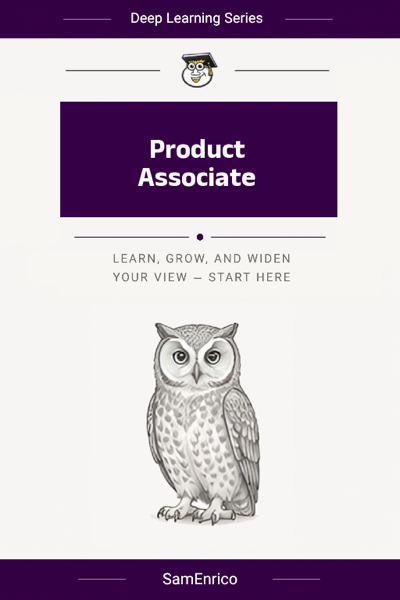
Non-FictionInformativeEducational
Product Associate eBook
A Coursebook on Product Associate
A Coursebook on Product Associate
Formats
Free sample
Chapter 1: The Output Trap--–- Sarah had just finished her third Jira ticket of the morning when her manager appeared at her desk. "Great work shipping the dark mode toggle," he said. "The stakeholders are thrilled. What's next on the roadmap?" Sarah felt a warm flush of pride. She had written the requirements, coordinated with design, shepherded the ticket through two sprints, and validated the implementation.
Dark mode was live. She had done her job.Two weeks later, product analytics showed that exactly 0.3% of users had enabled dark mode. Not three percent. Zero point three percent. The engineering team had spent eight days building a feature that almost no one wanted.
Sarah's pride curdled into confusion. She had followed every step of the product development process. She had written clear tickets, attended every standup, and launched on time. Why had it failed?This chapter is about answering that question before you write the first ticket. It is about the single most important distinction in product management: the difference between what you ship and what actually changes.The Features Factory vs.
The Outcomes Lab Every product team falls into one of two categories, whether they realize it or not. The first is the features factory. In a features factory, success is measured by output: how many tickets were closed, how many sprints were completed, how many features were shipped. The team celebrates launch days. The roadmap is a list of deliverables with dates attached.
When a stakeholder asks "What did you ship this quarter?" the team proudly lists five, eight, or twelve new capabilities.The second category is the outcomes lab. In an outcomes lab, success is measured by changes in user behavior. The team might ship only two things in a quarter, but each one moves a key metric: checkout completion up fifteen percent, support tickets down twenty percent, seven-day retention from thirty to forty percent. When a stakeholder asks "What did you ship?" the team answers with what changed.Here is the uncomfortable truth that most junior product associates learn the hard way: stakeholders almost always ask for outputs. They will request a banner, a button, a dashboard, a report, an integration, a notification.
These are tangible. They feel like progress. But a requested output is almost never the actual goal. The goal is hidden beneath the request, buried under assumptions about what will happen after the button is built.Sarah's dark mode toggle is a perfect example. The stakeholder requested "dark mode" because they assumed it would improve user satisfaction and retention.
But no one had tested whether users actually wanted dark mode, or whether it would change any behavior. The team shipped an output and got no outcome.Outputs and Outcomes: A Practical Framework Let us define these terms precisely, because precision is what separates effective product associates from order takers.An output is anything your team builds, ships, or delivers. Outputs are countable. They include:A new button or UI element An API endpoint A notification or email A report or dashboard A configuration change A database migration A redesign of an existing page Outputs are not bad. You cannot achieve outcomes without outputs.
But outputs are worthless unless they produce outcomes.An outcome is a measurable change in user behavior that creates business value. Outcomes are directional. They include:Checkout completion rate increased from 65% to 78%Average time to first successful search decreased from 45 seconds to 22 seconds Support tickets about password resets decreased by 40%Seven-day retention increased from 30% to 45%Referral rate from existing users doubled Notice the pattern. Outcomes are always measurable. They always have a baseline and a target.
They always describe what users do differently, not what the team built.The most dangerous situation for a product associate is when a request arrives that sounds like an output but is disguised as an outcome. "We need to increase engagement" is not an outcome; it is a vague aspiration. "We need a push notification system" is an output. The outcome might be "increase seven-day retention from 30% to 40% by reminding users to return." The push notification system is one possible solution, but it is not the only one.The Build Trap: Why Smart Teams Ship Useless Features The build trap is a specific pattern of failure that claims otherwise competent product teams. It was first described by Melissa Perri in her book Escaping the Build Trap, and it works like this:A team measures its success by how much it builds.
Building feels productive. Stakeholders request features. The team delivers. Everyone is happy. But because the team never measures outcomes, no one notices that the features are not actually moving business metrics.
Over time, the product becomes bloated with unused or underused capabilities. The engineering team spends most of its time maintaining features that add no value. And the company wonders why its product is not growing.The build trap is seductive because it rewards visible activity. Launching a feature is visible. Closing a ticket is visible.
Demoing a new capability at a quarterly review is visible. Improving retention by five percentage points is invisible until you look at the analytics dashboard, and even then, it is just a number.Associates are especially vulnerable to the build trap because they are often evaluated on execution speed. "Sarah shipped twelve features last quarter" sounds better than "Sarah shipped two features but increased retention by ten percent," especially to managers who do not understand product management. This is why you must learn to advocate for outcomes before you have authority. You must become the person who asks "Why?" before anyone writes a ticket.The Before/After Map: A Tool for Every Request Here is a practical tool you can use today, on your current project, without anyone's permission.
It is called the Before/After Map, and it takes less than five minutes.For any feature request, write two short paragraphs.Before: What is the user doing right now? What is the struggle, friction, or workaround? Be specific. Do not use vague words like "bad experience" or "hard to use." Describe actual behavior.After: What will the user do differently after your feature is built? How will their behavior change?
Again, be specific. "They will click faster" is not specific. "The average time from landing page to checkout will decrease from 120 seconds to 90 seconds" is specific.If you cannot write a specific Before and After paragraph for a request, you do not understand the request well enough to build it. Stop. Go talk to users.
Understand the before state. Only then should you consider building anything.Let us apply the Before/After Map to Sarah's dark mode toggle.Before: Users read content on the app. Some users, particularly those with light sensitivity or who use the app at night, experience eye strain. Their workaround is to reduce screen brightness manually or use their device's system-wide dark mode, which does not perfectly apply to the app's custom UI elements. We have no data on how many users actually experience this problem or how often.After: Users who prefer dark mode enable the toggle once.
Their eye strain is reduced. We hypothesize this will increase session duration and retention among this subset of users, but…
This is the end of the free sample. Get the eBook to keep going. Buy now
About this book
Details
- Author
- Scruggs Catharine
- Publisher
- SamEnrico
- Language
- English
- Genre
- Non-Fiction, Informative, Educational
- Released
- 2026-06-03
- Pages (approx.)
- 148
- Available as
- eBook, Audiobook

Read better in the ZLOADR app
Your eBooks on your phone or tablet. Sign in with your SamEnrico account and start reading.
More by Scruggs Catharine
 Self Taught DBT GuideScruggs Catharine$11.99
 The Listening Spouse Infidelity RecoveryScruggs Catharine$11.99
 The IBS Travel GuideScruggs Catharine$11.99
 The Enrico Fermi NuclearScruggs Catharine$11.99
 Quick Calm for Frazzled ParentsScruggs Catharine$11.99
 The Poisoned Perfume: The Enigma of Styliana TsiknakisScruggs Catharine$11.99
 West African Export SettlementScruggs Catharine$12.99
 ARIPO Success TipsScruggs Catharine$12.99
 Understanding Thiolase DeficiencyScruggs Catharine$17.99
 How to Become a Plate Assembler - Small BatteryScruggs Catharine$11.99
You may also like
 Hong Kong Handover 1997Dunn Johnnie$11.99
 Zumba For Postnatal Recovery CourseNeal Christian$11.99
 Zumba for BeginnersLadner Nikia$11.99
 YouTube Comment Mining GuideHumes Pandora$12.99
 Worry Box MeditationCarlin Rudy$11.99
 Workplace Stress MeditationNguyen Lynn$11.99
 Workplace Stress and Sleep RepairHawley Ivory$11.99
 Workplace Perfectionism CureDelaney Jeffry$11.99
 Workplace Injustice Anger GuideWallen Isabelle$11.99
 Work Addiction and Burnout LinkGreenwood Ester$11.99
 Women in Yoga and WellnessBeattie Galina$11.99
 Women in Stand Up ComedyChun Evangeline$11.99