
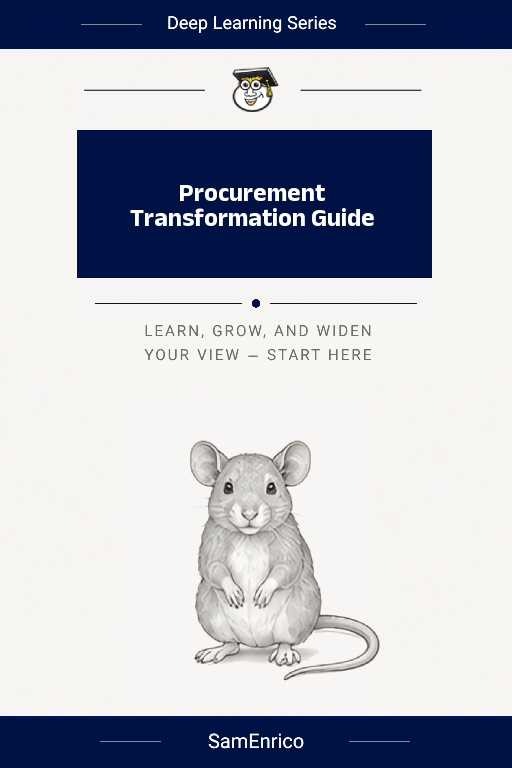
Non-FictionOperational Efficiency ManualTransformation
Procurement Transformation Guide eBook
Transform reactive procurement to strategic value
by Rico Toya
Transform reactive procurement to strategic value driver through process and technology changes.
Formats
Free sample
Chapter 1: The $11 Trillion Blind Spot--–- Jack Reynolds had been the Chief Procurement Officer at Apex Industries for eleven years. He had survived three recessions, two mergers, and one very awkward holiday party. But nothing—absolutely nothing—prepared him for the text message that arrived at 2:17 AM on a Tuesday morning in March.The message was from his head of supply chain risk: "Core supplier Tri State Components just filed Chapter 11. Effective immediately. No warning.
No inventory. Production stops in 72 hours."Jack sat up in bed, his heart hammering against his ribs. Tri State was the sole source for a specialized actuator used in Apex's highest-margin product line—the line that generated $400 million in annual revenue. There was no second source qualified. There was no safety stock beyond two weeks.
And there was no plan.Over the next seventy-two hours, Jack would learn three painful lessons. First, his team had no visibility into Tri State's deteriorating financial health, even though public data had signaled trouble for months. Second, qualifying a new supplier would take six months—far too late to prevent a production shutdown. Third, the cost of this single disruption would ultimately exceed $200 million in lost revenue, customer penalties, and expediting fees.The board meeting that followed was brutal. The CEO didn't yell.
She didn't have to. She simply asked, "Jack, what does procurement actually do here? Because from where I'm sitting, you processed purchase orders while our supply chain burned."Jack didn't have a good answer. And that is why you are reading this book.The Wake-Up Call That Most Leaders Never Hear Jack's story is not an outlier. It is the new normal.
In the past five years, supply chain disruptions have become more frequent, more severe, and more costly than at any point in modern business history. A global pandemic. A ship blocking the Suez Canal. Trade wars between the world's largest economies. Cyberattacks on critical suppliers.
Climate events shutting down factories and ports. The list goes on.And yet, despite these high-profile catastrophes, most organizations continue to treat procurement as a back-office cost center—a function that exists to negotiate prices and process purchase orders. This misperception is not just outdated. It is a direct liability that puts entire enterprises at risk.Here is the truth that this book will prove across twelve chapters: Procurement is the largest, most ignored strategic lever in every organization. It controls or influences 50-80% of most companies' total spend.
It sits at the intersection of every supplier relationship, every material cost, every logistics decision, and every ESG commitment. And when procurement is transformed from a reactive order-taker to a strategic value driver, the impact is staggering—lower costs, higher resilience, faster innovation, and measurable progress on sustainability.But here is the harder truth: Most procurement functions are failing. They are trapped in what this book calls the "white space"—the gap between what procurement does (process transactions) and what the business actually needs (strategic insights, risk intelligence, and value creation). This gap is not a failure of individual effort. It is a failure of design, of metrics, and of leadership.The $11 Trillion Number—And Why It Matters to You Let's put a number on the problem.
According to Mc Kinsey & Company's analysis of global supply chains, the average Fortune 500 company leaves approximately 1.2billiononthetableannuallythroughpoorprocurementpractices.Extrapolatedacrosstheglobaleconomy,thetotalvalueatstakeisroughly1.2 billion on the table annually through poor procurement practices. Extrapolated across the global economy, the total value at stake is roughly 1.2billiononthetableannuallythroughpoorprocurementpractices.Extrapolatedacrosstheglobaleconomy,thetotalvalueatstakeisroughly11 trillion in wasted potential—money spent on the wrong suppliers, at the wrong prices, with the wrong terms, often for products and services that don't deliver their promised value.That is not a typo. Eleven trillion dollars. More than the GDP of Japan and Germany combined.This waste takes many forms. It is the maverick spend that bypasses negotiated contracts, paying 15-30% more than necessary.
It is the total cost of ownership blind spot, where a low purchase price conceals high logistics, maintenance, and quality failure costs. It is the innovation left on the table because procurement optimized for savings instead of supplier collaboration. It is the resilience gap, where a cheaper single source becomes an expensive disruption. It is the ESG failure, where supply chain emissions and labor violations create regulatory and reputational risk.This book will show you how to capture your share of that $11 trillion. But first, you need to understand why traditional procurement is so fundamentally broken.The Archetype of the "Old Procurement"—And Why It's a Liability To understand where procurement needs to go, you must first understand where it has been.
For most of its history, procurement has operated under a set of assumptions that were once reasonable but are now actively dangerous.Assumption 1: Procurement's primary job is cost savings. This assumption treats every purchase as a zero-sum transaction where the buyer's gain is the supplier's loss. The result is a relentless focus on unit price, often at the expense of quality, delivery, innovation, and relationship health. Procurement professionals are incentivized to squeeze suppliers, switch providers for marginal savings, and celebrate every percentage point of price reduction—even when those "savings" are eaten by higher downstream costs.Assumption 2: Suppliers are interchangeable commodities. This assumption treats suppliers as vendors rather than partners.
It assumes that any supplier meeting basic specifications is essentially the same, so the only relevant differentiator is price. This assumption ignores the reality that deep supplier relationships yield innovation, preferential treatment during shortages, and co-investment in new capabilities.Assumption 3: Procurement's value is measured in transactions completed. This assumption celebrates purchase order volume, invoice accuracy, and cycle time reduction. These metrics are not inherently bad, but they are table stakes—the minimum required to function. When they become the primary measures of success, procurement becomes a processing factory rather than a strategic function.Assumption 4: Relationships with internal stakeholders are nice but secondary.
This assumption treats internal stakeholders (engineering, operations, sales, finance) as customers to be served rather than partners to be aligned. The result is procurement policies designed for procurement's convenience—long approval cycles, rigid supplier lists, and a default posture of "no" rather than "how can we make this work?"These four assumptions have created a procurement archetype that is reactive, transactional, and narrowly focused. This archetype worked reasonably well in an era of stable supply chains, abundant capacity, and low geopolitical risk. That era is over.The Cost of Reactivity: Maverick Spend, Firefighting, and Lost Opportunity When procurement is reactive, the costs are not theoretical. They show up every day on your income statement, your balance sheet, and your operational metrics.Maverick Spend: This is the term for purchasing that happens outside approved contracts and processes.
It includes an engineer buying components on a corporate credit card at retail prices. A plant manager ordering from a non-contracted supplier because the approved supplier is slow. A marketing director hiring a freelance agency without a purchase order. The cost of maverick spend is staggering—typically 15-30% above contracted prices, plus lost volume leverage, plus compliance and audit risk. Most organizations have maverick spend rates of 20-40% of total addressable spend.
That is not a leak. It is a flood.Duplicated Efforts: In a reactive procurement organization, the same work gets done…
This is the end of the free sample. Get the eBook to keep going. Buy now
About this book
Details
- Author
- Rico Toya
- Publisher
- SamEnrico
- Language
- English
- Genre
- Non-Fiction, Operational Efficiency Manual, Transformation
- Released
- 2026-06-01
- Pages (approx.)
- 134
- Available as
- eBook, Audiobook

Read better in the ZLOADR app
Your eBooks on your phone or tablet. Sign in with your SamEnrico account and start reading.
More by Rico Toya
 Pre Shot Routine HypnosisRico Toya$11.99
 Neuroplasticity Pain RetrainingRico Toya$11.99
 Buying Retirement Home RemotelyRico Toya$11.99
 The Accountant NetworkRico Toya$11.99
 Self Esteem and Chronic IllnessRico Toya$11.99
 The Silk and the Sickle: Ibn Battuta’s Lost Amazon ExpeditionRico Toya$11.99
 The Enigma of the Rosetta Stone: Decoding Ancient SecretsRico Toya$11.99
 Understanding Eye Defects Arachnodactyly CardiopathyRico Toya$17.99
 Writing Executive Summaries for HR and Talent PlansRico Toya$12.99
 OSP Construction ManagerRico Toya$11.99
 How to Become a Mold-filling OperatorRico Toya$11.99
You may also like
 Hong Kong Handover 1997Dunn Johnnie$11.99
 Zumba For Postnatal Recovery CourseNeal Christian$11.99
 Zumba for BeginnersLadner Nikia$11.99
 YouTube Comment Mining GuideHumes Pandora$12.99
 Worry Box MeditationCarlin Rudy$11.99
 Workplace Stress MeditationNguyen Lynn$11.99
 Workplace Stress and Sleep RepairHawley Ivory$11.99
 Workplace Perfectionism CureDelaney Jeffry$11.99
 Workplace Injustice Anger GuideWallen Isabelle$11.99
 Work Addiction and Burnout LinkGreenwood Ester$11.99
 Women in Yoga and WellnessBeattie Galina$11.99
 Women in Stand Up ComedyChun Evangeline$11.99