
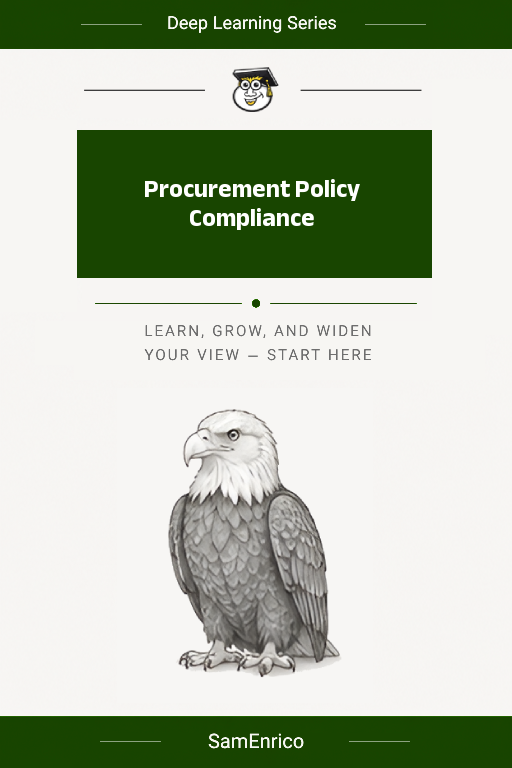
Non-FictionOperational Efficiency ManualCompliance
Procurement Policy Compliance eBook
Enforce purchasing policies through system control
Enforce purchasing policies through system controls and approval workflows in source-to-pay.
Formats
Free sample
Chapter 1: The Million-Dollar Email--It was a Tuesday afternoon when Sarah Chen, the newly appointed Chief Procurement Officer of a $2.4 billion manufacturing firm, discovered the email. Not because she was looking for it—she was reviewing quarterly financials—but because a junior accountant had flagged a discrepancy that turned into an anomaly that became a crisis.The email was brief, unremarkable, and had been sent eighteen months earlier from a regional plant manager to a supplier representative. It read: "Hey Tom, we need those filtration units ASAP. Just send the invoice to me directly and I'll handle it. Same pricing as before, just don't want to wait for the PO process."That single email bypassed every procurement control the company had.
No competitive bidding. No contract review. No price verification. No three-way match. Over the next eighteen months, that plant manager processed $4.7 million in purchases through what he called his "fast track"—a system of email requests, direct supplier billing, and after-the-fact expense reports that finance approved because, well, they always had.The kicker?
The supplier had increased prices three times during that period. Without a PO or contract locking in rates, the company overpaid by approximately $1.2 million. The plant manager wasn't stealing—he was just trying to keep the生产线 running. But his efficiency was costing the company millions.Sarah called a meeting. She asked a simple question: "How many other 'fast tracks' exist in this company?"No one could answer.The Silent Drain: Understanding Maverick Spend Every procurement leader has a version of Sarah's story.
The details change—the industry, the dollar amount, the offending department—but the pattern is universal. Organizations bleed value through purchasing that happens outside approved channels, and most don't even know it's happening until something breaks.This chapter dismantles the comfortable illusion that a well-written policy document stored on a shared drive ensures compliance. It quantifies the true cost of what procurement professionals call "maverick spend"—purchases made outside approved contracts, channels, and workflows. More importantly, it introduces the foundational shift that will carry through this entire book: moving from policing compliance (catching violations after they happen) to engineering compliance (designing systems where following the rules is easier than breaking them).What Is Maverick Spend, Really?Let's start with a precise definition because confusion about terms has paralyzed more compliance efforts than any technical limitation.Maverick spend refers to any purchase that deviates from established procurement policies, contracts, or systems. It includes purchases made without a purchase order, purchases made from non-preferred suppliers despite existing contracts, purchases that bypass competitive bidding requirements, and purchases that route around approval workflows.But this definition misses the human reality.
Maverick spend isn't malicious. Most of it comes from well-intentioned people trying to do their jobs faster. The plant manager in Sarah's company wasn't defrauding anyone. He was solving a problem: the official procurement process took seven days; he needed parts in two. So he built his own solution.
That solution happened to cost the company $1.2 million.The actual cost of maverick spend typically represents 5% to 15% of total organizational spend, according to research from leading procurement advisory firms. But that percentage tells only part of the story. The hidden cost premium on maverick purchases—the difference between what the organization paid and what it would have paid through approved channels—ranges from 20% to 40% or more.Let me repeat that for emphasis: For every dollar spent outside approved procurement channels, organizations overpay by twenty to forty cents on average.In a company with 100millioninannualspend,with10100 million in annual spend, with 10% maverick spend (100millioninannualspend,with1010 million), the annual leakage is 2to2 to 2to4 million. Every year. Without a single person committing fraud.The Iceberg Illusion Here's why maverick spend is so dangerous: what you see is not what you get.The "iceberg illusion" describes the phenomenon where visible compliance failures—a single large unauthorized purchase order, a contract signed by someone without authority, a supplier invoice that doesn't match a PO—are dwarfed by invisible ones.
Above the waterline, you might see one $500,000 PO that was routed around approvals. Below the waterline, you miss hundreds of small off-catalog purchases, dozens of subscription renewals no one remembers signing up for, and countless "urgent" buys that bypass competitive bidding.Consider the data. In a typical mid-sized organization with 500 employees who have procurement authority, studies show that approximately 40% of maverick transactions are for amounts under $500. Each one seems insignificant. Each one requires almost no effort to approve or process.
But together, they represent millions in leakage.The iceberg illusion creates a dangerous psychological trap. When leaders don't see the problem, they assume the problem doesn't exist. Sarah's predecessor at the manufacturing firm had no idea about the $4.7 million in email-based purchasing because finance had coded every expense to the plant's operating budget. The numbers looked fine. The plant hit its production targets.
No one asked how.Shadow Spend vs. Rogue Spend: A Critical Distinction Before we go further, we need to clarify two terms that are often confused but mean very different things.Shadow spend refers to purchasing that happens outside formal procurement systems but without malicious intent. The plant manager emailing a supplier directly. A department head buying software with a corporate credit card because IT procurement takes too long. A researcher ordering lab supplies from a catalog because the preferred supplier doesn't stock the specific item needed.
Shadow spend is typically driven by process friction, urgency, or ignorance. It is the largest category of maverick spend, representing perhaps 70-80% of all off-channel purchasing.Rogue spend refers to deliberate policy violations, often with an element of concealment or personal gain. The buyer who categorizes laptops as "office supplies" to avoid IT asset controls. The manager who splits a large purchase into multiple smaller ones to stay under approval thresholds. The employee who establishes a shell supplier and processes fake invoices.
Rogue spend is less common—perhaps 5-10% of maverick transactions—but carries disproportionate risk.This book addresses both, but the solutions differ. Shadow spend requires better system design—making the right path the easy path. Rogue spend requires segregation of duties, audit trails, and anomaly detection. You cannot solve a rogue problem with shadow solutions, and you cannot solve a shadow problem by assuming bad intent.Chapter 9 will return to rogue spend in depth, exploring how AI and anomaly detection catch deliberate violations that rules miss. For now, understand that most of what looks like rogue behavior is actually shadow behavior driven by poor system design.
And poor system design is fixable.Why "Just Enforce the Policy" Doesn't Work Every organization has a policy document. Most have several. They typically run twenty to fifty pages, cover approval authorities, preferred suppliers, competitive bidding requirements, and ethical standards. They are reviewed annually, updated occasionally, and signed by everyone who matters.They are also largely ignored.Not because people are bad. Because policies create friction, and humans are wired to avoid friction.
When a plant manager needs a part in two days and the policy says "submit a requisition for approval by three different people over seven days," the plant manager will find another way. Every time. The policy didn't fail because it was wrong. It…
This is the end of the free sample. Get the eBook to keep going. Buy now
About this book
Details
- Author
- Hardesty Belia
- Publisher
- SamEnrico
- Language
- English
- Genre
- Non-Fiction, Operational Efficiency Manual, Compliance
- Released
- 2026-05-29
- Pages (approx.)
- 143
- Available as
- eBook, Audiobook

Read better in the ZLOADR app
Your eBooks on your phone or tablet. Sign in with your SamEnrico account and start reading.
More by Hardesty Belia
 Shift Work Disability Claim GuideHardesty Belia$11.99
 Peg System for Memorizing Flight NumbersHardesty Belia$11.99
 Home Equity Conversion TacticsHardesty Belia$11.99
 Body Image for Cerebral Palsy CourseHardesty Belia$11.99
 The Freelance NetworkerHardesty Belia$11.99
 The Silent Storm: The Untold Story of the 1915 Gallipoli TunnellersHardesty Belia$11.99
 The Alchemists of Mesopotamia: Birth of Industrial Chemistry in the Fertile CrescentHardesty Belia$11.99
 Understanding Experimental Allergic EncephalomyelitisHardesty Belia$17.99
 Onsite ManagerHardesty Belia$11.99
 Executive Summary Frameworks for Strategy DocumentsHardesty Belia$12.99
 How to Become a Monument SetterHardesty Belia$11.99
You may also like
 Hong Kong Handover 1997Dunn Johnnie$11.99
 Zumba For Postnatal Recovery CourseNeal Christian$11.99
 Zumba for BeginnersLadner Nikia$11.99
 YouTube Comment Mining GuideHumes Pandora$12.99
 Worry Box MeditationCarlin Rudy$11.99
 Workplace Stress MeditationNguyen Lynn$11.99
 Workplace Stress and Sleep RepairHawley Ivory$11.99
 Workplace Perfectionism CureDelaney Jeffry$11.99
 Workplace Injustice Anger GuideWallen Isabelle$11.99
 Work Addiction and Burnout LinkGreenwood Ester$11.99
 Women in Yoga and WellnessBeattie Galina$11.99
 Women in Stand Up ComedyChun Evangeline$11.99