
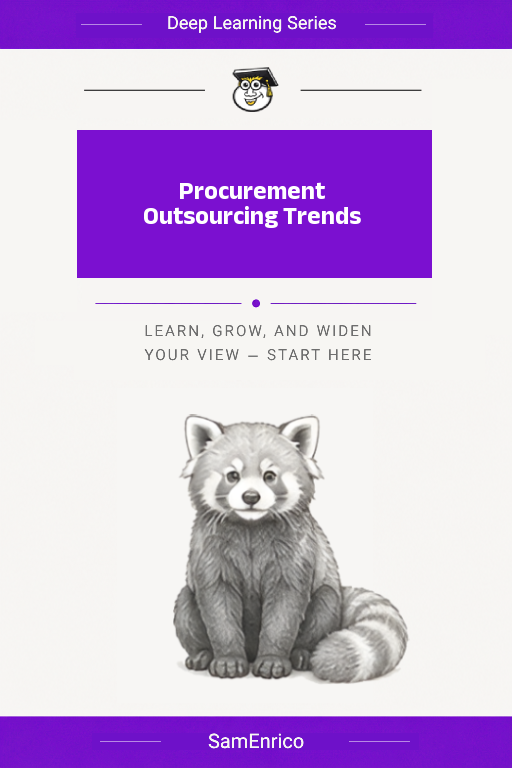
Non-FictionForecast & OutlookProcurement BPO
Procurement Outsourcing Trends eBook
Project third-party procurement services adoption,
by Duval Richie
Project third-party procurement services adoption, category management outsourcing, and strategic consulting.
Formats
Free sample
Chapter 1: The Value Mandate--–- In a windowless conference room on the forty-seventh floor of a Manhattan office tower, a chief procurement officer named Sarah was about to lose her job. Not because she had failed to save money—she had delivered 12% year-over-year cost reductions for three consecutive years, a feat her predecessor had called impossible. She was about to be fired because the CEO had finally asked the right question: “Sarah, you’ve saved us millions. So why does every business unit still hate procurement? And why did we just lose a major customer because we couldn’t deliver raw materials on time?”The room fell silent.
Sarah had no answer. She had done everything right according to the old playbook. She had consolidated suppliers. She had driven hard negotiations. She had moved transactional buying to a low-cost offshore center, cutting labor costs by 22%.
By every traditional metric, she was a star. But the CEO’s question exposed the uncomfortable truth that was dawning across corporate America: cost reduction was no longer enough. The world had changed, and procurement had not changed with it.Three months later, Sarah’s counterpart at a competitor—a company that had embraced a radically different approach to procurement—stood before her own board and presented a very different picture. Her team had not cut costs by 12%. They had cut costs by 8%, which was, on its face, worse.
But they had also reduced supply chain disruptions by 67%. They had cut procurement cycle time from forty-five days to twelve. And they had done it all with a team that was half the size of Sarah’s. The difference? Sarah had been trying to build a better internal procurement function.
Her competitor had learned how to orchestrate an ecosystem of external specialists.This is the story of the great shift in procurement outsourcing. It is not a story about moving jobs to India or the Philippines. It is a story about moving from a labor-arbitrage mindset to a value-creation mindset. And it is the story of how the most successful procurement leaders of the next decade will stop asking “How much can we save?” and start asking “What strategic capability can we unlock?”The Death of Lift and Shift For nearly three decades, procurement outsourcing followed a predictable pattern. A company would identify a set of transactional, repetitive tasks—purchase order creation, invoice matching, supplier master data maintenance, low-value RFQs—and contract them to a third-party provider with operations in a lower-cost geography.
The math was simple and compelling. An internal buyer in the United States or Western Europe cost the company 80,000to80,000 to 80,000to120,000 per year in salary, benefits, and overhead. The same role performed by an outsourced provider in India, the Philippines, or Eastern Europe cost 25,000to25,000 to 25,000to35,000. Multiply that by a hundred buyers, and the savings ran into the millions. This was the “lift and shift” model, and for a long time, it worked.But somewhere around 2018, the returns began to diminish.
The low-hanging fruit had been picked. The tasks that could be easily moved had been moved. What remained were the more complex, judgment-intensive activities that required category expertise, supplier relationship management, and strategic thinking. And here, lift and shift was failing.The evidence was everywhere. A 2022 study by the International Association for Contract and Commercial Management found that companies using traditional procurement outsourcing achieved average savings of only 6% in years three through five of their contracts, down from 15% in years one and two.
The same study found that customer satisfaction with outsourced procurement services dropped from 78% at contract signing to 42% after twenty-four months. Why? Because the providers had delivered on their promise of cheaper labor, but they had not delivered on the unspoken promise of better procurement. The internal stakeholders—the engineering managers, the marketing directors, the plant supervisors who actually used procurement services—were not happy. They found the outsourced team slow, unresponsive, and ignorant of their specific needs.
They began bypassing the system altogether, engaging in what industry insiders call “maverick spend.” And maverick spend is the silent killer of procurement value.A typical Fortune 500 company leaks between 5% and 15% of its addressable spend through off-contract purchasing. Employees who are frustrated with the official procurement process simply go around it. They use corporate credit cards. They open new supplier accounts without approval. They sign contracts that no one in procurement ever sees.
A 2023 report from GEP estimated that the average large enterprise loses $47 million annually to maverick spend—money that is not captured in any savings report, because it was never even in the system to begin with. The traditional lift-and-shift model, by making procurement more cumbersome and remote, actually exacerbated maverick spending. The cure became worse than the disease.Enter BPaa S: Business Process as a Service The limitations of lift and shift gave rise to a new model: Business Process as a Service, or BPaa S. The distinction is subtle but profound. Under traditional BPO, the provider agreed to perform a set of activities for a fixed fee per full-time equivalent.
Under BPaa S, the provider agrees to deliver a set of outcomes for a variable fee tied to those outcomes. The shift is from counting hours to delivering results.Consider the difference in practice. Under the old model, a procurement provider might be paid $50,000 per month to staff a team of ten buyers. Those buyers would process a certain number of purchase orders, run a certain number of RFQs, and manage a certain number of supplier records. But there was no guarantee that these activities actually produced value.
The provider could do everything right according to the contract and still deliver no savings, no cycle time reduction, and no improvement in compliance. Under BPaa S, by contrast, the provider is paid based on what it achieves. Maybe the fee is a percentage of savings delivered. Maybe it is a fixed fee per compliant transaction. Maybe it is a subscription fee that scales with the volume of spend under management.
The key is that the provider’s compensation is aligned with the client’s outcomes.The results speak for themselves. A 2024 study by ISG (Information Services Group) compared traditional BPO engagements with BPaa S engagements across three hundred companies. The BPaa S engagements delivered 34% higher net savings, 52% faster cycle times, and 28% higher stakeholder satisfaction. And importantly, they saw 41% less maverick spending, because the outsourced team was not seen as a distant, unresponsive back office but as a partner focused on making procurement easier for internal users.One manufacturing company in the study had outsourced its entire indirect procurement function under a BPaa S model. The provider was responsible for achieving 92% compliance on tail spend, a 12-day average cycle time for non-strategic purchases, and a minimum of 8% year-over-year savings on addressable spend.
If the provider exceeded these targets, it shared in the upside. If it missed them, its fee was reduced. The result was not just better procurement metrics but a fundamental change in how the internal stakeholders viewed procurement. The engineering manager who used to complain that “procurement is where innovation goes to die” became a vocal advocate. The outsourced team had made his job easier, not…
This is the end of the free sample. Get the eBook to keep going. Buy now
About this book
Details
- Author
- Duval Richie
- Publisher
- SamEnrico
- Language
- English
- Genre
- Non-Fiction, Forecast & Outlook, Procurement BPO
- Released
- 2026-05-30
- Pages (approx.)
- 156
- Available as
- eBook, Audiobook

Read better in the ZLOADR app
Your eBooks on your phone or tablet. Sign in with your SamEnrico account and start reading.
More by Duval Richie
 Special Needs Trust Fundamentals CourseDuval Richie$11.99
 Governor's Pandemic LeadershipDuval Richie$11.99
 Disclosure In Short Form VideoDuval Richie$11.99
 The Stair Lift And Accessibility BudgetDuval Richie$11.99
 Goal Setting for Addiction RecoveryDuval Richie$11.99
 The Blackout Tapes: The Night the Power FailedDuval Richie$11.99
 How to Start a Baling Press (not Agricultural) Business (Beginners Guide)Duval Richie$11.99
 Desk Based Body Scan ManualDuval Richie$12.99
 Understanding Iron DeficiencyDuval Richie$17.99
 Finance AdministratorDuval Richie$11.99
You may also like
 Hong Kong Handover 1997Dunn Johnnie$11.99
 Zumba For Postnatal Recovery CourseNeal Christian$11.99
 Zumba for BeginnersLadner Nikia$11.99
 YouTube Comment Mining GuideHumes Pandora$12.99
 Worry Box MeditationCarlin Rudy$11.99
 Workplace Stress MeditationNguyen Lynn$11.99
 Workplace Stress and Sleep RepairHawley Ivory$11.99
 Workplace Perfectionism CureDelaney Jeffry$11.99
 Workplace Injustice Anger GuideWallen Isabelle$11.99
 Work Addiction and Burnout LinkGreenwood Ester$11.99
 Women in Yoga and WellnessBeattie Galina$11.99
 Women in Stand Up ComedyChun Evangeline$11.99