
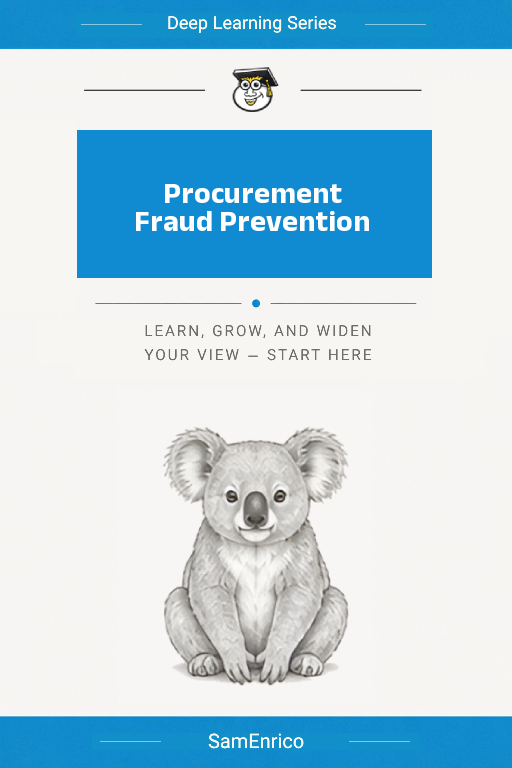
Non-FictionOperational Efficiency ManualFraud
Procurement Fraud Prevention eBook
Detect and prevent procurement fraud including bid
by Lemieux Chi
Detect and prevent procurement fraud including bid rigging, kickbacks, and invoice schemes.
Formats
Free sample
Chapter 1: The Eighty-Billion-Dollar Blindspot--–- In the autumn of 2017, a mid-sized construction firm in the American Midwest discovered that it had been systematically overpaying for concrete for nearly six years. The discovery did not come from an audit, a whistleblower, or a routine financial review. It came from a new accounts payable clerk who noticed that the price per cubic yard of concrete had remained exactly the same for sixty-seven consecutive months—while every other line item on the invoice had fluctuated. When she asked her supervisor why the concrete price never changed, he shrugged. When she asked the vendor, the vendor stopped returning her calls.
When she finally pulled the original contract from a storage room, she found something remarkable: the contract had expired four years earlier, yet the company had continued to pay the same vendor at the same inflated price, automatically renewing a deal that no one had ever renegotiated or re-tendered.The total loss was $4.2 million. No single person had stolen that money in the traditional sense. No one had forged a check or embezzled cash from a bank account. Instead, the loss had been baked into the very fabric of the procurement process—hidden in plain sight across thousands of routine transactions, each one too small to trigger an alarm, none of them fraudulent enough to attract attention, yet collectively catastrophic. The procurement manager who had signed the original contract had left the company three years earlier.
The vendor continued to invoice. The system continued to pay. And no one—for four full years—had asked a single question.This is the nature of procurement fraud. It is not a single dramatic heist but a slow, silent drain. It does not announce itself with missing funds or obvious theft.
Instead, it hides inside the mundane machinery of purchase orders, invoices, and delivery receipts. And it is, by a wide margin, the most costly and least understood form of asset misappropriation in the modern organization.The Scale of the Bleeding The numbers are staggering, yet they rarely appear in headlines. According to the United Kingdom's National Audit Office (NAO), procurement fraud accounts for an estimated £55 billion to £81 billion in annual losses across public and private sectors combined. To put that number in perspective, it exceeds the gross domestic product of more than half the nations on earth. The Association of Certified Fraud Examiners (ACFE), in its biennial Report to the Nations, consistently finds that procurement-related schemes—including bid rigging, kickbacks, and invoice fraud—represent the single largest category of asset misappropriation, outpacing payroll fraud, expense reimbursement fraud, and cash larceny combined.Yet most organizations treat procurement fraud as an afterthought.
They invest heavily in cybersecurity, in physical security, in external financial audits. They install firewalls and intrusion detection systems. They lock their server rooms and require badge access to the finance department. But the procurement function—the department that spends 40 to 60 percent of every revenue dollar in a typical organization—receives a fraction of that attention. It operates on trust.
It runs on relationships. And it bleeds.Consider the following findings from the ACFE's most recent global study, which analyzed more than 2,500 fraud cases across 125 countries. Procurement fraud schemes had a median duration of 18 months before detection—meaning that the average fraudster steals for a year and a half before anyone notices. The median loss per scheme was 150,000,butthatnumbermasksenormousvariation;inlargeorganizations,procurementfraudlossesroutinelyexceed150,000, but that number masks enormous variation; in large organizations, procurement fraud losses routinely exceed 150,000,butthatnumbermasksenormousvariation;inlargeorganizations,procurementfraudlossesroutinelyexceed5 million. And the detection methods are sobering: only 4 percent of procurement frauds are discovered through internal audit.
The vast majority are uncovered by accident, by whistleblower, or not at all.The NAO's analysis of public sector procurement in the United Kingdom found that nearly one in three contracts showed signs of potential fraud or serious irregularity. These were not back-alley deals with shell companies. These were contracts with established vendors, approved through official channels, signed by authorized personnel, and paid through standard accounts payable systems. The fraud was invisible because it was designed to be invisible—not by criminals, but by otherwise ordinary employees who had discovered a simple truth: the procurement system, as designed, is extraordinarily easy to manipulate.The Anatomy of the Procurement Fraudster Before we examine the schemes themselves, we must understand the person who perpetrates them. Because here is the uncomfortable truth that most fraud prevention books avoid: the typical procurement fraudster is not a hardened criminal.
He or she is not a career embezzler or a member of an organized crime syndicate. The typical procurement fraudster is a trusted employee—often a high-performing one—who has been with the organization for years, who has never been in trouble before, and who is, by most external measures, a model worker.This profile emerges consistently from fraud research. The ACFE's data shows that the median fraudster is 46 years old, has been with the organization for nine years, works in a managerial role, and has no prior criminal record. In procurement-specific cases, the fraudster is often even more entrenched: senior buyers, category managers, and procurement directors who have built deep relationships with key vendors over many years. They are not outsiders who have broken in.
They are insiders who have been given the keys.So what turns a trusted employee into a fraudster? The answer lies in a framework first developed by criminologist Donald Cressey in the 1950s, refined over decades, and now universally accepted in the fraud examination profession: the Fraud Triangle.The Fraud Triangle in Procurement The Fraud Triangle consists of three elements that must be present for an otherwise honest person to commit fraud: Pressure, Opportunity, and Rationalization.Pressure is the motive. In procurement fraud, pressure often comes from personal financial distress—unexpected medical bills, gambling debts, a child's college tuition, or a lifestyle that exceeds income. But pressure can also be professional: unrealistic cost-cutting targets, quarterly earnings demands, or the fear of losing a job. A buyer who is told to reduce spending by 20 percent with no clear path to do so faces enormous pressure.
Some will cut legitimate costs. Others will cut corners. And a few will begin to manipulate the system.Opportunity is the opening. In procurement, opportunity is everywhere. Weak segregation of duties means the same person who approves a vendor also processes the invoices.
Inadequate vendor vetting means shell companies are never discovered. Lack of post-award oversight means change orders are rubber-stamped. The procurement function is built for speed and efficiency, not for fraud resistance. Every shortcut that accelerates purchasing also creates opportunity.Rationalization is the psychological escape hatch. Fraudsters rarely see themselves as criminals.
Instead, they tell themselves stories: "I'm just borrowing the money; I'll pay it back." "The company owes me after all those unpaid overtime hours." "Everyone does it; I'm just leveling the playing field." "The vendor raised their prices anyway; this is just a small adjustment." These rationalizations allow otherwise ethical people to cross a line they never thought they would cross.When pressure, opportunity, and rationalization converge, fraud becomes almost inevitable. The goal of procurement fraud prevention is not to eliminate all three—that is impossible—but to reduce opportunity so dramatically that even under pressure…
This is the end of the free sample. Get the eBook to keep going. Buy now
About this book
Details
- Author
- Lemieux Chi
- Publisher
- SamEnrico
- Language
- English
- Genre
- Non-Fiction, Operational Efficiency Manual, Fraud
- Released
- 2026-06-01
- Pages (approx.)
- 150
- Available as
- eBook, Audiobook

Read better in the ZLOADR app
Your eBooks on your phone or tablet. Sign in with your SamEnrico account and start reading.
More by Lemieux Chi
 Downsizing Before Sixty FiveLemieux Chi$11.99
 Logical Creativity For Non ArtistsLemieux Chi$11.99
 The Pain Spots MethodLemieux Chi$11.99
 The Job Seeker NetworkLemieux Chi$11.99
 Self Esteem When Partner ChangesLemieux Chi$11.99
 The Silent Banquet: A Feast of Deceit in 18th-Century VersaillesLemieux Chi$11.99
 The Last Words of Virginia Woolf: A Literary ElegyLemieux Chi$11.99
 Understanding Facial ParalysisLemieux Chi$17.99
 Writing Executive Summaries for Compliance DocumentsLemieux Chi$12.99
 Palliative CareLemieux Chi$11.99
You may also like
 Hong Kong Handover 1997Dunn Johnnie$11.99
 Zumba For Postnatal Recovery CourseNeal Christian$11.99
 Zumba for BeginnersLadner Nikia$11.99
 YouTube Comment Mining GuideHumes Pandora$12.99
 Worry Box MeditationCarlin Rudy$11.99
 Workplace Stress MeditationNguyen Lynn$11.99
 Workplace Stress and Sleep RepairHawley Ivory$11.99
 Workplace Perfectionism CureDelaney Jeffry$11.99
 Workplace Injustice Anger GuideWallen Isabelle$11.99
 Work Addiction and Burnout LinkGreenwood Ester$11.99
 Women in Yoga and WellnessBeattie Galina$11.99
 Women in Stand Up ComedyChun Evangeline$11.99