
Non-FictionOperational Efficiency ManualCompliance
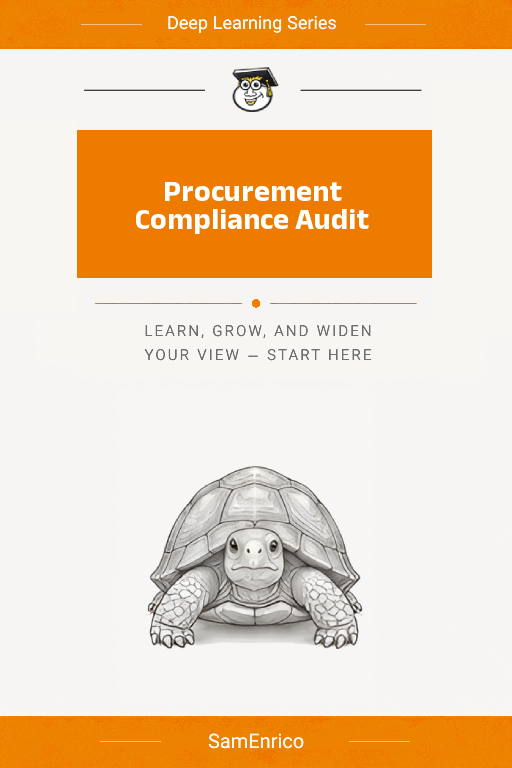
Procurement Compliance Audit eBook
Ensures policy adherence and audit readiness throu
Ensures policy adherence and audit readiness through automated controls, approval matrices, and PO compliance checks.
Formats
Free sample
Chapter 1: The Blind Spot...--The email arrived at 11:47 PM on a Tuesday. Emily, the newly promoted procurement director for a mid-sized manufacturing firm, had just settled into bed when her phone buzzed with the subject line: "URGENT – Audit Finding – Potential Fraud." Her heart sank. She had been in the role for only six weeks. The previous director had left abruptly, and she had inherited a system she was told was "robust" and "fully compliant."She opened the attachment. The internal audit team had run a routine test on the previous fiscal year's procurement data.
Their finding was concise, professional, and devastating: approximately 7% of sampled transactions showed indicators of policy violation, and of those, an estimated $1.2 million in payments appeared to have been made without proper approval. The audit team had not yet confirmed fraud. They had confirmed something worse: no one knew. The approvals existed in the system, but upon closer inspection, they were circular—people approving their own requests, managers rubber-stamping purchases they never reviewed, and a half-dozen POs that had been quietly edited after approval to increase quantities and prices.Emily stared at the screen. Her company had passed its external audit six months ago.
The external auditors had given them a clean opinion. And yet, here was evidence that the entire compliance framework was, to use the audit team's careful language, "ineffective in preventing or detecting non-compliant spend."What Emily discovered over the next six months would become the foundation of this book. She learned that her company was not unusual. It was, in fact, entirely typical. The vast majority of organizations operate with a compliance model that is fundamentally reactive, sampling-based, and designed to produce clean audit opinions rather than prevent actual losses.
They test 1% of transactions and call it rigorous. They trust their employees to follow policy without building systems that make it impossible not to. And they discover fraud, on average, eighteen months after it begins.This chapter is about that failure mode. It is about why traditional procurement auditing fails, why the "Shift Left" philosophy is the only viable alternative, and how you can begin measuring the true cost of poor compliance in your own organization before an 11:47 PM email arrives in your inbox.The Fatal Flaw of Traditional Procurement Auditing Let us begin with a simple question: What does your annual procurement audit actually test?If you are like most organizations, the answer is something along these lines: an internal or external audit team selects a statistical sample of transactions from the previous twelve months—perhaps 100 to 500 individual POs and invoices—and tests them against a checklist of policy requirements. Were approvals obtained?
Were vendors on the approved list? Did the three-way match align? The sample passes, the audit report says "controls are operating effectively," and everyone moves on.This is comforting. It is also, for most organizations, a dangerous illusion.The problem is not that auditors are incompetent. The problem is that sampling is fundamentally the wrong tool for detecting fraud or policy violations in a high-volume procurement environment.
Consider the mathematics. If your organization processes 100,000 POs per year, and your auditors sample 500 of them, they are testing exactly 0.5% of your transaction volume. Even if they test 1,000 transactions, that is still only 1%. The other 99% of your spend moves through the system entirely unexamined.Now consider where fraud and error tend to concentrate. They do not distribute themselves evenly across all transactions.
They cluster—in specific vendors, specific departments, specific users, specific times of day, specific patterns of approval. A well-designed sampling methodology can occasionally catch these clusters, but more often than not, fraudsters learn to stay below the sampling thresholds. They keep individual transactions small. They spread activity across multiple cost centers. They exploit the gap between what the audit tests and what the system allows.This is what Emily discovered.
The 1.2millioninquestionablepaymentsinhercompanywerenotlarge,singletransactionsthatwouldhavebeencaughtbyanyreasonableauditor.Theywereaseriesofsmallertransactions,eachindividuallybelowreviewthresholds,thatcollectivelyaddeduptoasignificantloss.Onevendorhadsubmittedfifteenseparateinvoicesoversixmonths,eachjustundertheamountrequiringa VPapproval.Eachinvoicewasmatchedtoa POthathadbeenquietlyeditedafterapproval—aquantityincreasedfrom100unitsto125,aunitpriceadjustedupwardby81.2 million in questionable payments in her company were not large, single transactions that would have been caught by any reasonable auditor. They were a series of smaller transactions, each individually below review thresholds, that collectively added up to a significant loss. One vendor had submitted fifteen separate invoices over six months, each just under the amount requiring a VP approval. Each invoice was matched to a PO that had been quietly edited after approval—a quantity increased from 100 units to 125, a unit price adjusted upward by 8%. The changes had been made by a buyer who reported to the same manager who approved the original PO.
No single change triggered a review. No single invoice looked suspicious. And yet, over six months, the company had overpaid by nearly 1.2millioninquestionablepaymentsinhercompanywerenotlarge,singletransactionsthatwouldhavebeencaughtbyanyreasonableauditor.Theywereaseriesofsmallertransactions,eachindividuallybelowreviewthresholds,thatcollectivelyaddeduptoasignificantloss.Onevendorhadsubmittedfifteenseparateinvoicesoversixmonths,eachjustundertheamountrequiringa VPapproval.Eachinvoicewasmatchedtoa POthathadbeenquietlyeditedafterapproval—aquantityincreasedfrom100unitsto125,aunitpriceadjustedupwardby8300,000 on that vendor alone.The traditional audit had missed this entirely because the sample did not include those specific transactions. The control environment, as documented, looked sound. The reality was a sieve.The Detective vs.
Preventive Control Paradigm To understand why traditional auditing fails, we need to distinguish between two fundamentally different types of controls: detective and preventive.Detective controls identify problems after they have occurred. They are the audit sample, the monthly reconciliation, the exception report run after the fact. Their purpose is to find errors or violations so that they can be corrected, and sometimes so that the perpetrators can be held accountable. Detective controls are necessary. No system can prevent every possible violation.
But detective controls have a fatal limitation: they find problems only after money has left the bank.Preventive controls, by contrast, stop problems before they occur. They are the system rule that blocks a requisition when budget is insufficient, the approval matrix that routes a high-value PO to a senior manager, the three-way match that rejects an invoice that does not align with the PO and receipt. Preventive controls operate in real time, at the moment of the transaction, and they impose a cost on non-compliance: the transaction simply does not proceed.Here is the uncomfortable truth that Emily learned: most organizations invest heavily in detective controls and only lightly in preventive ones. They run annual audits. They have monthly compliance reviews.
They generate exception reports. But their actual transaction systems—the ERP, the procurement software, the approval workflows—are configured with wide tolerances, permissive rules, and multiple overrides. They prioritize speed and user convenience over control. They assume that employees will follow policy unless proven otherwise, and they build systems that trust rather than verify.This is backward. A well-designed compliance framework inverts the investment: it puts the heavy lifting into preventive controls at the front of the process, and uses detective controls only to validate that the preventive controls are working and to catch the rare violations that slip through.The Shift Left Philosophy"Shift Left" is a term borrowed from software development, where it refers to moving testing and quality checks earlier in the development lifecycle.
In procurement compliance, Shift Left means moving compliance checks from the end of the process (invoice matching, payment review, post-audit) to the beginning of the process (requisition, PO creation, approval).Consider the difference in leverage. A compliance check at the requisition stage—before…
This is the end of the free sample. Get the eBook to keep going. Buy now
About this book
Details
- Author
- Mccormack Karyl
- Publisher
- SamEnrico
- Language
- English
- Genre
- Non-Fiction, Operational Efficiency Manual, Compliance
- Released
- 2026-05-29
- Pages (approx.)
- 158
- Available as
- eBook, Audiobook

Read better in the ZLOADR app
Your eBooks on your phone or tablet. Sign in with your SamEnrico account and start reading.
More by Mccormack Karyl
 Mindfulness for New Parents GuideMccormack Karyl$11.99
 The Empty Collar HandbookMccormack Karyl$11.99
 Complicated Grief After HomicideMccormack Karyl$11.99
 Civil Engineer Creativity GuideMccormack Karyl$11.99
 The Validating Trauma Responses GuideMccormack Karyl$11.99
 The Last Broadcast: How a 1996 Radio Signal Predicted the InternetMccormack Karyl$11.99
 Understanding Stimulant PsychosisMccormack Karyl$17.99
 How to Become a Sheepskin PicklerMccormack Karyl$11.99
 Client Relationship AssociateMccormack Karyl$11.99
 Voice Activated AccountingMccormack Karyl$12.99
You may also like
 Hong Kong Handover 1997Dunn Johnnie$11.99
 Zumba For Postnatal Recovery CourseNeal Christian$11.99
 Zumba for BeginnersLadner Nikia$11.99
 YouTube Comment Mining GuideHumes Pandora$12.99
 Worry Box MeditationCarlin Rudy$11.99
 Workplace Stress MeditationNguyen Lynn$11.99
 Workplace Stress and Sleep RepairHawley Ivory$11.99
 Workplace Perfectionism CureDelaney Jeffry$11.99
 Workplace Injustice Anger GuideWallen Isabelle$11.99
 Work Addiction and Burnout LinkGreenwood Ester$11.99
 Women in Yoga and WellnessBeattie Galina$11.99
 Women in Stand Up ComedyChun Evangeline$11.99