
Non-FictionInformativeEducational
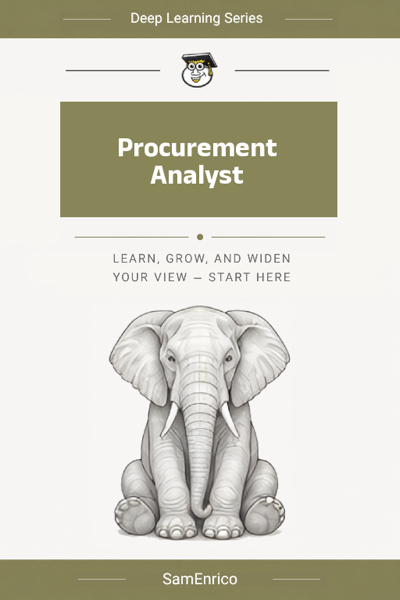
Procurement Analyst eBook
A Coursebook on Procurement Analyst
A Coursebook on Procurement Analyst
Formats
Free sample
Chapter 1: Beyond the Purchase Order--– The email arrived at 4:47 PM on a Friday, as these things always do. “Team – urgent. CFO needs procurement savings by Tuesday. Please send your numbers.” You’ve seen this message before. Maybe not these exact words, but the same frantic energy masked as leadership.
The problem isn’t the request. The problem is that most procurement analysts cannot answer it with confidence. They will spend the weekend scrambling through spreadsheets, guessing which supplier gave them the best price three quarters ago, and ultimately deliver a number that sounds plausible but has no foundation. Then they will repeat the process next month. And the month after.This chapter exists to ensure you never send that panicked email—and more importantly, that you never receive one without knowing exactly what to do.
Because the difference between a clerk who processes purchase orders and an analyst who drives business strategy is not about effort or experience. It is about understanding what the job actually is versus what most people think it is.The Great Misunderstanding Walk into almost any medium-sized company and ask ten employees what procurement does. You will receive ten different answers, and at least eight of them will be wrong. Finance people think procurement is an expense line waiting to be cut. Operations people think procurement is a bottleneck that slows down their production.
Salespeople think procurement is where deals go to die under layers of paperwork. And unfortunately, many procurement professionals have internalized these misconceptions, spending their days chasing approvals and apologizing for delays rather than demonstrating value.The truth is radically different. Procurement sits at the intersection of every major business function. Every dollar that leaves the company for a third-party good or service passes through procurement’s visibility—or it should. Every supplier relationship that affects product quality, delivery speed, or innovation touches procurement.
Every risk that could shut down a factory, from a supplier bankruptcy to a geopolitical crisis, is first visible in procurement data. The analyst who understands this becomes indispensable not because they work harder, but because they see what others cannot.But seeing requires a framework. And the first step in building that framework is understanding the three distinct activities that most people lump together under the vague label of “procurement.”Purchasing, Procurement, and Strategic Sourcing: The Three-Layer Cake Imagine a three-layer cake. At the bottom, widest and most visible, is Purchasing. This is the tactical, transactional work of issuing purchase orders, confirming receipt of goods, matching invoices, and processing payments.
Purchasing answers the question “Did we buy what we needed?” It is essential but mechanical. A well-designed system can automate most of it. Many analysts get stuck here, believing that fast PO processing equals high performance. It does not.The middle layer is Procurement. This adds the processes of sourcing, contracting, and supplier management.
Procurement answers the question “Did we buy it under the right terms?” This includes running requests for proposals, negotiating contracts, tracking compliance, and managing supplier relationships. This is where most mid-level analysts operate, and it is valuable work. But it is still reactive—responding to requests rather than shaping them.The top layer, the smallest but most powerful, is Strategic Sourcing. This is the data-driven analysis of supply markets, total cost structures, risk profiles, and long-term value creation. Strategic sourcing answers the question “Should we buy this at all, and if so, how do we maximize value over three to five years?” This is the domain of the indispensable analyst.
This is where you move from order-taker to business partner.Here is the brutal truth that no performance review will tell you: your organization will happily let you stay in the purchasing layer forever. You will be busy, appreciated, and completely replaceable. Because anyone with basic training can process a purchase order. But very few people can analyze a supply market, build a should-cost model, or predict a supplier’s bankruptcy risk before it happens. That expertise is rare, valuable, and the entire reason this book exists.The Four Core Responsibilities of the Strategic Analyst Throughout this book, we will build skills across four domains that collectively define the strategic procurement analyst.
Think of these not as sequential steps but as interrelated capabilities that reinforce each other. Mastery in any one area amplifies the others.First, spend analysis. This is the foundation of everything. Spend analysis means taking raw transactional data—purchase orders, invoices, procurement card transactions—and transforming it into intelligence. Which suppliers receive the most money?
Which categories have the most fragmentation? Where is maverick spending happening outside of contracts? The analyst who cannot answer these questions within an hour has no business advising anyone on savings. Chapter Two and Chapter Three will give you the tools to perform spend analysis faster and more accurately than 90 percent of your peers.Second, market research. Spend analysis tells you where your money went.
Market research tells you where it should go next. This means tracking commodity price indices, labor rates, logistics costs, and technological shifts that affect supply and demand. It means understanding not just who your current suppliers are, but who else exists in the market and what they offer. The analyst who walks into a negotiation knowing the supplier’s cost structure, their competitors’ pricing, and the trajectory of raw material prices has already won half the battle. Chapter Four covers this in depth.Third, supplier scorecarding and performance management.
Signing a contract is not the finish line; it is the starting line. The best negotiated price in the world means nothing if the supplier delivers late, delivers defective goods, or goes bankrupt halfway through the contract term. Supplier scorecarding means measuring what matters: on-time delivery, quality measured in defects per million units, responsiveness to issues, and strategic contributions like cost reduction ideas or innovation. Chapter Nine provides the templates and methodologies to rank your suppliers from “strategic partner” to “probation.”Fourth, contract compliance and leakage prevention. Most organizations lose between five and fifteen percent of their negotiated savings to contract leakage.
This happens when suppliers charge prices higher than the contract allows, when employees buy from non-approved suppliers, or when contracts auto-renew at unfavorable rates without review. The analyst who builds a quarterly compliance audit becomes the guardian of the company’s wallet. Chapter Eight walks through the exact Excel techniques to catch every dollar of leakage.Notice what is not on this list. Nowhere does it say “issue purchase orders quickly” or “get three bids for every requisition.” Those are table stakes—minimum requirements that keep you employed but do not advance your career. The four responsibilities above are where value creation happens.The Tech Stack: Your Arsenal of Tools You cannot do strategic work with tactical tools.
Spreadsheets are powerful—you will spend significant time in Excel throughout this book—but they are not sufficient alone. A modern procurement analyst needs familiarity with three categories of software.Enterprise Resource Planning systems—SAP, Oracle, Microsoft Dynamics—are the system of record. Every purchase order, every invoice, every receipt lives in the ERP. Your first task in any new role is learning how to extract data from the ERP efficiently. Most ERPs have terrible reporting…
This is the end of the free sample. Get the eBook to keep going. Buy now
About this book
Details
- Author
- Lozano Adelaide
- Publisher
- SamEnrico
- Language
- English
- Genre
- Non-Fiction, Informative, Educational
- Released
- 2026-05-18
- Pages (approx.)
- 138
- Available as
- eBook, Audiobook

Read better in the ZLOADR app
Your eBooks on your phone or tablet. Sign in with your SamEnrico account and start reading.
More by Lozano Adelaide
 Emotional Eating HandbookLozano Adelaide$11.99
 Whiplash Meditation ReliefLozano Adelaide$11.99
 Assumption Reversal Technique GuideLozano Adelaide$11.99
 Search Rescue Operator StressLozano Adelaide$11.99
 The First Light Seekers: Unlocking the Secrets of the Southern SkiesLozano Adelaide$11.99
 The Silent Strike: How a 19th-Century Typo Shut Down the World's RailwaysLozano Adelaide$11.99
 Understanding Familial Colorectal CancerLozano Adelaide$17.99
 Ghana Shipping Times GuideLozano Adelaide$12.99
 Data Presentation Samples Across Seven IndustriesLozano Adelaide$12.99
 How to Start a Dairy Concentrate (animal Feed) Business (Beginners Guide)Lozano Adelaide$11.99
You may also like
 Hong Kong Handover 1997Dunn Johnnie$11.99
 Zumba For Postnatal Recovery CourseNeal Christian$11.99
 Zumba for BeginnersLadner Nikia$11.99
 YouTube Comment Mining GuideHumes Pandora$12.99
 Worry Box MeditationCarlin Rudy$11.99
 Workplace Stress MeditationNguyen Lynn$11.99
 Workplace Stress and Sleep RepairHawley Ivory$11.99
 Workplace Perfectionism CureDelaney Jeffry$11.99
 Workplace Injustice Anger GuideWallen Isabelle$11.99
 Work Addiction and Burnout LinkGreenwood Ester$11.99
 Women in Yoga and WellnessBeattie Galina$11.99
 Women in Stand Up ComedyChun Evangeline$11.99