
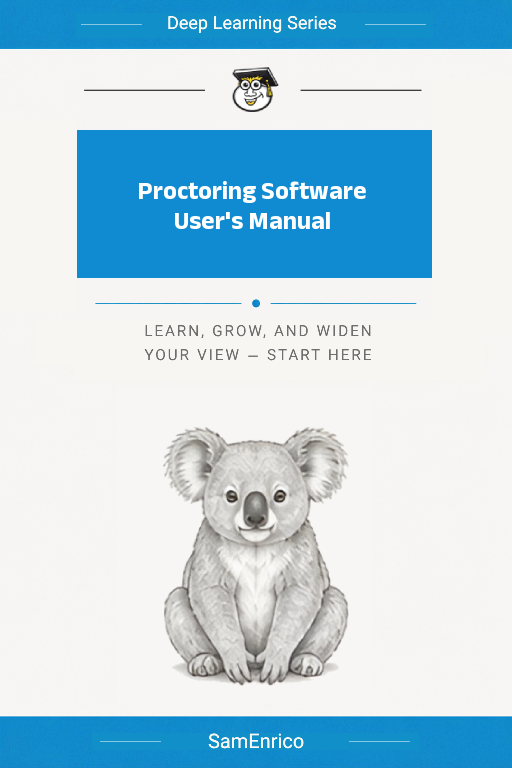
Non-FictionStudent's ShortcutSoftware GuideTechnical Manual
Proctoring Software User's Manual eBook
Understand how ProctorU, Honorlock, and Respondus
Understand how ProctorU, Honorlock, and Respondus flag behavior. Covers eye movement limits, bathroom break rules, and appealing false positives.
Formats
Free sample
Chapter 1: The Robot’s Witness...–- Every semester, thousands of students sit down to take an exam and do everything right. They study for days. They get a good night’s sleep. They show up early, check their webcam, clear their desk, and promise themselves they will follow every rule. Then, mid-way through question fourteen, they glance up at the ceiling to remember a formula.
Or they lean back to stretch their neck. Or they whisper the word “velocity” under their breath. And thirty minutes after submitting the test, they receive an email that changes everything: “Your exam has been flagged for review. A potential academic integrity violation has been detected.”This chapter is not about cheating. It is about the growing number of students who are falsely accused of cheating by automated proctoring systems that cannot tell the difference between deep thought and dishonesty.
It is about the study habits that served you faithfully for a decade—looking away to recall a fact, reading a question aloud to process it, glancing at a clock on the wall—that are now, algorithmically, evidence of academic misconduct. And it is about a fundamental mismatch between how humans learn and how machines watch.The Reframing: You Are Not Paranoid, You Are Outdated Let us begin with a simple experiment. Close your eyes for three seconds and recall what you had for breakfast yesterday. You likely looked away from this page, perhaps upward or to the side. That eye movement is a normal part of human memory retrieval.
Now imagine taking a proctored exam and doing the same thing. The software does not know you are remembering breakfast. It knows only that your gaze left the screen for a measurable period. To the algorithm, a memory-seeking glance and a phone-checking glance are visually identical.This is the central problem that this book will teach you to navigate. The proctoring software does not understand context.
It does not understand fatigue, anxiety, ADHD, or the simple human need to stretch after forty-five minutes of sitting still. It understands only deviations from a narrow, rigid baseline of “normal behavior” that was programmed into it by engineers who never watched you take a test.The traditional testing environment—a classroom with a human proctor—relies on contextual judgment. A human proctor sees a student look up at the ceiling and thinks, “She is thinking.” A human proctor sees a student mouth a word and thinks, “He is reading to himself.” A human proctor sees a student stretch and thinks nothing at all. Automated proctoring systems have no such capacity for inference. They log the behavior, calculate a risk score, and if that score crosses a threshold, they generate a flag.
That flag may lead to a human review, or it may lead directly to an automatic failure. And here is the most unsettling fact: in many cases, no human ever watches your exam video unless a flag is serious enough to warrant review. You are being judged by a robot that has never met you, does not know your habits, and cannot distinguish between a cheat sheet and a scratch piece of paper.A Brief History: From Human Proctors to Algorithmic Surveillance To understand why you are in this situation, you need to understand how quickly the landscape changed. Before 2020, remote proctoring existed but was a niche product used primarily by online universities and distance learning programs. Most students took exams in person, sitting in a classroom with a proctor who walked the aisles.
That proctor could see your face, hear your whispered questions, and make a judgment call about whether you were cheating or simply thinking.When the COVID-19 pandemic forced universities online almost overnight, schools scrambled for solutions. In-person proctoring was impossible. Honorlock, Proctor U, and Respondus saw their user bases explode from thousands to millions of students within weeks. Institutions that had never considered remote proctoring suddenly signed multi-year contracts. Faculty were trained—barely—on how to interpret the incident logs.
And students were told to download software that would monitor their every move.What no one fully appreciated at the time was that these systems were never designed to handle the full range of normal human test-taking behavior. They were designed to catch obvious cheating: a second person in the room, a phone held below the desk, a student reading answers from a hidden document. But when deployed at scale, they began flagging thousands of innocent behaviors. Looking down at scratch paper became “gaze deviation.” Reading a question aloud became “audio anomaly.” A roommate walking behind the camera became “secondary person detected.”The technology has improved since 2020, but the fundamental flaw remains: the software is built on a model of cheating that assumes guilt, not innocence. It is not looking for evidence that you are honest.
It is looking for anomalies that could be cheating. And because the consequences of a false negative (missing a real cheater) are considered far worse than the consequences of a false positive (accusing an innocent student), the systems are calibrated to flag aggressively. You will learn more about these thresholds in Chapter 3, but for now, understand this: the software would rather accuse ten innocent students than miss one guilty one. You are gambling against those odds every time you take a proctored exam.The Recording vs. Live Distinction: Know What Is Watching You Before we go further, you need to understand a critical distinction that will appear throughout this book.
Not all proctoring is the same, and the type of proctoring your school uses determines how dangerous false positives are for you.Recorded Sessions (AI-First): In this model, the software records your video, audio, and screen activity while you take the exam. An AI scans the recording in real time or immediately after submission, generating flags for any behavior that deviates from its model of “normal.” Only the most serious flags—or a pattern of many minor flags—trigger a human review. In many cases, a low-level flag is simply logged and never seen by a professor. But a moderate flag might be sent to a human reviewer who watches a 90-second clip of the flagged behavior without seeing the preceding or following context. And a high-severity flag can trigger an automatic failure or an immediate referral to the academic integrity office without any human watching the video at all.The problem with recorded sessions is that the AI is both the detective and the prosecutor.
It decides what is suspicious, highlights those moments, and then—if your school’s contract includes human review—sends those clips to a person. But as you will learn in Chapter 11, that human reviewer is often watching twenty screens at once and is heavily influenced by the AI’s initial flag. Once the algorithm says “cheating,” it takes a great deal of evidence to override that judgment.Live Sessions (Human in Real Time): In this model, a human proctor watches you via webcam during the exam. This is often called “Live+” by Proctor U, but other platforms have similar options. The human proctor can see you in real time, can hear you if you speak, and can make contextual judgments.
If you look up at the ceiling to think, the live proctor sees that you are not holding a phone.…
This is the end of the free sample. Get the eBook to keep going. Buy now
About this book
Details
- Author
- Pettit Harland
- Publisher
- SamEnrico
- Language
- English
- Genre
- Non-Fiction, Student's Shortcut, Software Guide, Technical Manual
- Released
- 2026-05-27
- Pages (approx.)
- 153
- Available as
- eBook, Audiobook

Read better in the ZLOADR app
Your eBooks on your phone or tablet. Sign in with your SamEnrico account and start reading.
More by Pettit Harland
 Dreams After Car Accident TraumaPettit Harland$11.99
 Digital Body Language PrimerPettit Harland$11.99
 Accountability Software For Recovery GuidePettit Harland$11.99
 PMS And Relationships GuidePettit Harland$11.99
 Dream Movement Therapy for TraumaPettit Harland$11.99
 The Secret of the Aral Sea: How Soviet Scientists Unlocked Nuclear PowerPettit Harland$11.99
 Neon Ghosts of the UndergroundPettit Harland$11.99
 Community Solar Growth ForecastPettit Harland$12.99
 Understanding Heart Defect Tongue Hamartoma PolysyndactylyPettit Harland$17.99
 How to Start a Brush for Cosmetics Business (Beginners Guide)Pettit Harland$11.99
 Computer EngineerPettit Harland$11.99
You may also like
 Hong Kong Handover 1997Dunn Johnnie$11.99
 Zumba For Postnatal Recovery CourseNeal Christian$11.99
 Zumba for BeginnersLadner Nikia$11.99
 YouTube Comment Mining GuideHumes Pandora$12.99
 Worry Box MeditationCarlin Rudy$11.99
 Workplace Stress MeditationNguyen Lynn$11.99
 Workplace Stress and Sleep RepairHawley Ivory$11.99
 Workplace Perfectionism CureDelaney Jeffry$11.99
 Workplace Injustice Anger GuideWallen Isabelle$11.99
 Work Addiction and Burnout LinkGreenwood Ester$11.99
 Women in Yoga and WellnessBeattie Galina$11.99
 Women in Stand Up ComedyChun Evangeline$11.99