
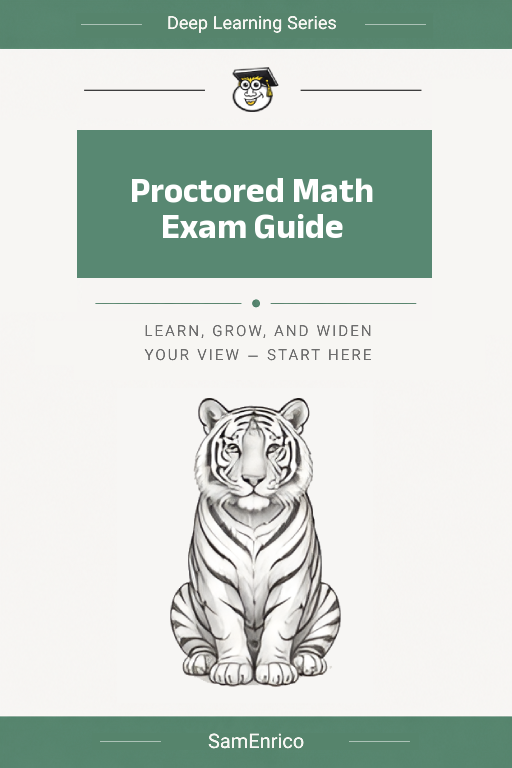
Proctored Math Exam Guide eBook
Solve math problems during online proctored exams
by Hills Branda
Solve math problems during online proctored exams using approved digital tools and showing work within camera view.
Formats
Free sample
Chapter 1: The 47-Second Rule--–- Maria was a good student. She had a 3.8 GPA. She had done every practice problem in her calculus textbook. She had taken three full-length practice exams under timed conditions and scored in the 92nd percentile. On the morning of her online proctored final exam, she was nervous but confident.She set up her laptop.
She cleared her desk. She showed her ID to the camera. She performed the room scan. The proctor approved her environment. The exam began.The first problem was a derivative: find f'(x) for f(x) = 3x⁴ - 2x³ + 5x - 7.
Maria knew this. She could do it in her sleep. She stared at the problem for a moment, thinking through the power rule in her head: multiply by the exponent, subtract one from the exponent. 3×4=12, so 12x³. -2×3=-6, so -6x².
5×1=5, so 5x. The derivative of -7 is 0.She did not write anything. She did not move the mouse. She just thought.Forty-seven seconds later, a chat window appeared on her screen. The proctor had typed: "Please keep your eyes on the screen and show your work."Maria was confused.
She had not looked away. Her eyes were on the screen the entire time. But the proctoring AI had flagged her. Forty-seven seconds without writing anything. No mouse movement.
No whiteboard activity. The AI could not distinguish between "thinking deeply" and "cheating by looking at hidden notes." The proctor, following protocol, interrupted her.The interruption broke her concentration. She fumbled the next problem. Her hands started shaking. She spent too long on the third problem.
By the time she reached the fourth problem, she had lost twelve minutes to anxiety and re-reading. She finished the exam, but her score was 73 percent—nineteen points below her practice average.Maria's story is not unusual. It happens to thousands of students every day. They know the math. They have prepared.
But they have not prepared for the unique constraints of an online proctored exam. They do not know the 47-Second Rule. They have never heard of the Evidence Trail. They have no framework for thinking while being watched.This chapter introduces that framework. It is called the Four-Step Framework, and it was invented by a Hungarian mathematician named George Polya in 1945.
Polya’s book How to Solve It changed mathematics education forever by arguing that problem-solving is not a mysterious gift—it is a teachable skill. But Polya wrote before the age of webcams and proctoring AI. His framework needs adaptation for the unique constraints of online proctored exams.This chapter provides that adaptation. You will learn the four steps, how to apply them while a camera watches you, and most importantly, how to avoid Maria’s fate. You will learn the 47-Second Rule: never go more than 45 seconds without writing something on your whiteboard.
You will learn the Evidence Trail: documenting every step so the proctor can see you working. And you will learn why the Four-Step Framework is more important in a proctored exam than it ever was on paper.The Four Steps That Changed Mathematics George Polya was not a test-prep guru. He was a mathematician at Stanford who noticed that his students could memorize formulas but could not solve unfamiliar problems. They had knowledge but no method. They could recite the quadratic formula but could not figure out which problems required it.Polya’s insight was that problem-solving follows a predictable pattern.
Every problem, from the simplest arithmetic to the most complex proof, can be solved by following four steps. He called them:Understand the problem Devise a plan Carry out the plan Look back These steps seem obvious. Of course you need to understand the problem before you solve it. Of course you need a plan. But obvious does not mean easy.
Most students skip Step One entirely. They read the problem once, circle the numbers, and start calculating. They have a plan only in the vaguest sense: “I’ll do some math and see what happens.” They never look back. They finish the calculation, circle an answer, and move on.In a traditional classroom exam, skipping steps costs you points. In a proctored online exam, skipping steps can cost you the entire exam.
The proctoring AI does not know you are thinking. It only knows what it sees. If you are not writing, it assumes you are not working. If you are not working, it assumes you are cheating.The Four-Step Framework gives you a structure that the AI can see. When you write “Step One: Unknown is x.
Given: 2x+5=13. Condition: x is real,” the AI sees engagement. When you write “Step Two: Plan – subtract 5, divide by 2,” the AI sees methodical thinking. When you write each calculation step, the AI sees legitimate work. You are not just solving a problem.
You are performing for the proctor.Step One: Understand the Problem (The Three-Bullet Method)Step One is where most students fail, and it is the step that Polya considered most important. He wrote: “It is foolish to answer a question that you do not understand. It is sad to work for a goal that you do not desire.”In a proctored exam, Step One is even more critical because you cannot go back. Many proctored exams, including the MAP Growth test, do not allow you to return to previous questions once you have clicked “Next.” Your answer is final. If you misinterpret the problem, you cannot fix it later.Polya distilled Step One into three questions.
This book calls these three questions the Three-Bullet Method. Before you touch your calculator or write a single number, write three bullet points on your whiteboard:Unknown: What are you actually trying to find? State it in your own words.Given: What information has the problem provided? List every number, variable, and relationship.Conditions: Are there constraints or assumptions you must honor? Are there hidden conditions?Let us see the Three-Bullet Method in action.Example Problem: “Find two consecutive integers whose product is 56.”The student who skips Step One reads the problem, thinks “consecutive integers, product,” and writes “n(n+1)=56.” This is not wrong, but it skips the understanding phase.
The student has not stated the unknown clearly. They have not listed the given data separately. They have not identified the condition explicitly.The student who uses the Three-Bullet Method writes:Unknown: Two consecutive integers. Let n = first integer, n+1 = second integer.Given: There are two integers. They are consecutive.
Their product is 56.Condition: n × (n+1) = 56The difference is subtle but profound. The second student has transformed the word problem into a mathematical statement. They have identified that “consecutive” means n and n+1. They have written the condition as an equation. They are ready to solve.
The first student is already solving, but they have not ensured they understand the problem. If the problem had asked for the sum instead of the product, the first student would have missed it entirely.In a proctored exam, write the Three Bullets before anything else. This serves two purposes. First, it ensures you understand the problem. Second, it shows the proctor that you are engaging systematically, not just guessing.Step Two: Devise a Plan…
This is the end of the free sample. Get the eBook to keep going. Buy now
About this book
Details
- Author
- Hills Branda
- Publisher
- SamEnrico
- Language
- English
- Genre
- Non-Fiction, Student's Shortcut, Math Exam, Problem Solving
- Released
- 2026-06-01
- Pages (approx.)
- 114
- Available as
- eBook, Audiobook

Read better in the ZLOADR app
Your eBooks on your phone or tablet. Sign in with your SamEnrico account and start reading.
More by Hills Branda
 Stolen Goods Fence NetworkHills Branda$11.99
 Purchase Multiple CompendiumHills Branda$11.99
 Parental Addiction and DeathHills Branda$11.99
 Lactose Free Grocery Shopping CourseHills Branda$11.99
 The Unseen Crown: The Rise and Fall of the First Female PharaohHills Branda$11.99
 From Ashes to Apollo: The Unlikely Return of Apollo 13Hills Branda$11.99
 Understanding Cassia–stocco–dos Santos SyndromeHills Branda$17.99
 DUNS Number Activation GuideHills Branda$12.99
 Customer Collaboration AnalystHills Branda$11.99
 How to Start a Potato Growing Business (Beginners Guide)Hills Branda$11.99