
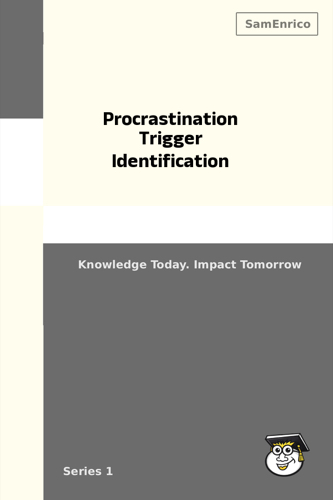
Procrastination Trigger Identification eBook
Recognize specific thoughts, emotions, and situati
Recognize specific thoughts, emotions, and situations that lead to task avoidance.
Formats
Free sample
Chapter 1: The Three-Second Betrayal--You just did it.Not the thing you were supposed to do. The other thing. The switch. The微小 escape that took less time than a heartbeat.You opened this book—or clicked on this chapter—with genuine intention. You wanted to understand your procrastination.
You wanted tools. You wanted to finally feel in control. And then, somewhere between the first sentence and now, your attention drifted. Maybe you checked your phone. Maybe you thought about something else.
Maybe you felt a tiny flicker of discomfort—the weight of yet another self-help promise—and your brain, that brilliant, ancient, exhausted machine, did what it always does: it looked for the exit.That moment—that three-second window between intention and distraction—is the most important moment in your entire relationship with work. And you have never looked at it closely.This book is not about motivation. It is not about time management. It is not about willpower or discipline or the perfect to-do list app. You have tried those things.
They work for a while, and then they stop working, and you blame yourself, and the cycle repeats. That cycle is not a character flaw. It is a detection problem.You cannot solve what you cannot see. And you have never really seen the exact second you stop.Welcome to the autopsy of that second.The Myth You Have Been Sold For decades, the self-help industry has told you a comforting lie: that procrastination is a time-management problem. If you just organized your calendar better, broke tasks into smaller pieces, or woke up at 5 a.m., you would finally get things done.
This lie persists because it is profitable. It sells planners, apps, courses, and a steady stream of guilt when those tools inevitably fail.The truth, supported by decades of clinical research from psychologists like Dr. Fuschia Sirois, Dr. Piers Steel, and Dr. Jane Burka, is radically different.Procrastination is not a time-management problem.
It is an emotional regulation problem.Let me say that again, because it will take time to sink through the layers of shame you have accumulated: You do not procrastinate because you are lazy, disorganized, or broken. You procrastinate because the task triggers a negative emotional state—anxiety, boredom, resentment, fatigue, fear—and your brain, designed to prioritize short-term survival over long-term goals, chooses to escape that feeling right now.The spreadsheet is not the problem. The spreadsheet triggers the feeling of inadequacy. The feeling of inadequacy triggers avoidance. The avoidance triggers relief.
The relief triggers habit. And the habit becomes who you believe you are.This chapter is the demolition of that belief.The Anatomy of a Three-Second Betrayal Let me walk you through a moment you have lived hundreds of times.You sit down at your desk. Your computer is open. You have a task in front of you—an email to send, a report to write, a call to make. You intend to start.
You really do. For a fraction of a second, your prefrontal cortex—the rational, planning part of your brain—activates. It says, "We should do this now."Then something happens.Maybe you notice the task is unclear. Maybe you remember a critical comment your boss made last week. Maybe you feel the familiar weight of perfectionism—the knowledge that whatever you produce will not be good enough.
Maybe you are just tired, and the task feels like climbing a hill with no summit.In that moment, your limbic system—the ancient, emotional, survival-oriented part of your brain—activates faster than your prefrontal cortex can respond. It does not see a spreadsheet. It sees a threat. And its only job is to eliminate threats immediately.So it offers you an escape: your phone. A snack.
A different tab. A sudden urgent need to organize your desktop folders. Anything that provides immediate mood repair.You take the escape. It takes three seconds.That is the three-second betrayal. And it happens dozens of times a day, to almost everyone, regardless of intelligence, education, or ambition.The difference between people who identify as "productive" and people who identify as "procrastinators" is not that the former never experience the betrayal.
It is that they have learned to see it coming.Why Willpower Is a Trap You have probably tried to fight this moment with willpower. You have told yourself to "just start." You have made promises to your future self. You have downloaded apps that block distracting websites. And sometimes—maybe often—these strategies work. For a while.Then comes the day you are tired.
Or stressed. Or hungry. Or just human. And the willpower fails. And you blame yourself.This is not a moral failure.
This is a misunderstanding of how willpower works.Research by Dr. Roy Baumeister and others has established that willpower—or more accurately, executive function—is a finite resource. Every decision you make, every emotion you suppress, every temptation you resist depletes this resource throughout the day. By 4 p.m., your prefrontal cortex is exhausted. It is not that you are weak.
It is that your brain's ability to override its limbic system has been used up on smaller battles.This is why the "just try harder" approach fails. It asks your exhausted brain to fight its own survival instincts with no backup.The alternative, which this book teaches, is not stronger willpower. It is earlier detection.If you can catch the three-second betrayal before it completes—if you can notice the trigger, name the emotion, and pause for just five seconds—you interrupt the automatic loop. You give your prefrontal cortex time to catch up. You turn a reflex into a choice.That is what identification does.
It does not eliminate the urge to avoid. It gives you a fighting chance.Introducing the Trigger Log You cannot study what you do not measure. And you have never measured your procrastination at the moment it happens. You have only measured the aftermath—the guilt, the missed deadlines, the shame.This book begins with a tool so simple that most people dismiss it. That is a mistake.
The Trigger Log is the single most important practice you will learn, because without it, every other strategy is guesswork.Here is what the Trigger Log looks like:Date Time Task I Avoided What I Did Instead The Thought The Feeling The Situation That is it. No complex scoring system. No apps. Just a notebook or a note on your phone where you record, as close to the moment as possible, the exact second you switched from intention to distraction.Here is the rule: Do not judge what you write. The Trigger Log is not a confession.
It is a crime scene. You are a detective collecting evidence. The evidence cannot be "bad" or "good." It simply is.For the first week, do not try to change anything. Do not try to stop procrastinating. Just catch the moment.
Every time you notice yourself switching tasks—from the report to your phone, from the email to You Tube, from the difficult conversation to the coffee machine—pause for three seconds and write down:What you were supposed to be doing What you did instead The…
This is the end of the free sample. Get the eBook to keep going. Buy now
About this book
Details
- Author
- Agnew Sunshine
- Publisher
- SamEnrico
- Language
- English
- Genre
- Non-Fiction, Self-Help, Behavioral Psychology
- Released
- 2026-06-11
- Pages (approx.)
- 153
- Available as
- eBook, Audiobook

Read better in the ZLOADR app
Your eBooks on your phone or tablet. Sign in with your SamEnrico account and start reading.
More by Agnew Sunshine
 Protein Digestibility ScoreAgnew Sunshine$11.99
 Metta for Veterans Crisis LineAgnew Sunshine$11.99
 Cocaine Addiction Journaling For Healing ManualAgnew Sunshine$11.99
 Stress and Hot Flashes in MenopauseAgnew Sunshine$11.99
 Household Cleaning MobilityAgnew Sunshine$11.99
 Accidental Death of SpouseAgnew Sunshine$11.99
 Nobel Laureates of Bell LabsAgnew Sunshine$11.99
 The Labors of Heracles: A Hero’s Burden and the Gods’ CrueltyAgnew Sunshine$11.99
 Silk Road Shadows: The Untold Empire of the Han Dynasty's Maritime TradeAgnew Sunshine$11.99
 A Collector's Handbook to the Morris 1100Agnew Sunshine$11.99
 World Bank IFC Private Sector GuideAgnew Sunshine$12.99
 Supply Chain Blue Collar to White Collar GuideAgnew Sunshine$12.99
You may also like
 Craving Reshaping Techniques HandbookKasper Loni$11.99
 Spending Triggers IdentificationEchevarria Kattie$11.99
 Slot Machine Addiction Psychological HooksHalcomb Pierre$11.99
 Habit Reversal for Binge EatingFitts Tanja$11.99
 Understanding Triggers and Building DefensesJefferies Sam$11.99
 Cocaine Addiction Understanding Triggers GuideCarrier Trula$11.99
 The Food Cravings Decoding GuideStrand Penney$11.99
 Mastering Habit Cue DetectionDuke Majorie$11.99
 Interruption Trigger Mapping CourseCulbertson Eric$11.99
 Instagram Reel Addiction WorkbookRobbins Dixie$11.99
 Praise Effort Not OutcomeSpears Pamelia$11.99
 Implementation Intention GuideLeclair Darline$11.99