

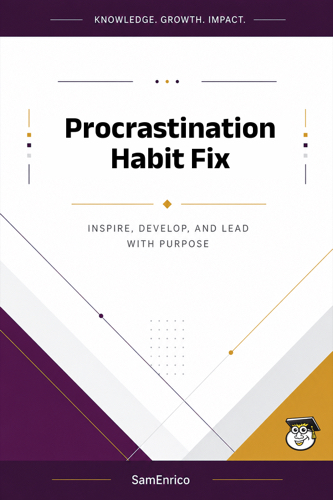
Non-FictionSelf-HelpProcrastination
Procrastination Habit Fix eBook
Apply the two minute rule to overcome task avoidan
Apply the two minute rule to overcome task avoidance instantly.
Formats
Free sample
Chapter 1: The Laziness Lie--–- You are not lazy. Let me say that again, because your entire self-concept probably just flinched: you are not lazy. The belief that procrastination equals laziness is the most expensive myth you will ever buy, because the price of believing it is your self-trust, your peace of mind, and potentially your future. Every time you fail to start a task and then call yourself lazy, you are not describing reality. You are performing an act of psychological self-harm dressed up as honesty.The word "lazy" has ruined more lives than any actual character flaw ever could, because it is not a diagnosis.
It is a verdict. And verdicts end conversations. When you tell yourself "I'm just lazy," you are not opening a path to change. You are closing the investigation. Case closed.
That's who you are. Might as well scroll through your phone for another hour.But what if the entire framework is wrong? What if the people who wake up early, crush their to-do lists, and seem to have infinite willpower are not morally superior to you? What if they have simply stumbled upon a neurological hack that you were never taught? What if procrastination is not a sin but a predictable, understandable, and fixable feature of how your brain processes time, emotion, and reward?This chapter dismantles the laziness lie brick by brick.
By the time you finish reading, you will never call yourself lazy again. Not because you will have "cured" your procrastination—that takes the rest of the book—but because you will understand exactly what is happening inside your skull when you avoid a task. And understanding, as it turns out, is the first and most powerful step toward changing anything.The Neuroeconomics of Putting Things Off Let us begin with a simple experiment you have conducted on yourself thousands of times without realizing it. Imagine two rewards. Reward A: you can watch a ten-minute You Tube video right now, this instant, no waiting, no effort.
Reward B: you can receive a $100 bonus at work, but only if you finish a boring spreadsheet by Friday.Which one feels more compelling in this very moment? If you are like the vast majority of human beings, the You Tube video exerts a gravitational pull that the spreadsheet bonus cannot match. Not because $100 is less valuable than ten minutes of entertainment—rationally, that makes no sense. But because your brain does not process "right now" and "Friday" on the same playing field.This is called present bias, and it is not a bug in your personal software. It is a feature of every human brain.
Present bias means that your brain systematically overvalues immediate rewards and undervalues future rewards. The technical term in behavioral economics is "hyperbolic discounting"—the tendency to discount future benefits at a rate that is not mathematically linear but steeply curved, like a hyperbola. A reward available today feels enormous. A reward available tomorrow feels smaller. A reward available next week feels tiny.
And a reward available next year might as well be imaginary.Your prehistoric ancestors did not need to save for retirement or finish quarterly reports. They needed to eat the berry now, because they might be dead by tomorrow. Your brain is running on operating software that is approximately 200,000 years old, and that software was optimized for a world of immediate threats and immediate opportunities. The modern world—with its 401(k)s, term papers, gym memberships, and six-month projects—is running on hardware that was never designed for it.This is not laziness. This is a mismatch between your neural architecture and your environment.
Calling yourself lazy for struggling with present bias is like calling a fish lazy for struggling to climb a tree. The fish is not lazy. The fish is in the wrong environment.The limbic system—the ancient, emotional, reward-seeking part of your brain—is constantly scanning for immediate pleasure and immediate threat avoidance. The prefrontal cortex—the newer, rational, planning part of your brain—is trying to delay gratification and pursue long-term goals. These two systems are not in balance.
They are in a constant wrestling match, and the limbic system has better muscle memory. It is faster, more automatic, and fueled by neurotransmitters that feel urgent. The prefrontal cortex is slower, more effortful, and easily exhausted.When you procrastinate, your limbic system has won a round. That is all. It is not a moral failure.
It is a neurological event.The Shame Spiral That Makes Everything Worse Here is where most productivity advice gets dangerously wrong. Conventional wisdom says: if you are procrastinating, you should feel bad about it. Guilt is supposed to motivate you. Shame is supposed to whip you into shape. "Get your act together," people say, as if you had simply chosen to leave your act scattered on the floor.But research tells a different story.
A landmark study on procrastination and emotion regulation found that guilt and shame do not reduce future procrastination. They increase it. The mechanism works like this: you avoid a task. You feel ashamed of avoiding it. That shame is unpleasant, so your brain seeks to escape it.
The fastest escape from shame is more avoidance—distraction, numbing, scrolling, cleaning the baseboards, reorganizing your bookshelf alphabetically by color. Avoid the task, feel shame, avoid the shame, avoid the task more. The loop tightens with each rotation.This is called the feedback loop of shame, and it is the engine that transforms occasional delay into chronic procrastination. The first time you put off a task, you might feel a small twinge of discomfort. The tenth time, you feel a wave of self-loathing.
And the twentieth time, the task itself becomes associated not with its actual difficulty but with the crushing weight of all the shame you have accumulated around it.At that point, you are no longer avoiding the spreadsheet. You are avoiding the person you become when you think about the spreadsheet. You are avoiding the version of yourself who has failed to start twenty times in a row. The task has become a mirror, and you do not want to look into it.This explains why punishing yourself for procrastination never works long-term. Punishment increases the emotional charge around the task.
And an increased emotional charge—even a negative one—makes the task feel more aversive. More aversive means more avoidance. More avoidance means more shame. The spiral deepens.The only way out is not to try harder or feel worse. The way out is to lower the emotional stakes so dramatically that your brain stops treating the task like a threat.
And that is exactly what the Two-Minute Rule is designed to do. But we will get to that in later chapters. First, you must fully absorb the truth that you are not broken, and shame is not your friend.The Two-Minute Rule: A First Glimpse Before we go any further, let me introduce the tool that will become the central character of this book. The Two-Minute Rule, in its original form, comes from David Allen's productivity methodology Getting Things Done. Allen's version is deceptively simple: if a task will take you…
This is the end of the free sample. Get the eBook to keep going. Buy now
About this book
Details
- Author
- Schulze Selma
- Publisher
- SamEnrico
- Language
- English
- Genre
- Non-Fiction, Self-Help, Procrastination
- Released
- 2026-06-11
- Pages (approx.)
- 133
- Available as
- eBook, Audiobook

Read better in the ZLOADR app
Your eBooks on your phone or tablet. Sign in with your SamEnrico account and start reading.
More by Schulze Selma
 Nobel Laureates In Membrane TransportSchulze Selma$11.99
 Exit Strategy Small Talk HandbookSchulze Selma$11.99Exit Strategy Small Talk HandbookSchulze Selma$11.99
 Online Support Community WeightSchulze Selma$11.99
 Walking Meditation for Self CompassionSchulze Selma$11.99
 The Last Echoes of the Cherokee Syllabary: A Language on the BrinkSchulze Selma$11.99
 The Djinn’s Forbidden Vow: A Love Beyond TimeSchulze Selma$11.99
 Security ManagementSchulze Selma$11.99
 Fintech Onboarding Checklist GuideSchulze Selma$12.99
 Freemium Community SupportSchulze Selma$12.99
 Understanding Graham–boyle–troxell SyndromeSchulze Selma$17.99
 How to Start a Buffalo Pickers Made of Leather Business (Beginners Guide)Schulze Selma$11.99
You may also like
 Hong Kong Handover 1997Dunn Johnnie$11.99
 Zumba For Postnatal Recovery CourseNeal Christian$11.99
 Zumba for BeginnersLadner Nikia$11.99
 YouTube Comment Mining GuideHumes Pandora$12.99
 Worry Box MeditationCarlin Rudy$11.99
 Workplace Stress MeditationNguyen Lynn$11.99
 Workplace Stress and Sleep RepairHawley Ivory$11.99
 Workplace Perfectionism CureDelaney Jeffry$11.99
 Workplace Injustice Anger GuideWallen Isabelle$11.99
 Work Addiction and Burnout LinkGreenwood Ester$11.99
 Women in Yoga and WellnessBeattie Galina$11.99
 Women in Stand Up ComedyChun Evangeline$11.99