
Non-FictionSelf-HelpFirefighting
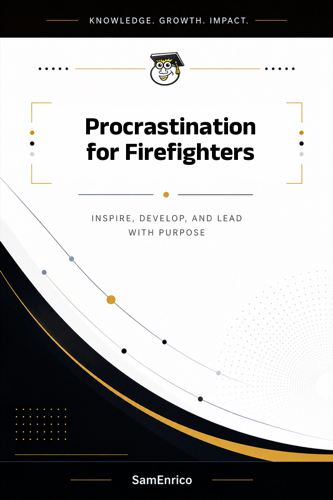
Procrastination for Firefighters eBook
Beats training and equipment delay.
Beats training and equipment delay.
Formats
Free sample
Chapter 1: The Quietest Kill--The morning of April 15, 2013, started like any other Tuesday for the men and women of Engine 4. The overnight had been quiet—a single EMS call at 2:17 AM for a drunken fall, nothing more. The coffee was fresh. The morning report was brief. The lieutenant mentioned that the thermal imaging camera battery had been flashing yellow the night before, but someone had plugged it in—probably—and it would be fine.At 10:48 AM, the tones dropped for a reported structure fire.
Single-family dwelling, basement involved, possibly occupants trapped. Engine 4 rolled out of the bay at 10:51 AM. They arrived on scene at 10:56 AM. By 10:58 AM, the first crew was inside.By 11:03 AM, the thermal imaging camera was dead.The crew spent forty-five seconds fumbling with the power button, then another thirty seconds trying to recall the last time anyone had actually tested the battery under load. They proceeded without it.
The fire had spread into the walls. The basement stairs were compromised. The search took three times longer than it should have. The occupant—a sixty-seven-year-old retired teacher—was found in a rear bedroom, twelve feet from an exit she could not see.She was pronounced dead at 11:47 AM.The after-action report noted that the TIC battery had been on a "maintenance cycle" for eleven days. No one had checked the log.
No one had verified the charge. The yellow flashing light had been seen, noted, and then forgotten—because the morning had been quiet, and the coffee was fresh, and the overnight had only been one drunk fall, and surely someone else would handle it.No one did.And that is how procrastination kills. Not with a bang, not with a dramatic failure, not with a villain in turnout gear making a conscious choice to be lazy. It kills with a yellow flashing light, a Tuesday morning, and the quiet, unspoken agreement that someone else will handle it later.The Most Dangerous Day of Your Career Is a Tuesday with No Calls Let us name the enemy. It is not laziness.
It is not incompetence. It is not a lack of caring. The enemy is the quiet day—the shift where nothing happens, where the routine becomes the rhythm, where the absence of urgency creates the illusion of safety.In the fire service, we are trained to respond to noise. The tones drop, and we move. The alarm sounds, and we run.
The radio crackles with a mayday, and every muscle contracts. We are exquisitely conditioned for emergency. But that conditioning has a dark side: when there is no noise, we relax. We assume that silence equals safety. We assume that because nothing happened yesterday, nothing will happen today.
We assume that the equipment that worked last month still works this month, even though we have not touched it.This is what I call the Complacency Scar. Unlike a physical scar that forms after an injury and reminds you of the wound, a complacency scar forms in the absence of injury. It is the psychological calcification that occurs when nothing bad happens for a long time. Your brain, seeking efficiency, begins to assume that nothing bad will ever happen. The vigilance that kept you alive in year one of your career begins to erode in year five.
By year ten, you are not even aware of the erosion.The research on this is unmistakable. A 2019 study published in the Journal of Fire Service Psychology examined mayday events across fourteen metropolitan departments. The researchers found that 73 percent of mayday calls occurred on shifts that had been classified as "quiet" by the crew—defined as two or more hours without a call prior to the tone. The crews themselves, when interviewed afterward, consistently used the same phrase: "We let our guard down."Let me repeat that. Three-quarters of mayday events happened not on busy, chaotic, high-stress shifts.
They happened on quiet shifts. Shifts where the crew had time to check the equipment—and did not. Shifts where the crew had time to run a drill—and chose not to. Shifts where the yellow flashing light was seen, acknowledged, and then dismissed until later.Later never came.The False Alarm Flu: How Nuisance Calls Vaccinate You Against Urgency There is a second mechanism at work, and it may be even more insidious than the quiet day. I call it the False Alarm Flu.Consider how a vaccine works.
A small, harmless dose of a virus is introduced into your body. Your immune system mounts a response. And then, when the real virus appears, your body is prepared—but also, crucially, your body is less alarmed by the presence of the virus. The immune response is faster but also more routine. The novelty is gone.Now consider the firehouse.
You run a nuisance call—a faulty smoke detector, a cooking fire that self-extinguished, a reported smell of gas that turns out to be a skunk. Your crew responds. You don your gear. You roll out. You arrive.
You investigate. You find nothing. You return to the station. The cycle takes forty-five minutes of adrenaline and zero minutes of actual fire.Do that once a week for a year. Do it twice a week.
Do it on a department that runs medical calls back-to-back, where the only fire you see is in the burn trailer at the annual training day.What happens to your brain?The same thing that happens to your immune system. You become desensitized. The next time the tones drop for a reported structure fire, your brain does not differentiate it from the fifty-three false alarms you ran last year. The same neural pathways activate. The same cortisol pattern emerges.
But the intensity is blunted. You are vaccinated against urgency.This is not a moral failing. It is neurobiology. The brain is designed to conserve energy by treating repeated stimuli as routine. The problem is that in firefighting, the difference between a false alarm and a working fire is the difference between a drill and a funeral.
And your brain cannot tell them apart until it is too late.A 2017 study of dispatch data from the National Fire Incident Reporting System found that departments with high false-alarm rates—more than forty nuisance calls per engine per year—had correspondingly slower response times to confirmed structure fires, even when controlling for distance and traffic. The researchers concluded that "dispatch familiarity" was the primary factor: crews who heard the word "fire" fifty times a year moved with less urgency on the fifty-first time, even when that call was real.The solution is not to stop running nuisance calls. You cannot control what the public reports. The solution is to recognize that the False Alarm Flu exists and to build deliberate countermeasures into every shift. Those countermeasures begin with understanding the cost of "we will do it tomorrow."The Mathematics of "Later": How a Five-Minute Delay Becomes a Funeral Let us talk about numbers.
Firefighters like numbers. They are honest. They do not lie.A five-minute delay in preventive maintenance—postponing the inspection of a worn hose section, skipping the weekly pump test, delaying the replacement of a battery—does not cost five minutes on the…
This is the end of the free sample. Get the eBook to keep going. Buy now
About this book
Details
- Author
- Flores Marcella
- Publisher
- SamEnrico
- Language
- English
- Genre
- Non-Fiction, Self-Help, Firefighting
- Released
- 2026-06-07
- Pages (approx.)
- 142
- Available as
- eBook, Audiobook

Read better in the ZLOADR app
Your eBooks on your phone or tablet. Sign in with your SamEnrico account and start reading.
More by Flores Marcella
 Russian Cigarette SmugglingFlores Marcella$11.99
 The Historical Demand CleanupFlores Marcella$11.99
 Anger And Low Blood SugarFlores Marcella$11.99
 Twenty Minutes Twice DailyFlores Marcella$11.99
 Anger and Job PerformanceFlores Marcella$11.99
 Senior Volunteer EsteemFlores Marcella$11.99
 Death and Rebirth in DreamsFlores Marcella$11.99
 The Renaissance of Speed: The Untold Story of Latin America's First Racing MaestroFlores Marcella$11.99
 The Siege of Chittorgarh: Blood and Honor in the Age of RajputsFlores Marcella$11.99
 The Photographer's Guide to PhotovoiceFlores Marcella$11.99
 Jute: Fiber Plant HarvestingFlores Marcella$11.99
 How to Start a Hobby in Cake DecoratingFlores Marcella$11.99
You may also like
 Hong Kong Handover 1997Dunn Johnnie$11.99
 Zumba For Postnatal Recovery CourseNeal Christian$11.99
 Zumba for BeginnersLadner Nikia$11.99
 YouTube Comment Mining GuideHumes Pandora$12.99
 Worry Box MeditationCarlin Rudy$11.99
 Workplace Stress MeditationNguyen Lynn$11.99
 Workplace Stress and Sleep RepairHawley Ivory$11.99
 Workplace Perfectionism CureDelaney Jeffry$11.99
 Workplace Injustice Anger GuideWallen Isabelle$11.99
 Work Addiction and Burnout LinkGreenwood Ester$11.99
 Women in Yoga and WellnessBeattie Galina$11.99
 Women in Stand Up ComedyChun Evangeline$11.99