
Non-FictionSelf-HelpConsulting
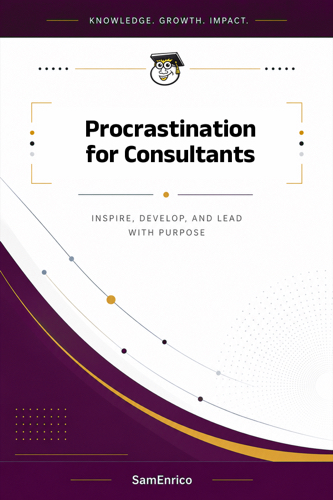
Procrastination for Consultants eBook
Beats deliverables and proposal delay.
by Goble Ma
Beats deliverables and proposal delay.
Formats
Free sample
Chapter 1: The 16-Hour Lie...--The email arrived at 7:32 PM on a Tuesday."Hey Jenna – quick question. The Johnson deck was due at 5 PM. Client just asked where it is. I told them 'any minute.' Can you give me an ETA?"Jenna stared at the screen. Her finger hovered over the reply button.
She had been working on the slides since 9 AM. Twelve hours. Twelve hours of pulling data, formatting charts, rewriting headlines, and moving boxes by two pixels because they felt wrong.She had told her Partner the deck would take six hours.That was Monday.She had nothing to show for Tuesday except 47 versions of the same slide, a growing sense of dread, and a calendar notification for a 9 AM Wednesday check-in that she was already dreading.The truth? The analysis was done by 2 PM. The conclusion was written by 3 PM.
The client's core question—"Should we enter the Brazilian market?"—had been answered with a clear "yes, but only through a distributor partner" by 4 PM.The remaining eight hours were spent on things no one asked for:– A sensitivity analysis with five scenarios (the client wanted two)– A competitor landscape with 12 logos (the client needed three)– A footnote on page 14 about a tax implication in a region the client wasn't even considering Jenna finally hit reply at 9:47 PM. "So sorry for the delay. Wanted to add one more scenario. Sending now." She attached the file. She closed her laptop.
She did not sleep well.The Partner's response arrived at 7:03 AM: "Thanks. Next time, send at 5 PM. We can always add scenarios later."Jenna had just learned the most expensive lesson in consulting: Perfectionism is not a virtue. It is a tax on your margin, your reputation, and your sleep.This book is about paying that tax less often.The Consulting Procrastination Paradox Here is the thing that no one tells you in onboarding. You are not lazy.
You are not disorganized. You are not bad at your job.You are a high achiever who has been trained to believe that "more" equals "better." More analysis. More slides. More scenarios. More footnotes.
And because you believe this, you delay delivery until you have added everything you can imagine.This is the Consulting Procrastination Paradox:The very traits that make you a good consultant—thoroughness, diligence, client focus, analytical rigor—are the same traits that make you late.General procrastination research (Burka & Yuen, Pychyl, Tracy) focuses on people who avoid work because it is boring, difficult, or anxiety-provoking. That is not you. You do not avoid work. You overwork. You add.
You polish. You expand. And then you deliver late—not because you were watching Netflix, but because you were adding a 13th footnote to a slide that only needed three.This chapter is about understanding why you do this and learning the first and most important tool to stop: distinguishing between real work and perfectionism work.The Opening Scene: A Story You Recognize Let me tell you about David. David is a senior consultant at a mid-tier strategy firm. He is smart, dedicated, and well-liked.
He is also chronically late.I interviewed David for this book. He gave me permission to share his story if I changed his name.The Project: A three-week diagnostic for a retail client. The deliverable was a 20-slide deck answering one question: "Why are our same-store sales declining?"The Estimate: David told his Partner the analysis would take 40 hours. He believed it.The Reality: David spent 72 hours. Thirty-two hours over budget.
On a fixed-fee project, that meant he worked 32 hours for free.Where did the time go? I asked David to walk me through his week.Day Planned Actual Gap Monday Pull sales data (4 hrs)Pulled data, then ran 3 extra segmentations "just in case" (7 hrs)+3Tuesday Build initial charts (6 hrs)Built charts, then reformatted all colors, fonts, and axis labels (10 hrs)+4Wednesday Draft conclusions (4 hrs)Wrote conclusions, then added 2 alternative scenarios "for completeness" (7 hrs)+3Thursday Review with Partner (4 hrs)Sat on draft for 3 hours "re-checking numbers" before sending (7 hrs)+3Friday Finalize and send (2 hrs)Added an appendix with "full methodology" (5 hrs)+3Total overage: 16 hours. A full two days of work. On a fixed-fee project, those 16 hours were a 40% margin eraser.When I asked David why he added the extra segmentations, the alternative scenarios, and the full methodology appendix, he paused for a long time. Then he said: "I was afraid that if I didn't include everything, the Partner would ask for it later.
And then I'd have to do it anyway. So I just did it upfront."This is the core delusion of consulting procrastination. Let me name it for you.The "Just in Case" Fallacy The "Just in Case" Fallacy is the belief that doing work before it is requested saves time later.It is almost always wrong.Here is what actually happens when you do work "just in case":You spend time on something the client or Partner may never ask for.That time is taken away from something they definitely need (like on-time delivery).The work you did "just in case" is often wrong because you did not have the context of their actual question.When they finally see it, they say, "Oh, we don't need that. But can you add this other thing instead?"The "Just in Case" Fallacy is driven by a specific flavor of perfectionism: Perfectionism of Scope.Perfectionism of Scope is the belief that more features, more slides, more scenarios, and more data points automatically create more value for the client.They do not.In fact, research on executive decision-making shows that adding more information beyond a certain point reduces confidence in the recommendation. A study in the Journal of Behavioral Decision Making found that executives rated recommendations as less trustworthy when accompanied by more than three supporting data points.
Three was the sweet spot. Four or more felt like "overwhelm" or "overcompensating."The client does not want your 12 scenarios. They want your best recommendation and a clear rationale. The Partner does not want your 47 slides. They want a story they can tell in under 10 minutes.
The CEO does not want your methodology appendix. They want to know one thing: Should I do this or not?Everything else is perfectionism work—work that makes you feel smart, thorough, and prepared, but adds zero value to the person paying for it.Real Work vs. Perfectionism Work: The 2x2 Matrix Let me give you a framework that will save you hundreds of hours over your career.Draw a 2x2 matrix. The X-axis is Value to Client (low to high). The Y-axis is Perfectionism Driver (low to high—meaning the work is driven by your anxiety rather than client need).Here is where consulting activities land:Low Perfectionism Driver High Perfectionism Driver High Value to Client Real Work (Answer the core question, 3 supporting data points, clear recommendation)Over-engineered Real Work (The same answer, but with 12 slides, 2 extra scenarios, and a methodology appendix)Low Value to Client Necessary Administration (Timesheets, expense reports, scheduling)Perfectionism Work (Reformatting slides for 2 hours, reading 17 industry reports, adding footnotes no one will read)Your job is to spend as much time as possible in the top-left quadrant (Real Work) and as…
This is the end of the free sample. Get the eBook to keep going. Buy now
About this book
Details
- Author
- Goble Ma
- Publisher
- SamEnrico
- Language
- English
- Genre
- Non-Fiction, Self-Help, Consulting
- Released
- 2026-06-05
- Pages (approx.)
- 146
- Available as
- eBook, Audiobook

Read better in the ZLOADR app
Your eBooks on your phone or tablet. Sign in with your SamEnrico account and start reading.
More by Goble Ma
 Anger After Brain Injury GuideGoble Ma$11.99
 Ukrainian Organized CrimeGoble Ma$11.99
 The Spare Parts Safety StockGoble Ma$11.99
 Verbal De escalation SkillsGoble Ma$11.99
 Senior Self Worth After LossGoble Ma$11.99
 British Empire Statue WarsGoble Ma$11.99
 The Trickster ArchetypeGoble Ma$11.99
 The Crown and the Crown: How a 19th-Century Royal Wedding Broke Protocol and Sparked a ScandalGoble Ma$11.99
 The Maestro of Chaos: Marcelo Bielsa and the Revolution of Tactical Football in Latin AmericaGoble Ma$11.99
 How to Produce Water-based DuctsGoble Ma$11.99
 The Photographer's Guide to Monochrome PhotographyGoble Ma$11.99
 How to Produce a Power TillerGoble Ma$11.99
You may also like
 Hong Kong Handover 1997Dunn Johnnie$11.99
 Zumba For Postnatal Recovery CourseNeal Christian$11.99
 Zumba for BeginnersLadner Nikia$11.99
 YouTube Comment Mining GuideHumes Pandora$12.99
 Worry Box MeditationCarlin Rudy$11.99
 Workplace Stress MeditationNguyen Lynn$11.99
 Workplace Stress and Sleep RepairHawley Ivory$11.99
 Workplace Perfectionism CureDelaney Jeffry$11.99
 Workplace Injustice Anger GuideWallen Isabelle$11.99
 Work Addiction and Burnout LinkGreenwood Ester$11.99
 Women in Yoga and WellnessBeattie Galina$11.99
 Women in Stand Up ComedyChun Evangeline$11.99