
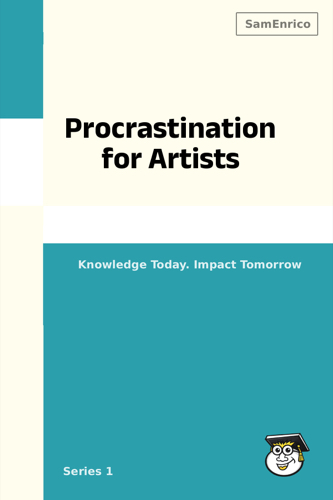
Procrastination for Artists eBook
Beats creative block and studio delay.
Beats creative block and studio delay.
Formats
Free sample
Chapter 1: The Resistance Compass--–- You have been lied to. The lie is whispered by well-meaning teachers, repeated in glossy Instagram quotes, and reinforced every time a successful artist says, “The painting just flowed out of me.” The lie is this: Real creativity feels easy. When struggle appears—when the brush feels heavy, the sentence won’t come, the melody sounds like garbage—you conclude something terrible about yourself. You are a fraud. You have lost your talent.
The universe is trying to tell you that this project was never meant to exist.So you stop. You close the notebook. You wipe the canvas. You tell yourself you will come back to it when inspiration returns. And then you wait.
Days become weeks. Weeks become months. The project rots in a folder called “Someday.” You tell yourself you are being realistic. You are being honest about your limitations. You are saving yourself from the humiliation of making something bad.You are wrong.
You are not being realistic. You are being outmaneuvered by a force that every working artist learns to recognize, name, and fight. That force is called Resistance.The Force You’ve Been Fighting Alone Resistance is the invisible enemy that rises up specifically when you are about to do meaningful, soul-deepening work. It is not laziness. It is not a lack of discipline.
It is not a character flaw. Resistance is a reaction—like your immune system attacking a foreign body—and the foreign body is the act of creation itself.Here is the paradox that will save your creative life: The harder Resistance fights you, the more important the work is to your growth.Think about that for a moment. When you sit down to do something easy—scroll through social media, reorganize your bookshelf, answer low-stakes emails—Resistance is silent. It doesn't care about those tasks. But when you sit down to do the thing that matters—the painting that scares you, the song you’ve been avoiding, the script that feels too personal—Resistance shows up with both fists.
It gives you a headache. It reminds you of that one mean comment from 2018. It convinces you that you need to clean the bathroom immediately.Resistance is not a sign you are on the wrong path. Resistance is a confirmation you are on the right one.This insight was crystallized by Steven Pressfield in his essential book The War of Art, and it forms the bedrock of everything that follows in this book. Every professional artist—every painter who fills galleries, every musician who tours, every writer who finishes novels—has learned to recognize Resistance as the cost of doing business.
The amateur sees Resistance and quits. The professional sees Resistance and says, “Good. That means I’m aiming at something that matters.”The Three Disguises of Resistance Resistance is a shapeshifter. It never looks the same way twice. Learning to recognize its disguises is the first step to beating it.
Here are the three most common masks Resistance wears in the artist’s studio.Disguise #1: The Sudden Urgency of Everything Else You sit down to work. Your brush touches the canvas. And suddenly—suddenly—you remember that you haven’t replied to your mother’s text from three days ago. And your car needs an oil change. And you really should organize your reference photos.
And have you checked your email in the last twenty minutes? What if something important arrived?This is not distraction. This is Resistance wearing the mask of urgency. It floods your brain with plausible, reasonable, even responsible tasks because it knows you are a good person who wants to be responsible. And it works.
You put down the brush. You send the text. You check the email. You spend forty-five minutes organizing your reference photos. You feel productive.
You feel virtuous. You have not made a single mark.The tell: True urgency is rare. Most “urgent” tasks can wait ninety minutes. Resistance knows this and lies anyway.Disguise #2: The Seduction of Preparation This disguise is especially seductive because it feels like work. You decide you are finally going to start that project.
But first, you need the right tools. You spend three hours researching brushes. You watch eleven You Tube tutorials about color mixing. You reorganize your studio. You make a detailed schedule.
You create a beautiful mood board. You have done everything except make the thing.Resistance loves preparation because preparation is infinite. You can prepare forever. You can research, plan, organize, and optimize until you die, and you will never have to face the terror of the blank page.The tell: If you have spent more time researching than doing, Resistance has won. The tools you have right now are enough.
The space you have right now is enough. Stop preparing. Start making.Disguise #3: The Self-Diagnosis of Inadequacy This is the cruelest disguise. You sit down to work, and a voice says: “You’re not good enough to do this. You need more training.
You should take another class. Read another book. Wait until you feel ready.” This voice sounds reasonable. It sounds humble. It sounds like honest self-assessment.It is none of those things.
It is Resistance wearing the mask of humility. And it is lying.You will never feel ready. Readiness is a myth. Every artist who has ever made something great made it while terrified, under-qualified, and convinced they were about to be exposed as a fraud. The only difference between them and you is that they started anyway.The Strawberry Alarm Clock: How Professionals Work Let me tell you about the Strawberry Alarm Clock.
It’s a concept I first encountered in the writing of Brian Koppelman, the screenwriter behind Rounders and Billions, and it changed how I think about creativity forever.The Strawberry Alarm Clock is a cheap, plastic children’s alarm clock shaped like a strawberry. It’s the kind of thing you would buy at a drugstore for nine dollars. And here is how the professional uses it: they set it for the same time every day. When it goes off, they start working. They do not ask how they feel.
They do not check if they are inspired. They do not wait for the muse to arrive. The alarm goes off, and they work.The amateur waits for inspiration. The professional sets the alarm.This is not romantic. It is not glamorous.
It is the opposite of every movie about tortured artists having breakthroughs at 3 AM. But it is how real work gets made. Mozart wrote music every morning, regardless of mood. Maya Angelou rented a hotel room and arrived at 6 AM, even when she didn’t feel like writing. Picasso painted every single day.
Not because every day was inspired. Because showing up is the only thing that works.The Myth of the Tortured Artist Before we go any further, we need to kill a myth. The myth is that creativity requires suffering—that great art emerges from pain, and that if you aren’t suffering, you aren’t a real artist. This myth has destroyed more creative careers than any other single belief.Here is the truth: effort is required. Struggle is required.…
This is the end of the free sample. Get the eBook to keep going. Buy now
About this book
Details
- Author
- Barnes Kristen
- Publisher
- SamEnrico
- Language
- English
- Genre
- Non-Fiction, Self-Help, Art
- Released
- 2026-06-07
- Pages (approx.)
- 126
- Available as
- eBook, Audiobook

Read better in the ZLOADR app
Your eBooks on your phone or tablet. Sign in with your SamEnrico account and start reading.
More by Barnes Kristen
 Russian Doping Cover Up CrimeBarnes Kristen$11.99
 Anger And Envy ManagementBarnes Kristen$11.99
 The Newsvendor Safety StockBarnes Kristen$11.99
 Teacher Anger Management GuideBarnes Kristen$11.99
 Senior Financial EsteemBarnes Kristen$11.99
 Stress Reduction Through TMBarnes Kristen$11.99
 Bankruptcy Insurance ClaimBarnes Kristen$12.99
 Sun and Moon in Jungian DreamsBarnes Kristen$11.99
 Nancy Ajram: The Voice That United a RegionBarnes Kristen$11.99
 The Forgotten Derby: How Two Immigrant Clubs United a Nation in 1920s AmericaBarnes Kristen$11.99
 Lamb's Lettuce: Corn SaladBarnes Kristen$11.99
 How to Produce Practice PadsBarnes Kristen$11.99
You may also like
 Hong Kong Handover 1997Dunn Johnnie$11.99
 Zumba For Postnatal Recovery CourseNeal Christian$11.99
 Zumba for BeginnersLadner Nikia$11.99
 YouTube Comment Mining GuideHumes Pandora$12.99
 Worry Box MeditationCarlin Rudy$11.99
 Workplace Stress MeditationNguyen Lynn$11.99
 Workplace Stress and Sleep RepairHawley Ivory$11.99
 Workplace Perfectionism CureDelaney Jeffry$11.99
 Workplace Injustice Anger GuideWallen Isabelle$11.99
 Work Addiction and Burnout LinkGreenwood Ester$11.99
 Women in Yoga and WellnessBeattie Galina$11.99
 Women in Stand Up ComedyChun Evangeline$11.99