
Non-FictionSelf-HelpProcrastination
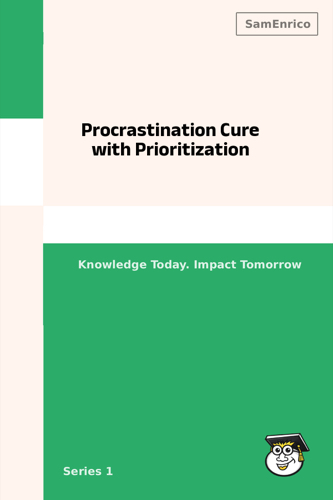
Procrastination Cure with Prioritization eBook
Teaches using ABCDE to break down overwhelming tas
by Sawyer Ute
Teaches using ABCDE to break down overwhelming tasks into doable steps.
Formats
Free sample
Chapter 1: The List That Lies--–- Every morning, millions of people perform a ritual they believe will save them. They sit down with a coffee, open a notebook or a digital app, and write a list of everything they need to do. Ten items. Fifteen. Sometimes twenty.
They feel a small rush of control as the chaos of their obligations becomes neat black text on a white page. Then they look at the list, choose the easiest, smallest, most satisfying task—usually email—and complete it. Then another easy one. Then another. Eight hours later, they close their laptop exhausted, convinced they have worked hard.
But the one thing that actually mattered? The big, difficult, slightly scary task that was sitting at the bottom of the list? It remains untouched. And it will remain untouched tomorrow, and the day after, until it becomes a screaming crisis.This is not productivity. This is a trap.The traditional to-do list, used by billions of people around the world, is not a tool for getting things done.
It is, in fact, one of the most effective procrastination devices ever invented. It hides the hard tasks behind easy ones. It rewards you for doing small, meaningless work while allowing you to avoid the work that actually changes your life. And worst of all, it makes you feel busy—that dangerous, seductive feeling of motion without progress. Busy is not productive.
Busy is the comfortable blanket you wrap around yourself to avoid the cold discomfort of your most important work.This chapter will dismantle everything you think you know about to-do lists. It will introduce two foundational frameworks—the Pareto Principle and the Eisenhower Matrix—that will rewire how you see every task on your plate. And by the end, you will understand why your current system is failing you and what must change before any prioritization method can work.The Comfort of the Easy Task Let us begin with an experiment. Think about your to-do list from yesterday. Write it down mentally.
Now answer this question honestly: which task did you complete first?If you are like ninety percent of the people who have taken this test, you completed the easiest, quickest, least emotionally demanding task first. Perhaps you answered a few routine emails. Perhaps you organized your desktop folders. Perhaps you printed documents for a meeting next week. These tasks require almost no cognitive effort.
They produce a small, reliable hit of dopamine—the neurotransmitter associated with pleasure and reward—because completing anything, no matter how trivial, triggers a sense of accomplishment.Here is the problem. That small hit of dopamine is addictive. Your brain learns that easy tasks feel good and hard tasks feel bad. So the next time you look at your list, your brain will subtly guide your attention toward the easy tasks again. And again.
And again. By the time you finally run out of easy tasks, you are mentally exhausted, and the hard task—the one that requires creativity, courage, or concentration—seems insurmountable. So you push it to tomorrow. Tomorrow, the same thing happens. This is the procrastination loop, and the traditional to-do list is its perfect engine.Consider the research of Dr.
Piers Steel, a psychologist who has spent decades studying procrastination. In his meta-analysis of over twenty years of studies, Steel found that people consistently choose tasks with three characteristics: they are pleasant, they are easy, and they provide immediate feedback. The traditional to-do list does nothing to discourage this. In fact, it encourages it by presenting all tasks as visually equal. A ten-minute email and a three-hour strategic plan sit side by side, looking identical on the page.
Your brain, being efficient, will always choose the ten-minute email.This is not a character flaw. This is how the human brain evolved. Our ancestors did not need to complete long-term strategic projects. They needed to find food, avoid predators, and seek immediate rewards. The modern workplace demands exactly the opposite: delayed gratification, sustained focus on abstract goals, and the ability to tolerate discomfort for hours or days.
You are not broken. You are using a tool—the simple to-do list—that was never designed for the job you are asking it to do.The 80/20 Rule: Why Most of Your Work Doesn't Matter In 1906, Italian economist Vilfredo Pareto made an observation that would eventually change how the world thinks about productivity. He noticed that approximately twenty percent of the pea pods in his garden contained eighty percent of the peas. This uneven distribution fascinated him, and he soon found the same pattern everywhere: twenty percent of the people owned eighty percent of the land; twenty percent of his clients generated eighty percent of his revenue.Decades later, management consultant Joseph Juran named this pattern the Pareto Principle, or the 80/20 Rule. And it has since been validated in countless domains.
Twenty percent of your customers produce eighty percent of your sales. Twenty percent of your products produce eighty percent of your profits. Twenty percent of your efforts produce eighty percent of your results.Here is the uncomfortable implication for your to-do list: approximately twenty percent of the tasks on your list will produce eighty percent of the value. The other eighty percent of your tasks—the majority of what you do every day—produce only twenty percent of the results. You are spending eighty percent of your time on things that barely matter.Stop and let that land.
If you work a forty-hour week, you are likely spending thirty-two hours on low-value tasks and only eight hours on high-value tasks. Flip that ratio, and you would accomplish in one week what currently takes you five. But you cannot flip the ratio until you can identify which tasks belong to the vital twenty percent.Most people cannot identify them because they have never been taught to look. They operate under the implicit assumption that all tasks are roughly equal. Answering an email and writing a business proposal feel different, sure, but they both go on the same list, and they both get checked off.
This is a catastrophic error. An email takes two minutes and produces almost no long-term value. A business proposal might take three hours and produce a hundred thousand dollars in revenue. They are not the same. They are not even in the same universe.
But your to-do list treats them as identical.The Pareto Principle forces you to ask a question that most people never ask: what is the twenty percent of my work that produces eighty percent of my results? For a salesperson, it might be the twenty percent of clients who generate most of the revenue. For a writer, it might be the twenty percent of hours spent in deep, uninterrupted writing. For a manager, it might be the twenty percent of strategic decisions that drive team performance. Once you identify that twenty percent, you have found your true work.
Everything else is noise.This chapter will not yet tell you how to restructure your entire day around the 80/20 Rule. That will come later. But you must internalize the principle now because every method in this book depends on it. The ABCDE…
This is the end of the free sample. Get the eBook to keep going. Buy now
About this book
Details
- Author
- Sawyer Ute
- Publisher
- SamEnrico
- Language
- English
- Genre
- Non-Fiction, Self-Help, Procrastination
- Released
- 2026-06-09
- Pages (approx.)
- 150
- Available as
- eBook, Audiobook

Read better in the ZLOADR app
Your eBooks on your phone or tablet. Sign in with your SamEnrico account and start reading.
More by Sawyer Ute
 Personal Ing For Success Podcast GuestingSawyer Ute$11.99
 Cocaine Addiction Recovery HandbookSawyer Ute$11.99
 Opioid Induced Androgen DeficiencySawyer Ute$11.99
 No Hot Water High AchieverSawyer Ute$11.99
 The Frozen Cure: A Scientist’s Race Against Time in the Middle East’s Arctic WastelandSawyer Ute$11.99
 The Last Broadcast: The Night the Radio Towers FellSawyer Ute$11.99
 Understanding Blaichman SyndromeSawyer Ute$17.99
 Bootcamp Networking Value TestSawyer Ute$12.99
 Alibaba Trade Assurance Deep DiveSawyer Ute$12.99
 Special Effects TechnicianSawyer Ute$11.99
 How to Start a Powder Made of Copper Business (Beginners Guide)Sawyer Ute$11.99
You may also like
 Hong Kong Handover 1997Dunn Johnnie$11.99
 Zumba For Postnatal Recovery CourseNeal Christian$11.99
 Zumba for BeginnersLadner Nikia$11.99
 YouTube Comment Mining GuideHumes Pandora$12.99
 Worry Box MeditationCarlin Rudy$11.99
 Workplace Stress MeditationNguyen Lynn$11.99
 Workplace Stress and Sleep RepairHawley Ivory$11.99
 Workplace Perfectionism CureDelaney Jeffry$11.99
 Workplace Injustice Anger GuideWallen Isabelle$11.99
 Work Addiction and Burnout LinkGreenwood Ester$11.99
 Women in Yoga and WellnessBeattie Galina$11.99
 Women in Stand Up ComedyChun Evangeline$11.99