

Non-FictionSelf-HelpTime Management
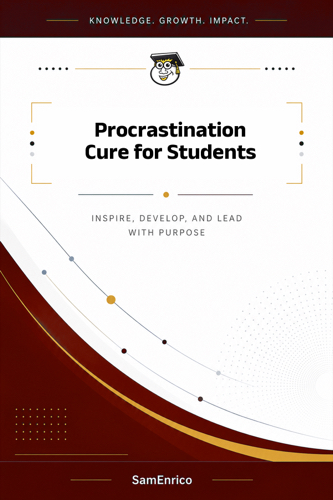
Procrastination Cure for Students eBook
Break the cycle of last-minute panic using task ch
Break the cycle of last-minute panic using task chunking and reward systems.
Formats
Free sample
Chapter 1: The Comfort Monkey--–- The first time I watched a student cry over a single sentence, I knew we had the problem completely backwards.Her name was Maya, a second-year pre-med student with a 3.9 GPA, seven extracurricular activities, and the kind of schedule that would make a CEO beg for a nap. She was not lazy. She was not undisciplined. She was not looking for an excuse. And yet, there she sat in my study skills workshop, tears streaming down her face, because she had spent the last six hours trying to write the opening sentence of a two-page reflection paper.Six hours.
One sentence.“I don’t understand what’s wrong with me,” she whispered, so quietly that the microphone barely picked it up. “I’ve had two weeks to do this. It’s only two pages. My roommate wrote hers in an hour. Why can’t I just… do it?”I asked her what she did during those six hours.
She opened her laptop. She stared at the blinking cursor. She typed a word, deleted it, typed another word, deleted that too. She opened a new tab and checked Instagram. She watched three “study with me” videos on You Tube.
She reorganized her desk. She made tea. She scrolled through her syllabus to see if maybe the deadline had been extended (it had not). She cried. She closed her laptop.
She opened it again. Then she came to my workshop, hoping for a miracle.Here is what I did not tell her that day, because I did not yet know it: Maya was not broken. She was not weak. She was not a procrastinator in the way she had been led to believe. She was, instead, the unwilling host of two competing internal forces that every student carries—and almost nobody understands.This book is the manual I wish I had handed her.The Myth of Laziness Let us begin by slaughtering a sacred cow.The word “procrastination” comes from the Latin procrastinatus: “pro-” (forward) and “crastinus” (belonging to tomorrow).
To procrastinate is to put off until tomorrow. But somewhere along the way, that neutral description became a moral indictment. We stopped saying “I am postponing this task” and started saying “I am lazy.” We stopped seeing a behavior and started seeing a character flaw.This is not merely inaccurate. It is actively destructive.When a student believes they are lazy, they stop looking for solutions and start looking for validation. They say things like “I’m just not a morning person” or “I work better under pressure” or “I have procrastination anxiety”—as if these were permanent personality traits carved into their bones.
They build identities around their inability to start. And once something becomes your identity, changing it feels like betraying who you are.But here is the truth that the multi-billion-dollar productivity industry does not want you to hear: Procrastination is not a character defect. It is a biological defense mechanism.Your brain is not betraying you when it avoids a difficult task. It is trying to protect you. It is just using a very old map to navigate a very new world.The Two Wolves Inside Your Skull To understand why Maya spent six hours avoiding one sentence, we need to take a brief tour of your brain.
I promise to keep the neuroscience painless and the metaphors vivid.Imagine that inside your skull, there are two distinct systems battling for control. Neuroscientists call them the limbic system and the prefrontal cortex. I am going to call them something more memorable: the Comfort Monkey and the Planner.The Comfort Monkey is the older of the two. It has been around for hundreds of millions of years. Every creature with a central nervous system has something like it.
The Comfort Monkey cares about one thing and one thing only: immediate survival and pleasure. It wants you to eat when you are hungry, sleep when you are tired, seek warmth when you are cold, and—crucially—avoid anything that feels difficult, uncertain, or threatening.The Comfort Monkey does not understand deadlines. It does not understand grades. It does not understand that writing a two-page reflection paper today will prevent a crisis tomorrow. The Comfort Monkey lives in an eternal present tense, and its entire worldview can be summarized in five words: If it feels bad, stop.The Planner is the younger system.
It lives in your prefrontal cortex, just behind your forehead, and it is the most recent evolutionary upgrade to the mammalian brain. The Planner can think about the future. It can delay gratification. It can understand that struggling through a difficult textbook chapter today will lead to a passing grade in December. The Planner is the voice that says, “I really should start that paper.”Here is the problem: the Planner is weak.
It tires easily. It requires energy, glucose, and rest to function. The Comfort Monkey, by contrast, is ancient, powerful, and always on. When the Planner is rested and fed, it can keep the Monkey in check for a few hours. But the moment the Planner gets tired—after a long day of classes, after a difficult conversation, after scrolling through social media for forty-five minutes—the Monkey breaks free.And the Monkey does not negotiate.When Maya sat down to write her paper, her Planner said, “Okay, let’s write the first sentence.” But her Comfort Monkey looked at that blank page and saw a threat.
Writing is hard. What if the sentence is bad? What if the professor hates it? What if I write something stupid and everyone realizes I’m not actually smart? The Monkey felt fear.
And fear, to the Monkey, is a signal to run away and seek comfort.So Maya checked Instagram. That felt good. She watched study videos. That felt productive without being difficult. She reorganized her desk.
That felt like progress without any risk. She made tea. That felt warm and safe.Every single one of those behaviors was the Comfort Monkey successfully protecting her from a perceived threat. The tragedy is that the threat was not real. A blank page cannot hurt you.
A bad sentence will not end your academic career. But try telling that to a three-hundred-million-year-old survival system that still thinks you might be eaten by a saber-toothed tiger every time you feel uncertain.The Panic Monster: Why You Only Work at 2 AMThere is a third character in this drama, and it is the one that creates the experience Maya knew so well: the last-minute adrenaline rush that finally, finally gets you to start working at 2 AM the night before the deadline.I call it the Panic Monster.The Panic Monster lives in your amygdala, the brain’s emergency response center. Unlike the Comfort Monkey (always on) or the Planner (easily tired), the Panic Monster sleeps most of the time. It only wakes up when it detects a genuine, near-term threat to your survival or your social standing. And here is the crucial insight: for the Panic Monster, a deadline is a threat.When a deadline is seven days away, the Panic Monster does not care.
Seven days is not an emergency. The Comfort Monkey is still in charge, and the Monkey is very happy to…
This is the end of the free sample. Get the eBook to keep going. Buy now
About this book
Details
- Author
- Draper Vanesa
- Publisher
- SamEnrico
- Language
- English
- Genre
- Non-Fiction, Self-Help, Time Management
- Released
- 2026-06-07
- Pages (approx.)
- 153
- Available as
- eBook, Audiobook

Read better in the ZLOADR app
Your eBooks on your phone or tablet. Sign in with your SamEnrico account and start reading.
More by Draper Vanesa
 Sales Relationship Building GuideDraper Vanesa$11.99
 Self Hypnosis For Emotional RegulationDraper Vanesa$11.99
 Physical Strain ManualDraper Vanesa$11.99
 Menopause Transition PeriodsDraper Vanesa$11.99
 Shadows of the Silk Road: The Forgotten War of the SteppeDraper Vanesa$11.99
 The Clockwork Tide: Medieval Automation in the Indian OceanDraper Vanesa$11.99
 Data Operations SpecialistDraper Vanesa$11.99
 How to Become a Career-guidance TechnicianDraper Vanesa$11.99
 Understanding Ectodermal DysplasiaDraper Vanesa$17.99
 Voiceover Website GuideDraper Vanesa$12.99
 Brazil Data Protection GuideDraper Vanesa$12.99
You may also like
 Hong Kong Handover 1997Dunn Johnnie$11.99
 Zumba For Postnatal Recovery CourseNeal Christian$11.99
 Zumba for BeginnersLadner Nikia$11.99
 YouTube Comment Mining GuideHumes Pandora$12.99
 Worry Box MeditationCarlin Rudy$11.99
 Workplace Stress MeditationNguyen Lynn$11.99
 Workplace Stress and Sleep RepairHawley Ivory$11.99
 Workplace Perfectionism CureDelaney Jeffry$11.99
 Workplace Injustice Anger GuideWallen Isabelle$11.99
 Work Addiction and Burnout LinkGreenwood Ester$11.99
 Women in Yoga and WellnessBeattie Galina$11.99
 Women in Stand Up ComedyChun Evangeline$11.99