
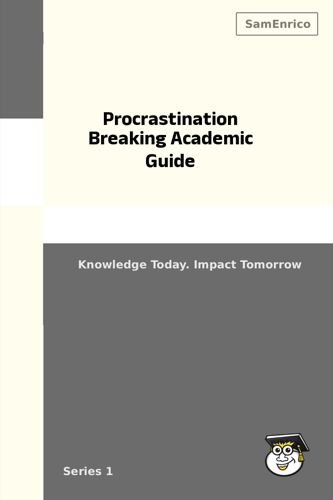
Non-FictionSelf-HelpProcrastination
Procrastination Breaking Academic Guide eBook
Uses pomodoro technique and task decomposition to
Uses pomodoro technique and task decomposition to overcome study avoidance.
Formats
Free sample
Chapter 1: The Pain Before the Page--You are not lazy. Let me say that again because you probably didn’t believe it the first time: you are not lazy. You are sitting there—maybe with three tabs open, a cold cup of coffee, and a document that has been blank for forty-seven minutes—and you feel like a fraud. You watch classmates post their progress on social media. You see the deadline approaching on your calendar.
You have told yourself “I’ll start in ten minutes” five times in the last hour. And underneath all of that is a quiet, toxic whisper: What is wrong with me?The answer, which might be the most liberating sentence you read this year, is this: nothing is wrong with you. You are experiencing a predictable, well-documented, and entirely surmountable neurological conflict. The problem is not your character. The problem is not your work ethic.
The problem is that your brain, through no fault of your own, has learned to treat your academic work as a threat. And brains are very, very good at avoiding threats.This chapter will show you the hidden machinery of procrastination. You will learn why staring at a blank page activates the same neural circuits as physical pain. You will discover the crucial difference between task paralysis and genuine laziness—a distinction that will change how you talk to yourself. And you will be introduced to the single most important metric in this entire book: the Activation Energy gap between how hard a task feels and how hard it actually is.
By the end of this chapter, you will stop asking “Why am I like this?” and start asking “What is my brain trying to protect me from?” That shift in framing is the first brick in the wall.The Pain of Beginning In 2011, a team of researchers at the University of Sheffield did something slightly cruel to a group of undergraduate students. They placed the students inside f MRI machines—those claustrophobic tubes that measure brain activity through changes in blood flow—and then showed them a series of prompts. Some prompts were neutral: “think about a tree” or “imagine a calm beach.” Other prompts were designed to trigger the specific anxiety of academic work: “you have to write a 500-word essay in the next ten minutes” and “your essay will be graded by a panel of professors.”The results were astonishing. When students saw the academic prompts, the same brain regions lit up that activate when a person experiences physical pain. The anterior insula and the dorsal anterior cingulate cortex—these are the areas that scream ouch when you touch a hot stove—were just as active during the anticipation of writing an essay as they were during actual physical discomfort.
The brain, in other words, does not distinguish neatly between a threat to your body and a threat to your self-esteem. Both register as danger.This is not a metaphor. This is not a productivity guru telling you to “push through the pain.” This is neuroscience: your brain literally, measurably, physiologically responds to academic tasks as if they were mild physical threats. And what does a brain do when it perceives a threat? It avoids.
It distracts. It seeks safety in the nearest available pleasure—a snack, a scroll through social media, a video, anything except the thing that hurts.Let that land for a moment. Every time you have avoided opening a reading, delayed starting a paper, or spent an hour reorganizing your folder structure instead of writing, your brain was not being lazy. Your brain was being protective. It was trying to keep you safe from the anticipated pain of failure, judgment, or inadequacy.
The problem is that the protection is mis-calibrated. Your thesis cannot hurt you. Your professor’s feedback cannot cause physical harm. But your brain, evolutionarily designed to prioritize survival over success, does not know the difference.This is why willpower-based advice fails. When someone tells you “just do it” or “push through the discomfort,” they are asking you to override a survival instinct with conscious effort.
That is possible sometimes, for short bursts, but it is exhausting. It is like trying to hold a beach ball underwater—the moment your attention slips, the ball rockets back to the surface. The beach ball is not weak. It is doing exactly what it was designed to do. And so are you.Task Paralysis vs.
Genuine Laziness One of the most damaging myths in academic culture is the equation of procrastination with laziness. They are not the same. They feel different, look different, and require completely different solutions. Understanding this distinction is the first step toward self-compassion—and self-compassion, as we will see throughout this book, is not soft. It is strategic.Genuine laziness is rare.
A genuinely lazy person does not feel bad about not working. They are not anxious about the deadline. They do not scroll through their phone while thinking I should be studying because the thought “I should be studying” never occurs to them. They are simply content to do nothing. Laziness is low arousal, low guilt, and low distress.
It is choosing to rest without the accompanying voice of self-criticism.Task paralysis is the opposite. Task paralysis is high arousal, high guilt, and high distress. You want to work. You intend to work. You have cleared your schedule, opened your laptop, and told yourself “today is the day.” And then you sit there.
The cursor blinks. Your heart rate increases slightly. You open a new tab “just to check something.” Two hours later, you have accomplished nothing, and you feel like a failure. The defining feature of task paralysis is the gap between intention and action—not the absence of intention.You can test this distinction on yourself right now. Think about the task you have been avoiding.
Ask yourself: when I imagine doing it, do I feel nothing (laziness) or do I feel a knot in my stomach, a tightening in my chest, a sense of dread or anxiety (task paralysis)? For the vast majority of students who pick up a book with a title like this one, the answer is the second. You are not avoiding work because you do not care. You are avoiding work because you care too much—and your brain has learned to protect you from the anticipated sting of falling short.This is why shame is such a terrible motivator. Shame tells you “you are bad for not working.” But your brain hears “the thing you are not doing is dangerous” and doubles down on avoidance.
The more you shame yourself, the more your brain tries to protect you. The more your brain tries to protect you, the less you work. The less you work, the more you shame yourself. This is the procrastination loop, and it is not broken by trying harder. It is broken by understanding.The Activation Energy Metric Now that you understand the neuroscience and the distinction between paralysis and laziness, we need a practical tool to measure your personal procrastination patterns.
This tool is called the Activation Energy Metric, and it will appear throughout this book as a diagnostic and progress-tracking…
This is the end of the free sample. Get the eBook to keep going. Buy now
About this book
Details
- Author
- Lord Laurette
- Publisher
- SamEnrico
- Language
- English
- Genre
- Non-Fiction, Self-Help, Procrastination
- Released
- 2026-06-11
- Pages (approx.)
- 154
- Available as
- eBook, Audiobook

Read better in the ZLOADR app
Your eBooks on your phone or tablet. Sign in with your SamEnrico account and start reading.
More by Lord Laurette
 Religious Trauma Self Worth GuideLord Laurette$11.99
 Assertive Communication in DivorceLord Laurette$11.99
 Morning Stretch Routine GuideLord Laurette$11.99
 TikTok Body Comparison RecoveryLord Laurette$11.99
 The Ghosts of the SS Edmund Fitzgerald: The Storm That Swallowed 29 MenLord Laurette$11.99
 Understanding MyxedemaLord Laurette$17.99
 Consumer Collections SpecialistLord Laurette$11.99
 Citation Rules for Law StudentsLord Laurette$12.99
 Promotion Business Case WorkbookLord Laurette$12.99
 How to Start a Oxygen Breathing Equipment for Medical Use Business (Beginners Guide)Lord Laurette$11.99
You may also like
 Hong Kong Handover 1997Dunn Johnnie$11.99
 Zumba For Postnatal Recovery CourseNeal Christian$11.99
 Zumba for BeginnersLadner Nikia$11.99
 YouTube Comment Mining GuideHumes Pandora$12.99
 Worry Box MeditationCarlin Rudy$11.99
 Workplace Stress MeditationNguyen Lynn$11.99
 Workplace Stress and Sleep RepairHawley Ivory$11.99
 Workplace Perfectionism CureDelaney Jeffry$11.99
 Workplace Injustice Anger GuideWallen Isabelle$11.99
 Work Addiction and Burnout LinkGreenwood Ester$11.99
 Women in Yoga and WellnessBeattie Galina$11.99
 Women in Stand Up ComedyChun Evangeline$11.99