
Non-FictionInformativeEducational
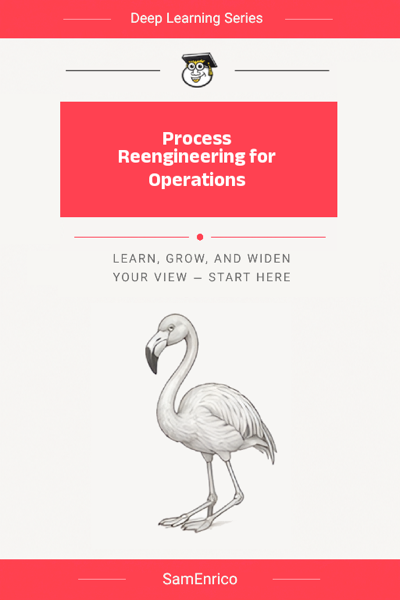
Process Reengineering for Operations eBook
A Coursebook on Process Reengineering for Operatio
by Guffey Ines
A Coursebook on Process Reengineering for Operations
Formats
Free sample
Chapter 1: Beyond the Band-Aid--– Every operations leader has been told the same comforting lie: that small, steady improvements will eventually save you. Show up early, leave late, shave a minute off the cycle time, reduce defects by one percent, celebrate the win, and repeat. This philosophy, borrowed from the legendary Toyota Production System and popularized as Kaizen, has become the default religion of operations management worldwide. And for a certain type of problem—a process that already works fundamentally well but needs tuning—it is absolutely the right answer.But here is the uncomfortable truth that most consultants, textbooks, and Linked In influencers will not tell you: Kaizen is a trap when applied to a broken process. You cannot polish a turd.
You cannot improve your way out of a fundamentally flawed design. And yet, millions of hours and billions of dollars are wasted every year doing exactly that—applying continuous improvement tools to processes that should have been burned to the ground and rebuilt from scratch.This book exists because that mistake is both disastrous and avoidable.If you are reading this, you already suspect that your operations are not performing at their potential. Perhaps your order-to-delivery cycle takes two weeks when your competitor does it in two days. Perhaps your customer service team handles the same complaints repeatedly because the underlying process produces the same errors again and again. Perhaps your employees have stopped suggesting improvements because they have learned that management is not actually interested in fixing the root causes.
You have tried Lean. You have tried Six Sigma. You have tried running more meetings, adding more checklists, and asking people to try harder. The numbers barely moved.This is not your fault. This is not your team's fault.
This is the fault of a fundamental misunderstanding about the nature of change. There are two distinct ways to change a process, and confusing them is the single most expensive mistake in operations management.The Two Kinds of Change Let us establish a distinction that will frame the entire book. Imagine you own a house. The roof leaks. The foundation is cracked.
The electrical system was installed in 1952 and has been patched so many times that the breaker box looks like a plate of spaghetti. What do you do?Option A: You call a handyman. You patch the roof. You seal the crack in the foundation with epoxy. You replace the oldest breakers.
You make the house slightly better than it was. This is incremental improvement—Kaizen. It is appropriate for a house with good bones, a sound structure, and isolated problems. It is a terrible strategy for a house that is fundamentally unsound.Option B: You demolish the house and build a new one. You start with a clean sheet of paper.
You pour a new foundation, install modern electrical, design a roof that will not leak. This is radical redesign—Reengineering. It is expensive, disruptive, and uncomfortable. It is also the only sensible choice when the existing structure is beyond repair.Here is the problem: most operations leaders choose Option A for problems that require Option B. Not because they are foolish, but because Option A feels safer.
It does not require admitting that years of incremental improvements have failed. It does not require convincing senior leadership to fund a disruptive project. It does not require telling employees that their familiar routines are about to change. So they keep patching the roof. And the roof keeps leaking.The Core Thesis: Reengineering is not a better version of continuous improvement.
It is a different species of activity entirely. Where Kaizen asks, "How can we make this process 10% better?" Reengineering asks, "If we were starting from scratch today, would we build this process at all?" Until you answer that second question, the first question is a distraction.What This Book Means by "Operations"Before we go further, we need to be precise about a term that will appear thousands of times in the pages ahead. The book is titled Process Reengineering for Operations. But what exactly do we mean by "operations"?In the broadest sense, operations refers to the processes that deliver value to customers. This includes manufacturing plants where physical products are assembled.
It includes hospitals where patients are treated. It includes software companies where code is written and deployed. It includes banks where transactions are processed and loans are approved. It includes call centers where customer questions are answered. It includes supply chains where goods are moved from suppliers to warehouses to customers.The principles in this book apply to all of these contexts.
A broken hospital discharge process and a broken manufacturing changeover process and a broken software deployment process all suffer from the same underlying dysfunctions: handoffs, wait times, rework, unclear accountability, and misaligned incentives. The tools may vary by industry, but the logic of reengineering is universal.However, precision also requires acknowledging limits. This book is not about personal productivity (how to organize your own inbox). It is not about strategy (which markets to enter). It is not about culture change for its own sake (though culture will change as a result of reengineering).
It is about the structured, systematic redesign of how work flows through an organization. If your challenge is not about how work flows, this book will not help you.With that boundary established, let us return to the problem of continuous improvement.The Three Cs: Why Reengineering Is Necessary Now You might be wondering: if reengineering has been around since the early 1990s, when Michael Hammer and James Champy published Reengineering the Corporation, why is it suddenly urgent again? The answer lies in three forces that have accelerated dramatically in the past decade. Call them the Three Cs.Customers have changed. A generation ago, customers had limited choices and low expectations.
If a bank took five days to process a loan application, what were you going to do—switch to the other bank that also took five days? Today, customers have been trained by Amazon, Uber, and Netflix to expect convenience, speed, and personalization as the baseline. A five-day loan process is not merely inconvenient; it is a competitive liability. Customers will defect to anyone who serves them faster, easier, and with less friction. And they will tell everyone about it on social media.Competition has changed.
Your competitors are no longer just the companies in your industry, in your geography, with your business model. They are global, digital, and often invisible until they are dominant. A startup with fifty employees and a cloud-based platform can reengineer an entire industry while incumbents are still holding continuous improvement workshops. The threat is not that competitors are slightly better than you. The threat is that they are playing a different game entirely.Change itself has changed.
The pace of technological disruption is accelerating. Artificial intelligence, automation, and data analytics are not future possibilities; they are present realities. Organizations that cannot adapt quickly will be rendered obsolete. And adaptation requires more than incremental improvement. It requires the ability to fundamentally rethink how work gets done, repeatedly, as conditions change.Taken together, the Three Cs mean that the cost of doing nothing has never…
This is the end of the free sample. Get the eBook to keep going. Buy now
About this book
Details
- Author
- Guffey Ines
- Publisher
- SamEnrico
- Language
- English
- Genre
- Non-Fiction, Informative, Educational
- Released
- 2026-05-06
- Pages (approx.)
- 158
- Available as
- eBook, Audiobook

Read better in the ZLOADR app
Your eBooks on your phone or tablet. Sign in with your SamEnrico account and start reading.
More by Guffey Ines
 Gestalt Dream Work GuideGuffey Ines$11.99
 Loneliness Hiking Group GuideGuffey Ines$11.99
 The Exhaustion Reset WorkbookGuffey Ines$11.99
 Counteroffer NegotiationGuffey Ines$11.99
 Stress Kidney Function GuideGuffey Ines$11.99
 Senior Anxiety Esteem GuideGuffey Ines$11.99
 HSP Anxiety HypnosisGuffey Ines$11.99
 Antwerp Heist Extradition FightGuffey Ines$11.99
 Eye Closure Challenge MethodGuffey Ines$11.99
 Volt Rush: The Untold Story of the Tesla Roadster's Secret Test DriveGuffey Ines$11.99
 The Serpent’s Gambit: Typhon’s Defiance Against the OlympiansGuffey Ines$11.99
 Echoes of the First Moonwalk: The Untold Story of Apollo 11’s Lost Radio BroadcastGuffey Ines$11.99
You may also like
 Hong Kong Handover 1997Dunn Johnnie$11.99
 Zumba For Postnatal Recovery CourseNeal Christian$11.99
 Zumba for BeginnersLadner Nikia$11.99
 YouTube Comment Mining GuideHumes Pandora$12.99
 Worry Box MeditationCarlin Rudy$11.99
 Workplace Stress MeditationNguyen Lynn$11.99
 Workplace Stress and Sleep RepairHawley Ivory$11.99
 Workplace Perfectionism CureDelaney Jeffry$11.99
 Workplace Injustice Anger GuideWallen Isabelle$11.99
 Work Addiction and Burnout LinkGreenwood Ester$11.99
 Women in Yoga and WellnessBeattie Galina$11.99
 Women in Stand Up ComedyChun Evangeline$11.99