
Non-FictionInformativeEducational
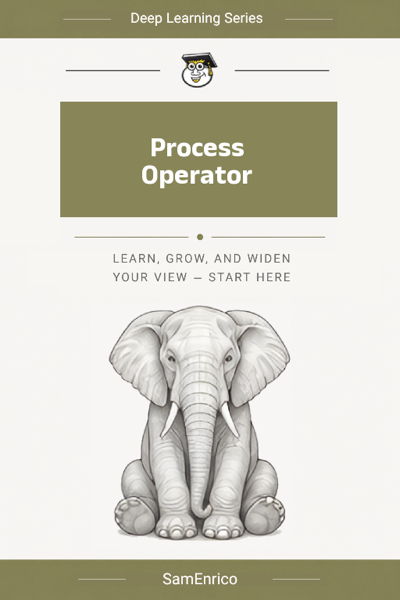
Process Operator eBook
A Coursebook on Process Operator
A Coursebook on Process Operator
Formats
Free sample
Chapter 1: The Invisible Job--The alarm panel lit up at 2:17 AM. Eighteen points in red. A siren he hadn’t heard since training. The senior operator was in the bathroom. The shift supervisor was in a meeting.
For thirty seconds, the new operator stood alone in the control room with a decision that could cost millions—or lives. He didn’t panic. He didn’t guess. He followed a routine that had been drilled into him not by a manual, but by the quiet mentorship of a man who had spent thirty years learning when to act and when to wait.That new operator survived the night. So did the plant.
And the lesson he learned—that being a process operator is almost nothing like what outsiders imagine—is the subject of this chapter.The Valve Turner Myth If you ask someone on the street what a process operator does, they will likely say something like “turns valves” or “watches gauges.” This is roughly equivalent to saying a airline pilot “steers” or a surgeon “cuts.” It is technically true and comprehensively wrong.The modern process operator is the single point of integration for safety, production, quality, and environmental compliance. Between your hands sits equipment that cost hundreds of millions of dollars. Under your watch, chemical reactions occur at temperatures that would vaporize steel and pressures that would turn a shipping container into confetti. And your primary tool is not a wrench—it is judgment.Consider what an operator actually does during a typical shift. You arrive forty-five minutes before your start time—not because you are required to, but because you need to read the logs from the previous two shifts to understand what has changed.
You walk your area before the pass-down meeting, listening for a pump that sounds different than it did yesterday. You attend a safety huddle where someone describes a near-miss from a sister plant. You receive the face-to-face handover from the outgoing operator, who tells you not what the logbook says, but what the logbook cannot capture: “That control valve on the reflux drum has been sticking. Don’t trust the position indicator. Go look at it.”Then the outgoing operator leaves.
And you are alone with a thousand decisions.The Four Pillars of Operator Responsibility Every decision you make as an operator falls into one of four domains. Understanding these pillars—and their sometimes competing demands—is the first step toward mastery.Safety Safety is not a department. It is not a poster on the wall. It is the operating condition that allows you to go home at the end of your shift with the same number of fingers, eyes, and breaths you had when you arrived. Every other pillar depends on this one.
There is no production goal worth a fatality. There is no quality specification worth a life.The safety pillar includes process safety (preventing catastrophic releases of hazardous materials) and personal safety (preventing slips, trips, falls, and struck-by or caught-between injuries). Process safety is the spectacular failure you see on the news—the refinery fire, the chemical release, the explosion. Personal safety is the quiet failure that actually kills more operators: the ladder you didn’t secure, the line you didn’t verify was depressurized, the lock you didn’t install because you were in a hurry.A senior operator once told a young apprentice: “Every rule in this plant was written by someone’s close call. The question isn’t whether you can break the rule and get away with it.
The question is whether you want to be the reason the next rule gets written.”Quality Quality means producing product that meets specifications. In a refinery, this might mean gasoline with the correct octane rating and vapor pressure. In a chemical plant, it might mean polymer with the correct molecular weight distribution and melt index. In a pharmaceutical facility, it might mean active ingredient purity measured in parts per billion.The operator’s role in quality is not theoretical. You are the one who adjusts the column reflux ratio when the lab calls with an off-spec result.
You are the one who decides whether to divert off-spec product to a slop tank or blend it back into the feed. You are the one who signs the batch record, attesting that every step was performed according to procedure.Quality failures have costs. An off-spec shipment might be rejected, costing the company not only the value of the product but also the transportation, the disposal, and the customer’s trust. A chronic quality problem might trigger an investigation that shuts down the unit for days. And if the off-spec product reaches a customer and causes damage—a gasoline that corrodes engines, a polymer that fails in a medical device—the liability can run into nine figures.Environmental Compliance Environmental compliance is the pillar that most new operators underestimate.
You are not an environmental engineer. You do not design scrubbers or permits. But you do operate the equipment that keeps emissions within legal limits. A flare that smokes because you are sweeping too much gas. A cooling tower that overflows chlorinated water into the storm drain.
A relief valve that lifts and releases hydrocarbons because you pressurized a vessel too quickly. Each of these is an environmental event, and each carries potential fines, reporting requirements, and reputational damage.The operator’s environmental responsibility extends to waste handling as well. That drum of catalyst you change out is not “trash.” It is a hazardous waste that must be manifested, labeled, and shipped to an approved facility. The rag you use to wipe up a drip of benzene is not “shop towel”—it is hazardous waste as soon as it contacts the chemical.One environmental violation can cost more than the operator’s annual salary. A pattern of violations can cost the plant its license to operate.
And a major release can land the operator—personally—in criminal court. This is not hyperbole. Operators have gone to prison for bypassing environmental controls or failing to report releases.Throughput Optimization Throughput is the fourth pillar: making product at the maximum sustainable rate. This is where the operator’s technical knowledge directly translates to the company’s bottom line. A refinery that runs at 95% of capacity instead of 90% generates millions of dollars in additional margin per year.
A chemical plant that avoids unplanned shutdowns for an extra month delivers hundreds of thousands in profit.But throughput optimization is never pursued at the expense of the other three pillars. The operator who pushes a unit beyond its safe operating limits is not optimizing—he is gambling. The operator who accepts off-spec product to keep the line running is not optimizing—he is storing up trouble for the next shift, the next customer, the next quarter’s earnings call.The skilled operator tunes throughput like a musician tunes an instrument: listening for the point where everything is in balance, where the unit is running hard but not straining, where the margins are captured without the risks. This is an art as much as a science, and it is developed over years of watching, listening, and learning from mistakes.The Business Case for Good Operations Operators…
This is the end of the free sample. Get the eBook to keep going. Buy now
About this book
Details
- Author
- Rosario Ouida
- Publisher
- SamEnrico
- Language
- English
- Genre
- Non-Fiction, Informative, Educational
- Released
- 2026-05-06
- Pages (approx.)
- 149
- Available as
- eBook, Audiobook

Read better in the ZLOADR app
Your eBooks on your phone or tablet. Sign in with your SamEnrico account and start reading.
More by Rosario Ouida
 EU Tariff Classification GuideRosario Ouida$11.99
 Senator Fundraising MasteryRosario Ouida$11.99
 The Progressive Body ScanRosario Ouida$11.99
 Secure Transportation Routing Field HandbookRosario Ouida$11.99
 Hypnotic Breathing For PainRosario Ouida$11.99
 The Panama Papers: The Untold War of the Global EliteRosario Ouida$11.99
 Silicon Showdown: The Epic Battle for Fair Play in the App StoreRosario Ouida$11.99
 Geopolitical Supply Chain GuideRosario Ouida$12.99
 China Sports Facilities GuideRosario Ouida$12.99
 Understanding Congenital Hypomyelination NeuropathyRosario Ouida$17.99
 How to Start a Prepared Additives for Cement Business (Beginners Guide)Rosario Ouida$11.99
You may also like
 Hong Kong Handover 1997Dunn Johnnie$11.99
 Zumba For Postnatal Recovery CourseNeal Christian$11.99
 Zumba for BeginnersLadner Nikia$11.99
 YouTube Comment Mining GuideHumes Pandora$12.99
 Worry Box MeditationCarlin Rudy$11.99
 Workplace Stress MeditationNguyen Lynn$11.99
 Workplace Stress and Sleep RepairHawley Ivory$11.99
 Workplace Perfectionism CureDelaney Jeffry$11.99
 Workplace Injustice Anger GuideWallen Isabelle$11.99
 Work Addiction and Burnout LinkGreenwood Ester$11.99
 Women in Yoga and WellnessBeattie Galina$11.99
 Women in Stand Up ComedyChun Evangeline$11.99