
Non-FictionSelf-HelpProcess ImprovementWorkflow
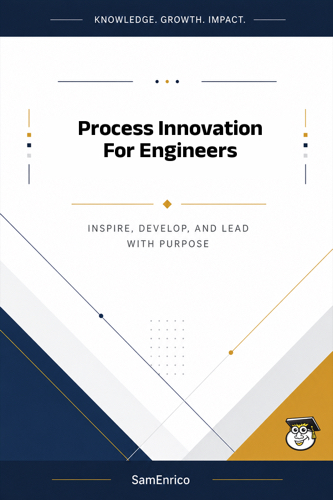
Process Innovation For Engineers eBook
Redesign workflows and manufacturing processes usi
Redesign workflows and manufacturing processes using creative improvement techniques.
Formats
Free sample
Chapter 1: The Twenty-X Imperative--–- Marcus Chen had been a process engineer for eleven years. He had black belts in Six Sigma, green belts in Lean, and a wall of certifications that would make a compliance officer weep with joy. Last Tuesday, he was laid off via a fifteen-second Zoom call.The plant he had optimized—meticulously, lovingly, repeatedly—was not losing money. It was making money. It was making more money than it had made five years ago, when Marcus had started.
But the CEO had explained it to him in terms that haunted Marcus during the long drive home: "Marcus, you improved the process by 12 percent every year for five years. That's great. But your competitor in Vietnam started from scratch two years ago and their process is half the cost of yours. They didn't improve anything. They just built something entirely different."Marcus had been a world-class process improver.
He had not been a process innovator. And that distinction had cost him his career.This book is about making sure the same thing never happens to you.The Great Misunderstanding Most engineers believe they are in the business of improvement. They are wrong. They are in the business of value creation, and improvement is only one narrow path to that destination. The other path—the one that separates the Marcus Chens of the world from the engineers who become vice presidents, consultants, and industry icons—is innovation.Here is the distinction that will determine the trajectory of your career:Improvement (Kaizen) is the act of making an existing process better.
You reduce cycle time from ten minutes to eight. You increase yield from 94 percent to 96 percent. You change a bolt from a hex head to a socket cap because it saves three seconds per installation. These are noble activities. They pay the bills.
They keep the lights on. They are also, in the long run, a trap.Innovation (Kaikaku) is the act of creating an entirely different process that makes the old one obsolete. You don't reduce cycle time from ten minutes to eight. You eliminate the cycle entirely by changing the physics of the operation. You don't increase yield from 94 percent to 96 percent.
You design a process that cannot produce defects. You don't save three seconds on a bolt. You ask why the bolt needs to exist at all.The Japanese industrial engineers who codified these concepts had a useful way of thinking about the relationship between the two. Kaizen is the steady, incremental climb up a hill. Kaikaku is the act of building a helicopter and flying to the next mountain.
Both get you to higher ground. Only one gets you there before your competitors.The tragedy of modern engineering education is that it trains you magnificently for Kaizen. You learn statistical process control. You learn design of experiments. You learn root cause analysis.
These are essential tools. They are also, if you are not careful, a comfortable prison. Because the more skilled you become at improving an existing process, the more invested you become in that process's continued existence. You become the world's greatest buggy-whip maker, just as the automobile rolls off the assembly line.The S-Curve: Knowing When to Stop Improving Every process follows the same lifecycle. It is called the S-Curve, and understanding it is the single most important skill in process innovation.In the early days of a new process, things are chaotic.
Yields are low. Cycle times are unpredictable. Operators are confused. This is the bottom of the S, where the curve is flat. Improvement is easy and dramatic.
You can reduce defects by 50 percent in a week simply by adding a visual work instruction. You can cut cycle time in half by rearranging the tools on a cart. This is the steep part of the S-Curve, where Kaizen shines. Every hour you invest in improvement returns ten hours of value.Then something changes. The curve flattens.You have eliminated the obvious waste.
You have trained every operator. You have optimized every setup. You have run design of experiments on every variable. Now, improving cycle time from 8.2 minutes to 8.1 minutes requires a six-month project with a capital investment of two hundred thousand dollars. Your return on investment is measured in fractions of a percent.
You are on the flat part of the S-Curve, and you may not even know it.The engineers who get trapped on flat S-Curves are not bad engineers. They are often the best engineers—the ones who refuse to accept that a process cannot be improved further. They throw more tools at the problem. More data. More analysis.
More late nights. They extract the last possible drop of efficiency from a process that should have been retired years ago.The process innovator, by contrast, develops a different instinct. When the S-Curve flattens, they do not reach for a sharper scalpel. They reach for a sledgehammer. They ask a question that feels almost unprofessional to ask: "What if we just...
stopped doing this entirely and started over?"The Chemical Reactor That Changed Everything Consider the case of a specialty chemical plant in the Midwest. For twenty years, the plant had produced a polymer additive using a batch reactor process. Operators would load raw materials, heat the vessel, stir for precisely forty-five minutes, cool, discharge, clean, and repeat. The cycle time was six hours per batch. The plant ran three shifts.
The engineers had optimized this process to a mirror shine.They had reduced cleaning time from ninety minutes to twenty-two. They had reduced heating time by optimizing the steam valve response curves. They had reduced cooling time by installing a heat exchanger with twice the surface area. The process was, by any measure, a masterpiece of continuous improvement. The S-Curve had been flat for five years.Then a new engineer—young, inexperienced, and therefore ignorant of what "could not be done"—asked a simple question: "Why are we doing this batch at all?
Could we make it continuous?"The plant manager laughed. The senior engineers explained patiently that the reaction kinetics required precise temperature control that could only be achieved in a batch vessel. The young engineer went away, did the math, and came back three weeks later with a design for a continuous flow reactor that used a different catalyst and a different temperature profile. The reaction that had taken forty-five minutes in a batch could be completed in ninety seconds in a continuous tube.The plant spent fourteen months rebuilding. The capital cost was enormous.
The disruption was brutal. And when the new line started up, the old batch reactors were never turned on again. Cycle time dropped from six hours to four minutes. Labor cost dropped by 80 percent. Quality improved because every molecule experienced the exact same residence time, instead of the batch-to-batch variation that had plagued the old process.The young engineer did not improve the batch process.
She innovated it out of existence. That is the difference between Kaizen and Kaikaku. That is the difference between a career of steady employment and a career of industry transformation.The Twenty-X Rule If you take only one concept from this chapter into the rest of…
This is the end of the free sample. Get the eBook to keep going. Buy now
About this book
Details
- Author
- Waggoner Jesenia
- Publisher
- SamEnrico
- Language
- English
- Genre
- Non-Fiction, Self-Help, Process Improvement, Workflow
- Released
- 2026-06-10
- Pages (approx.)
- 151
- Available as
- eBook, Audiobook

Read better in the ZLOADR app
Your eBooks on your phone or tablet. Sign in with your SamEnrico account and start reading.
More by Waggoner Jesenia
 Escobar Los Pepes RevengeWaggoner Jesenia$11.99
 Stress Induced Inflammation HandbookWaggoner Jesenia$11.99
 Social Entrepreneur Pivot NonprofitWaggoner Jesenia$11.99
 Holding Rental After MoveWaggoner Jesenia$11.99
 The Water Keepers of the Andes: Ancient Sanitation and the Birth of Public HealthWaggoner Jesenia$11.99
 Blood and Bronze: The Lion of Babylon’s Last RoarWaggoner Jesenia$11.99
 Understanding Familial Veinous MalformationsWaggoner Jesenia$17.99
 How to Become a Cash-register ServicerWaggoner Jesenia$11.99
 EU VAT Registration AbroadWaggoner Jesenia$12.99
 Strategy Meeting Checklist Before You InviteWaggoner Jesenia$12.99
 Religion TeacherWaggoner Jesenia$11.99
You may also like
 Hong Kong Handover 1997Dunn Johnnie$11.99
 Zumba For Postnatal Recovery CourseNeal Christian$11.99
 Zumba for BeginnersLadner Nikia$11.99
 YouTube Comment Mining GuideHumes Pandora$12.99
 Worry Box MeditationCarlin Rudy$11.99
 Workplace Stress MeditationNguyen Lynn$11.99
 Workplace Stress and Sleep RepairHawley Ivory$11.99
 Workplace Perfectionism CureDelaney Jeffry$11.99
 Workplace Injustice Anger GuideWallen Isabelle$11.99
 Work Addiction and Burnout LinkGreenwood Ester$11.99
 Women in Yoga and WellnessBeattie Galina$11.99
 Women in Stand Up ComedyChun Evangeline$11.99