
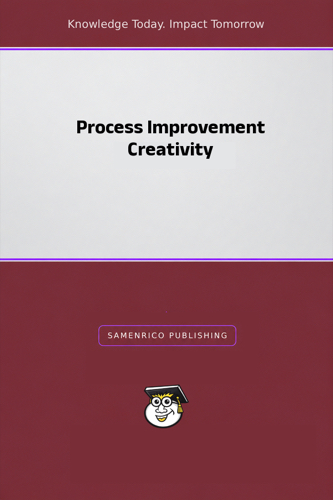
Non-FictionSelf-HelpProcess Innovation
Process Improvement Creativity eBook
Reimagine workflows and systems using this practic
by Chan Karan
Reimagine workflows and systems using this practical guide for operations professionals.
Formats
Free sample
Chapter 1: The Assembly Line Whisperer--–- Etsuko Tanaka had worked at the Toyota plant in Toyota City for nineteen years. She could weld a chassis joint in forty-three seconds flat. She knew every bolt, every torque spec, every alarm sound. And for eighteen of those nineteen years, she had done exactly what she was told.Then one Tuesday morning, she pulled the Andon cord.The entire assembly line stopped. Red lights flashed.
A supervisor came running. Thirty-seven cars sat frozen in place. The factory held its breath.Etsuko pointed at a rubber seal on the driver's side door. "This part comes from a new supplier," she said. "It's two millimeters too thick.
In summer heat, it will expand. Customers will hear wind noise at highway speeds."The supervisor measured. She was right. The production run was halted. The supplier was called.
And Etsuko—a line worker with no engineering degree, no management title, and no "creative" job description—had just saved Toyota from a potential recall that would have cost millions.When asked later how she noticed what dozens of engineers had missed, she shrugged. "I do the same motion eight hundred times a day," she said. "Anything different feels wrong. That's not creativity. That's just paying attention."The executives who heard this story nodded politely.
But they missed the point entirely.What Etsuko described is creativity. It is the highest form of operational creativity: the ability to see a deviation from a standard and imagine a consequence that hasn't happened yet. It is constraint-driven, pattern-based, and deeply embedded in process. And it is available to every single person in every single organization—not just the "creative types" in marketing or product design.The problem is that most operations professionals don't believe this. And most leaders don't know how to unlock it.The Great False Division Walk into almost any company and you will hear the same implicit split: there are "creative" roles (design, marketing, strategy, R&D) and there are "process" roles (operations, logistics, quality, compliance).
The creative people get colorful sticky notes and brainstorming retreats. The process people get spreadsheets and standard operating procedures.This division is not just wrong. It is destructive.Research from Harvard Business School's Teresa Amabile, summarized in the HBR's 10 Must Reads on Creativity, shows that creativity is not a personality trait but a behavior that can be enabled or disabled by environment. When Amabile studied hundreds of knowledge workers across seven companies, she found that the single biggest predictor of creative output was not IQ, not training, not "innate talent"—but whether the person felt they had permission to experiment within their existing constraints.In other words: the assembly line worker with the Andon cord is not a rare exception. She is the rule.Yet most operations professionals have been taught the opposite.
They have absorbed a myth—the myth of the creative genius—that says creativity belongs to lone visionaries who break rules, ignore processes, and wait for lightning to strike. This myth serves no one. It makes creatives feel isolated and mysterious. And it makes operations people feel like their job is to execute, not to imagine.This book exists to destroy that myth.What This Book Is (And Is Not)Process Improvement Creativity is not a book about "thinking outside the box." That phrase has been repeated so often it has lost all meaning. Besides, the box—your actual workflow, your actual constraints, your actual team—is the only thing worth thinking about.This book is a practical guide for operations professionals who want to:Turn every bottleneck into a creative invitation Stop repeating "we've always done it this way"Run experiments that cost little and teach much Build a culture where the Etsukos on your team feel safe pulling the cord It draws from the best-selling books in both process improvement (The Goal, Lean, Six Sigma) and creativity (Creativity, Inc., HBR's 10 Must Reads on Creativity, Managing Change, Creativity and Innovation).
The central argument is simple: constraints drive creativity, and systematic processes scale innovation.The book is organized into twelve chapters, each with a practical outcome tool. You can read it sequentially or jump to the chapter that matches your current pain point. By the end, you will have a toolkit for making your workflows not just more efficient, but more alive—capable of adapting, improving, and surprising you.But first, we need to clear away the debris of old thinking.The Myth of the Lone Genius The creative genius myth takes many forms. In popular culture, it looks like Steve Jobs in his black turtleneck, unilaterally deciding that phones should have no buttons. Or like Einstein in his patent office, suddenly seeing E=mc² on a napkin.
Or like the Pixar story—a small group of brilliant animators locked in a room until Toy Story emerged.These stories are not just oversimplified. They are dangerously misleading.Steve Jobs did not invent the i Phone alone. He stood on the shoulders of thousands of engineers, supply chain experts, and factory workers who turned his vague desire for "an i Pod that makes calls" into a manufacturable object. Einstein's annus mirabilis of 1905 was preceded by years of tedious work in the Swiss patent office, where he examined hundreds of mundane inventions about clocks and electrical synchronization—a process that trained his mind to think about time and simultaneity. And Pixar's creative success was not the result of geniuses in isolation but of a ruthless, systematic process called the "brain trust," where rough cuts are shown to peers who are required to give candid, constructive feedback—no egos allowed, no hierarchy respected.As Ed Catmull, co-founder of Pixar, writes in Creativity, Inc.: "The people who built Pixar weren't hired for their talent.
They were hired for their ability to work together, to trust each other, and to give honest feedback. The process—not the person—was the secret."In other words: Pixar succeeded because of process, not in spite of it.The same is true of Toyota, the most studied operations system in history. The Toyota Production System (TPS) is often misunderstood as a set of rigid rules. In fact, it is a system for surfacing problems so they can be solved by the people closest to them. The Andon cord is not a shutdown button.
It is an invitation. Every time a worker pulls it, the organization learns something. The standardization is not the enemy of creativity. It is the baseline that makes creativity possible.This is the first paradox of process improvement creativity: without standards, there is nothing to improve. If every day is different, you cannot tell what works.
If every output is unique, you cannot measure quality. Standardization does not kill creativity. Chaos kills creativity. Standardization enables it.The Second Paradox: Constraints as Fuel The second paradox is even more counterintuitive: constraints make us more creative, not less.Consider a classic study from the Journal of Personality and Social Psychology. Researchers gave two groups of college students the same creative problem: design a children's toy.
The first group was given unlimited access to materials—cardboard, markers, glue, wheels, batteries, lights. The second group was given only cardboard, scissors, and…
This is the end of the free sample. Get the eBook to keep going. Buy now
About this book
Details
- Author
- Chan Karan
- Publisher
- SamEnrico
- Language
- English
- Genre
- Non-Fiction, Self-Help, Process Innovation
- Released
- 2026-06-06
- Pages (approx.)
- 149
- Available as
- eBook, Audiobook

Read better in the ZLOADR app
Your eBooks on your phone or tablet. Sign in with your SamEnrico account and start reading.
More by Chan Karan
 Mindfulness for Stress WorkbookChan Karan$11.99
 Food Intolerance and EosinophilicChan Karan$11.99
 The Blue Zone Moderate DrinkingChan Karan$11.99
 The Prolonged Grief Disorder GuideChan Karan$11.99
 Gold & Ghosts: The Rothschilds' Secret War in the Napoleonic WarsChan Karan$11.99
 How to Start a Pet Scanners Business (Beginners Guide)Chan Karan$11.99
 Early Payment Discount CaptureChan Karan$12.99
 Anomaly Detection AccountingChan Karan$12.99
 Understanding Sternal CleftChan Karan$17.99
 C++ Cross Platform Application DeveloperChan Karan$11.99
You may also like
 Hong Kong Handover 1997Dunn Johnnie$11.99
 Zumba For Postnatal Recovery CourseNeal Christian$11.99
 Zumba for BeginnersLadner Nikia$11.99
 YouTube Comment Mining GuideHumes Pandora$12.99
 Worry Box MeditationCarlin Rudy$11.99
 Workplace Stress MeditationNguyen Lynn$11.99
 Workplace Stress and Sleep RepairHawley Ivory$11.99
 Workplace Perfectionism CureDelaney Jeffry$11.99
 Workplace Injustice Anger GuideWallen Isabelle$11.99
 Work Addiction and Burnout LinkGreenwood Ester$11.99
 Women in Yoga and WellnessBeattie Galina$11.99
 Women in Stand Up ComedyChun Evangeline$11.99