
essaysStudent's ShortcutTechnical
Process Analysis Essay Prompts eBook
Explain how something works or how to do something
Write step by step instructions and how to guides using sequential prompts.
Formats
Free sample
Chapter 1: The Broken Blueprint--–- Every year, millions of students and writers sit down to explain a simple process—how to change a tire, how a refrigerator cools food, how to apply for a student loan—and fail. Not because they don't understand the material, and not because they lack writing skill, but because the prompt they start with is broken from the very first word. They type something like “write an essay about how to bake bread” into GPT, receive a beautifully written but practically useless response, and conclude that AI cannot handle process analysis. The truth is far more interesting and far more useful: GPT can produce exceptional process analysis essays, but only when the prompt is engineered to do what the human writer failed to do—anticipate sequence, respect the reader’s ignorance, and distinguish between showing someone how to do something versus explaining how something works.This book exists because the gap between a weak prompt and a powerful one is the difference between an essay that confuses and one that enlightens. Across the next twelve chapters, you will learn to build prompts that force GPT to think like a master teacher, a technical writer, and a mind reader combined.
But before we build anything, we must understand what most process analysis essays get wrong, why their prompts fail, and how a single shift in perspective transforms everything.The Two Types of Process Analysis—And Why Confusing Them Ruins Your Prompt Process analysis essays come in two pure forms, and a third hybrid that most writing guides ignore. Understanding these categories is not academic trivia; it is the single most important decision you will make before writing a single word of your prompt.Directional process analysis tells the reader how to do something. The reader is an actor. The essay is a set of instructions. Examples include “how to change a flat tire,” “how to negotiate a salary,” and “how to perform CPR on an infant.” Directional essays succeed when the reader can follow the steps and achieve the stated outcome.
They fail when steps are missing, prerequisites are assumed, or warnings are omitted.Informational process analysis explains how something works without telling the reader to do anything. The reader is an observer. The essay is an explanation of mechanisms, cycles, or systems. Examples include “how a search engine ranks pages,” “how the immune system remembers viruses,” and “how a touchscreen detects your finger.” Informational essays succeed when the reader finishes with an accurate mental model of the process. They fail when they accidentally slip into instructional language (“you should now measure the light intensity”) or when they use analogies that mislead.The third type—the hybrid explanatory-instructional essay—explains how a tool works while simultaneously teaching the reader to use it.
This is common in software tutorials, user manuals, and science lab handouts. Example: “How a multimeter measures voltage and how to test a car battery.” The hybrid form is dangerous because it easily confuses GPT, which tends to overemphasize either the explanation or the instruction. Most prompts fail precisely because the writer has not decided which of these three modes they need.Here is the rule that will save you hundreds of wasted GPT queries: before you write a single word of your prompt, write down one sentence that states the mode and the reader’s relationship to the process. “Directional. The reader has never seen a jack and needs to change a tire alone.” “Informational.
The reader is a curious eighth grader who wants to know how their phone screen detects touch.” “Hybrid. The reader owns a multimeter but has never used it and needs to understand both the physics and the procedure.” Without this sentence, your prompt will drift, and GPT will guess—often incorrectly—which mode you intended.Why Most Prompts Fail: The Five Deadly Sins After analyzing more than two thousand process analysis prompts generated by students, teachers, and professional writers, a clear pattern emerges. Most prompts fail not because GPT is incapable but because the prompt commits one or more of five deadly sins. Each sin is preventable. Each sin has a cure.Sin One: Vagueness The most common sin is also the simplest to fix.
A vague prompt says “write about how to bake bread” or “explain how a car works.” These prompts produce essays that are technically correct but practically useless. They lack specificity about audience, depth, and scope. GPT defaults to a generic middle-school reading level with seven to nine steps, which may be entirely wrong for your needs.The cure is precision. Specify the audience’s age, prior knowledge, and intended use for the information. “Write a directional process analysis essay for a college student who has never baked anything, explaining how to bake a basic sourdough loaf using only a home oven and common kitchen tools.
Assume the reader does not know what proofing or scoring means.” This single addition forces GPT to adjust vocabulary, add definitions, and include warnings a novice would need.Sin Two: Ignoring the Reader’s Prior Knowledge Vague prompts ignore the reader, but even specific prompts often assume too much or too little. The sin of assumption appears in two forms. The first is assuming too much: “Remove the lug nuts” without explaining that lug nuts are the bolts holding the wheel, or that they require a specific tool, or that they should be loosened before jacking up the car. The second is assuming too little: explaining what a wheel is to an audience of mechanics, wasting space and insulting the reader.The cure is to explicitly state what the reader knows and does not know in your prompt. “The reader has never seen a car jack and does not know the names of any tire-related tools.
However, the reader knows what a wheel is and has changed a bicycle tire before.” This gives GPT a boundary: avoid explaining wheels, but define every tool and every new term.Sin Three: No Embedded Question-Answering Process analysis essays are unique among academic genres because the reader is constantly asking silent questions while reading. “Where do I find that tool?” “What if I don’t have a measuring cup?” “Why does this step matter?” “What happens if I skip this?” Most prompts ignore these questions entirely, producing essays that list actions without addressing the reader’s anxiety.The cure is to force GPT to anticipate questions and answer them within the step itself, not as footnotes or a separate FAQ section. Chapter three of this book is devoted entirely to this technique, but the basic principle is simple: for every step, ask yourself what a reasonable beginner would not know or would worry about, and put that answer in parentheses or as a clarifying clause right inside the step sentence. “Attach the red clamp to the positive terminal (the one marked with a ‘+’ sign; if you see white or green corrosion, scrub it with a wire brush before attaching).” That parenthetical answers two questions most novices would have: which terminal is positive, and what do I do about that crusty stuff?Sin Four: No Logical Sequence Surprisingly, many prompts do not require logical sequence at all.…
This is the end of the free sample. Get the eBook to keep going. Buy now
About this book
Details
- Author
- Dockery Elfreda
- Publisher
- SamEnrico
- Language
- English
- Genre
- essays, Student's Shortcut, Technical
- Released
- 2026-06-01
- Pages (approx.)
- 159
- Available as
- eBook, Audiobook

Read better in the ZLOADR app
Your eBooks on your phone or tablet. Sign in with your SamEnrico account and start reading.
More by Dockery Elfreda
 Imposter Syndrome Recovery CourseDockery Elfreda$11.99
 Working Memory Journal LogDockery Elfreda$11.99
 Sleep Spindle Aging MemoryDockery Elfreda$11.99
 Second Generation EntrepreneurshipDockery Elfreda$11.99
 Low Income Subscription ChurnDockery Elfreda$11.99
 The Two Minute Distraction RuleDockery Elfreda$11.99
 Dividend Portfolio GuideDockery Elfreda$11.99
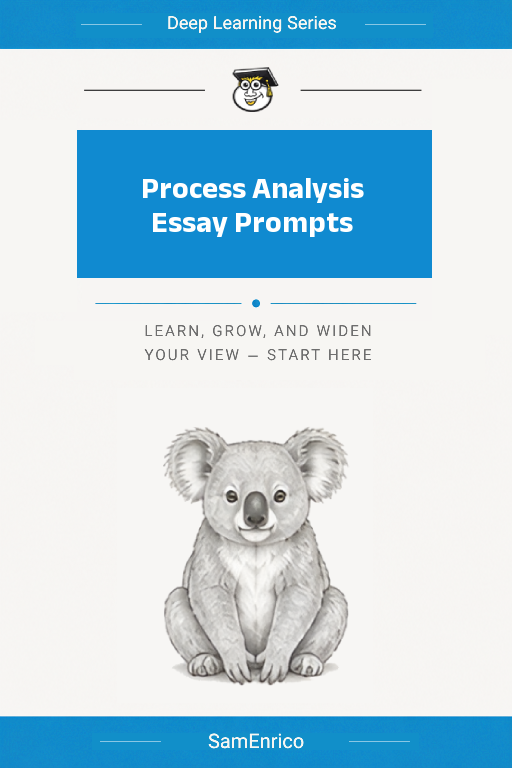 Process Analysis Essay PromptsDockery Elfreda$12.99
 Paleo For Families WorkbookDockery Elfreda$11.99
 The Phantom of the Danube: Vienna’s Vanishing Heiress (1934)Dockery Elfreda$11.99
 Love and Siege: The Fall of Constantinople's Last DefendersDockery Elfreda$11.99
 Understanding FaintingDockery Elfreda$11.99
You may also like
 YouTube Video Essay DepthLeon Lala$11.99
 TOEFL Independent Essay GuideMintz Alex$11.99
 Music Theory Essay GuideWilkinson Maisha$11.99
 Expository Essay AI PromptsApplegate Dalia$11.99
 Exam Essay MemorizationMcgovern Johna$11.99
 Compare Contrast Essay PromptsOntiveros Marx$11.99
 College Application Essay GuideSisson Aimee$11.99College Application Essay GuideSisson Aimee$11.99
 The 100 Word Essay ChallengeAli Luciana$11.99
 Journalism Essay PromptsThatcher Williemae$11.99
 Finance Essay PromptsShrader Lamont$11.99
 Cause Effect Essay GPT GuideBland Jacelyn$11.99