
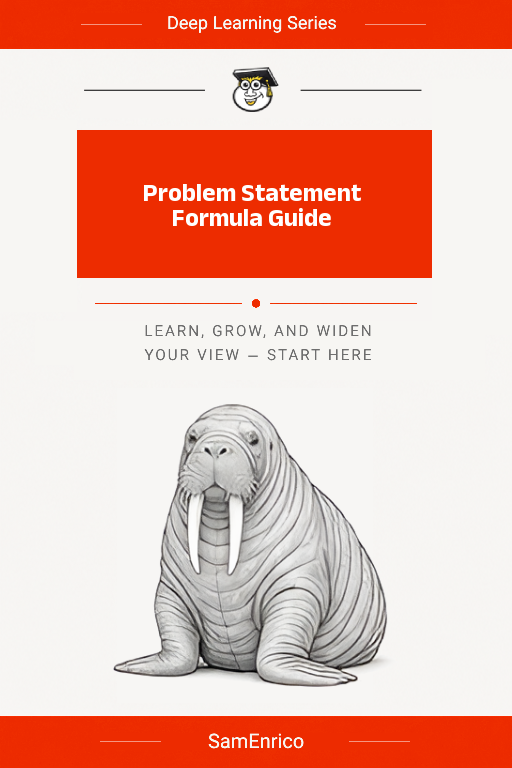
Problem Statement Formula Guide eBook
Craft a research gap and significance statement us
by Gray Allen
Craft a research gap and significance statement using a three-sentence template that hooks admissions committees immediately.
Formats
Free sample
Chapter 1: The Seven-Second Execution--You have already lost.Not because your research is weak. Not because your writing is poor. Not because you lack intelligence or ambition. You have lost because the person reading your application has already decided, in the time it took you to read the first four words of this sentence, that your problem statement is not worth their attention.Seven seconds. That is the average time an admissions committee member spends on the first page of your research proposal before deciding whether to continue reading or reach for the next file in the stack.
Seven seconds to establish that you understand the conversation, have identified a genuine gap, and can explain why anyone should care. Seven seconds to separate yourself from the other ninety-seven applicants who all wrote some version of “the purpose of this study is to explore…”This chapter will do three things. First, it will reveal the cognitive psychology behind those seven seconds – why committees scan instead of read, why they hunt for flaws instead of virtues, and why your beautifully crafted literature review may never be seen. Second, it will introduce the Three Cardinal Sins – the high-level failures that trigger automatic rejection in the first glance. Third, it will present the solution that the rest of this book exists to deliver: the Three-Sentence Template, a weaponized structure that flips the power dynamic and forces even the most fatigued reader to pay attention.By the end of this chapter, you will understand why your current problem statement is almost certainly failing the seven-second test.
You will have a diagnostic tool to prove it. And you will have the first clear look at the template that will transform your writing from ignorable to inevitable.The Reality of the Review Process Let us begin with a truth that most guidebooks dance around: admissions committees are not looking for reasons to accept you. They are looking for reasons to reject you.This is not malice. It is mathematics. A typical doctoral program in the United States receives between two hundred and eight hundred applications for ten to twenty-five spots.
Even at a modest ratio of forty applicants per seat, the committee cannot afford to read every word of every file. They must filter aggressively. They must find excuses to say no so they can focus on the handful of candidates who force them to say yes.The filtering happens in stages. The first stage is the seven-second scan. A committee member opens your file, glances at the first paragraph of your statement of purpose or research proposal, and makes a binary decision: continue reading or move on.
This decision is not conscious. It is not careful. It is a trained reflex, honed over years of reading hundreds of applications that all blur together.What triggers the “continue reading” reflex? Two things, and only two things. First, the opening sentences must signal that the writer understands the existing conversation.
Second, the opening sentences must identify a specific, defensible omission in that conversation. That is it. Committees do not need to be charmed. They do not need to be impressed by your vocabulary. They need to see, in seven seconds, that you have done your homework and found a crack worth investigating.What triggers the “move on” reflex?
This is where most applicants fail. The committee sees a laundry list of facts without a coherent gap. They see a claimed gap that is obviously false (“no one has studied this” when a quick database search proves otherwise). They see a gap with no articulated consequence (“this is interesting” without any explanation of why it matters). Any one of these three failures is enough to end your application’s journey.The Three Cardinal Sins The failures that trigger automatic rejection fall into three high-level categories.
Throughout this book, we will refer to these as the Three Cardinal Sins. Each sin represents a family of specific writing errors. (In Chapter 12, you will encounter the Seven Deadly Sins – a detailed diagnostic checklist that breaks each Cardinal Sin into its component parts. For now, focus on the big picture.)Cardinal Sin #1: The Laundry List The Laundry List is the most common sin. It occurs when an applicant opens with a series of factual statements about their topic – statements that are true, relevant, and utterly inert.
The reader learns what is known but never learns what is missing.Consider this example: “Social media use among adolescents has increased dramatically over the past decade. Studies have shown correlations between social media use and mental health outcomes. Depression rates among teenagers have also risen during this period.”Every sentence in this opening is factually correct. Every sentence is also useless. The reader has learned nothing except that the applicant can summarize obvious trends.
There is no gap. There is no argument. There is no reason to continue reading.The Laundry List kills your application because it signals that you have not yet moved from summarizing to analyzing. You are still reporting what others have said. You have not yet located yourself in the conversation.Cardinal Sin #2: The Fake Gap The Fake Gap is the second most common sin, and it is more dangerous than the first because it signals not just amateurishness but carelessness.
The Fake Gap occurs when an applicant claims that “no one has studied X” or “little research exists on Y” when, in fact, a substantial literature exists.Committee members know their fields. They have read the key papers. When you claim a gap that does not exist, you are not fooling anyone. You are announcing that you did not do a thorough literature review. Worse, you are announcing that you assumed no one else had thought of your brilliant idea – an assumption that is almost always wrong.Consider this example: “No research has examined the relationship between sleep deprivation and academic performance among college students.” A committee member in psychology or education will read that sentence and think: This applicant has never heard of the hundreds of studies on this exact topic.
Reject.The Fake Gap is not always blatant. Sometimes it takes subtler forms: “Surprisingly little attention has been paid to…” or “There is a dearth of research on…” These phrases can be legitimate if the gap is real. But most applicants deploy them as rhetorical crutches, hoping the reader will not notice the missing citations. The reader always notices.Cardinal Sin #3: The Missing “So What?”The Missing “So What?” is the most subtle sin, and it is the one that kills otherwise strong applications. An applicant identifies a real gap – something genuinely understudied – but never explains why filling that gap matters.
The implicit argument is “this gap exists, therefore we should study it.”That is not an argument. That is a non sequitur. The existence of a gap does not justify research. Millions of gaps exist. The fact that no one has studied the correlation between toenail growth rates and stock market fluctuations is a real gap.
It is also a useless one. Without a consequence – without a reason that filling the gap would change something important – your gap is merely trivia.Consider this example: “While extensive research has…
This is the end of the free sample. Get the eBook to keep going. Buy now
About this book
Details
- Author
- Gray Allen
- Publisher
- SamEnrico
- Language
- English
- Genre
- Non-Fiction, Student's Shortcut, Research Writing, Proposal Structure
- Released
- 2026-05-29
- Pages (approx.)
- 155
- Available as
- eBook, Audiobook

Read better in the ZLOADR app
Your eBooks on your phone or tablet. Sign in with your SamEnrico account and start reading.
More by Gray Allen
 Bipolar Prodrome RecognitionGray Allen$11.99
 Listening For Detectives GuideGray Allen$11.99
 Entrepreneur Distraction GuideGray Allen$11.99
 The Stress Reset Couples RetreatGray Allen$11.99
 Gratitude Letter Writing WorkshopGray Allen$11.99
 Traditional Healer CollaborationGray Allen$11.99
 Kobe Bryant MambaGray Allen$11.99
 Dream Theme Tracking GuideGray Allen$11.99
 The Fisherman's NetGray Allen$11.99
 The Black Eagle’s Gambit: Habsburg Espionage in the Thirty Years' WarGray Allen$11.99
 The Great Penguin Highway: How Birds Crossed the OceanGray Allen$11.99
 The Alchemist of Timbuktu: The Golden Secrets of Muhammad al-MaghiliGray Allen$11.99